Beijing, June 6 (Xinhua) — Topic: During his first official visit after being re-elected, Chinese and Lao leaders highlighted a shared key term.
Recently, China’s “diplomatic momentum” has continued to intensify. Xi Jinping, General Secretary of the Communist Party of China Central Committee and President of China, held talks with Thongloun Sisoulith, General Secretary of the Lao People’s Revolutionary Party Central Committee and President of Laos, at the Great Hall of the People in Beijing on June 5. This marks Thongloun’s first official overseas visit since his re-election.
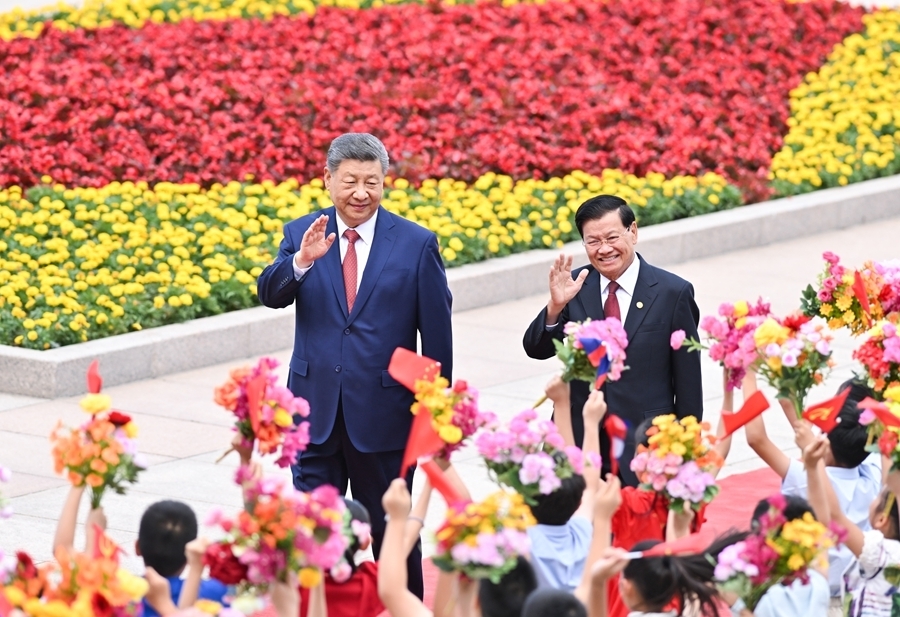
On the afternoon of June 5, Xi Jinping, General Secretary of the Communist Party of China Central Committee and President of China, held talks with Thongloun Sisoulith, General Secretary of the Lao People’s Revolutionary Party Central Committee and President of Laos, who was in China for a state visit, at the Great Hall of the People in Beijing. This photo shows Xi Jinping welcoming Thongloun with a ceremony on the East Square outside the Great Hall of the People before the talks.
During the talks, the Chinese and Lao leaders highlighted a shared key term: a “new era all-weather” community with a shared future. The two countries clearly stated in a joint declaration that they unanimously agreed to work together to build a new era all-weather China-Laos community with a shared future.
Thongloun’s visit coincides with the 65th anniversary of the establishment of diplomatic relations between China and Laos and the “China-Laos Friendship Year.” Experts noted that the face-to-face meeting between the two leaders at this critical juncture has propelled China-Laos relations to a new level.
Xi Jinping put forward four points on advancing China-Laos relations and the construction of the community with a shared future towards high standards, high quality, and high levels: adhere to the socialist direction, solidify the foundation of mutually beneficial cooperation, consolidate the traditional friendship between the peoples, and strengthen coordination of foreign policies.
An expert from Fudan University believes that these four points are closely linked, providing direction and strong momentum for building the new era all-weather China-Laos community with a shared future.
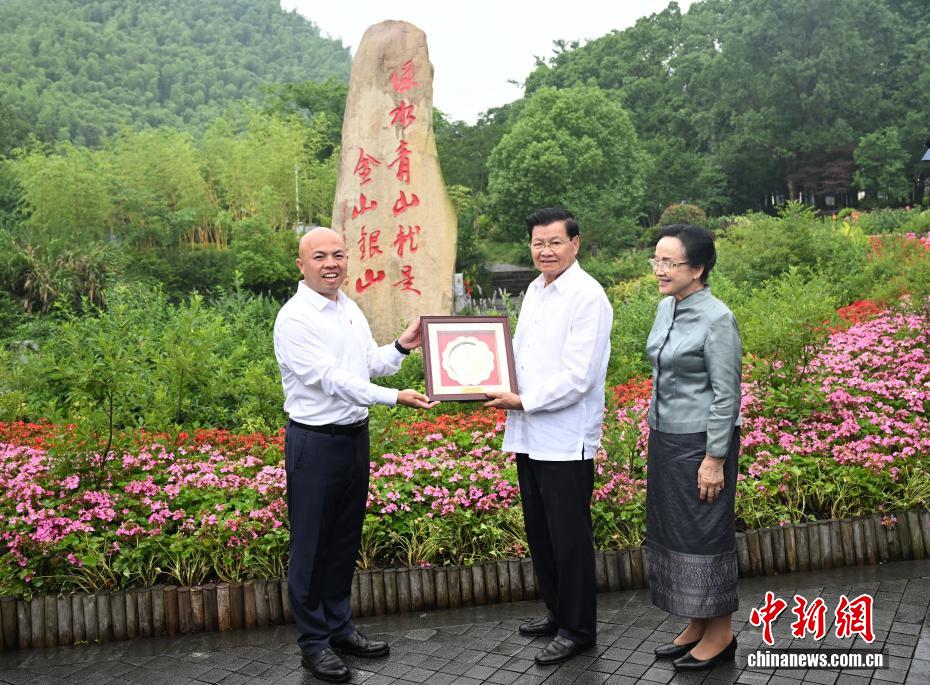
On June 3, Thongloun presented a souvenir engraved with his name to Yucun Village. On that day, Thongloun, General Secretary of the Lao People’s Revolutionary Party Central Committee and President of Laos, visited Yucun Village in Anji, Huzhou, Zhejiang, the birthplace of the “Two Mountains” concept. He also inspected rural homestays and a bamboo-for-plastic demonstration center, experiencing the new developments in Zhejiang’s rural areas.
Building the new era all-weather China-Laos community with a shared future requires continuous joint efforts.
China and Laos are socialist neighbors sharing a common destiny. Over the 65 years of diplomatic relations, the traditional friendship has withstood the tests of changing times and international situations, growing stronger over time.
During the talks, Xi Jinping pointed out that both sides should jointly uphold the socialist system and the ruling status of the communist parties, maintain close strategic communication, implement the new five-year cooperation plan between the two parties, and deepen exchanges on party governance and state administration experiences.
Observers noted that Thongloun’s visit included learning about ecological governance experiences in Anji, Zhejiang, the birthplace of the “Two Mountains” concept, and a special visit to the Central Party School (National Academy of Governance) in Beijing, where he had studied in 2000. The expert from Fudan University believes that the same institutional foundation and continuous party and government exchanges provide institutional guarantees for long-term political mutual trust between China and Laos.
Building the new era all-weather China-Laos community with a shared future requires deepening mutually beneficial cooperation.
In recent years, China-Laos cooperation has continued to expand. China has been the largest foreign investor and export destination for Laos for many years. Close cooperation has helped Laos accelerate its transformation from a “landlocked country