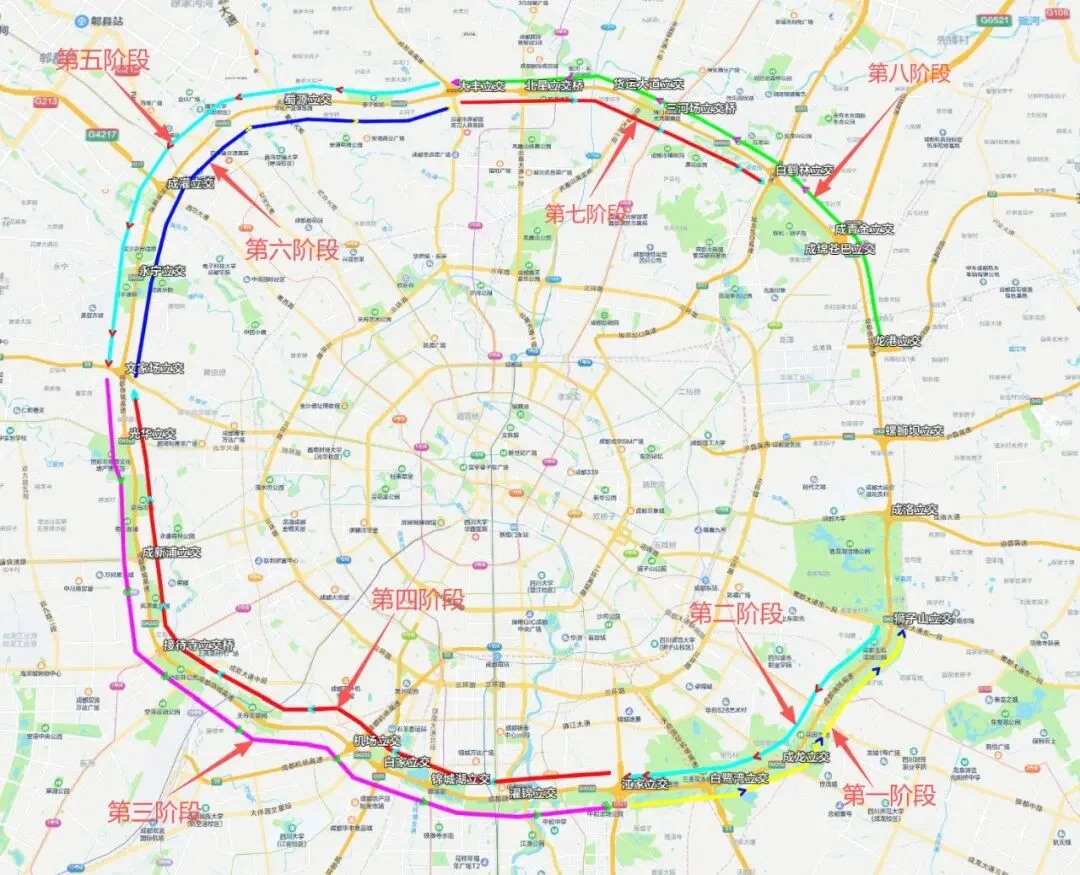
According to Sichuan Chuanxi Expressway Co., Ltd., starting from January 4th, temporary nighttime traffic control will be implemented in sections on both the inner and outer rings of the Chengdu Ring Expressway due to construction work. Details are as follows:
Due to the gantry installation work for the Chengdu Ring Expressway Intelligent Expansion Project, and in accordance with relevant laws and regulations such as the “Road Traffic Safety Law of the People’s Republic of China,” the “Highway Law of the People’s Republic of China,” and the “Sichuan Province Expressway Regulations,” it has been decided to implement temporary nighttime traffic control in sections on both the inner and outer rings of the Chengdu Ring Expressway.
1. Traffic Control Period: From January 4, 2026, to January 12, 2026, daily from 10:00 PM to 6:00 AM the following day.
Phase One: From 10:00 PM on January 4, 2026, to 6:00 AM on January 5, 2026, the outer ring section from Jiangjia Junction to Shizishan Interchange, a length of 11.35 km (Stake Numbers: Outer Ring K34+631 to K23+285), will be closed.
Phase Two: From 10:00 PM on January 5, 2026, to 6:00 AM on January 6, 2026, the inner ring section from Shizishan Interchange to Jiangjia Junction, a length of 11.35 km (Stake Numbers: Inner Ring K23+285 to K34+631), will be closed.
Phase Three: From 10:00 PM on January 6, 2026, to 6:00 AM on January 7, 2026, the outer ring section from Wenjiachang Junction to Jiangjia Junction, a length of 25.97 km (Stake Numbers: Outer Ring K60+600 to K34+631), will be closed.
Phase Four: From 10:00 PM on January 7, 2026, to 6:00 AM on January 8, 2026, the inner ring section from Jiangjia Junction to Wenjiachang Junction, a length of 25.97 km (Stake Numbers: Inner Ring K34+631 to K60+600), will be closed.
Phase Five: From 10:00 PM on January 8, 2026, to 6:00 AM on January 9, 2026, the outer ring section from Dafeng Junction to Wenjiachang Junction, a length of 18.4 km (Stake Numbers: Outer Ring K79+000 to K60+600), will be closed.
Phase Six: From 10:00 PM on January 9, 2026, to 6:00 AM on January 10, 2026, the inner ring section from Wenjiachang Junction to Dafeng Junction, a length of 18.4 km (Stake Numbers: Inner Ring K60+600 to K79+000), will be closed.
Phase Seven: From 10:00 PM on January 10, 2026, to 6:00 AM on January 11, 2026, the inner ring section from Dafeng Junction to Baihelin Junction, a length of 12.5 km (Stake Numbers: Inner Ring K79+000 to K0, K0 to K6+500), will be closed.
Phase Eight: From 10:00 PM on January 11, 2026, to 6:00 AM on January 12, 2026, the outer ring section from Longgang Interchange to Dafeng Junction, a length of 19.8 km (Stake Numbers: Outer Ring K13+800 to K0, K0 to K79+000), will be closed.
2. Traffic Control Measures
3. Important Notes
During the traffic control period, all passing vehicles must proceed safely and orderly in accordance with road traffic signs and the instructions of on-site personnel. Any violation of this notice’s provisions or disobedience to the command and management of on-site personnel will be dealt with according to law and regulations. In case of severe weather or other force majeure factors during the construction period, the closure times will be postponed accordingly.
Information Hotline: 121