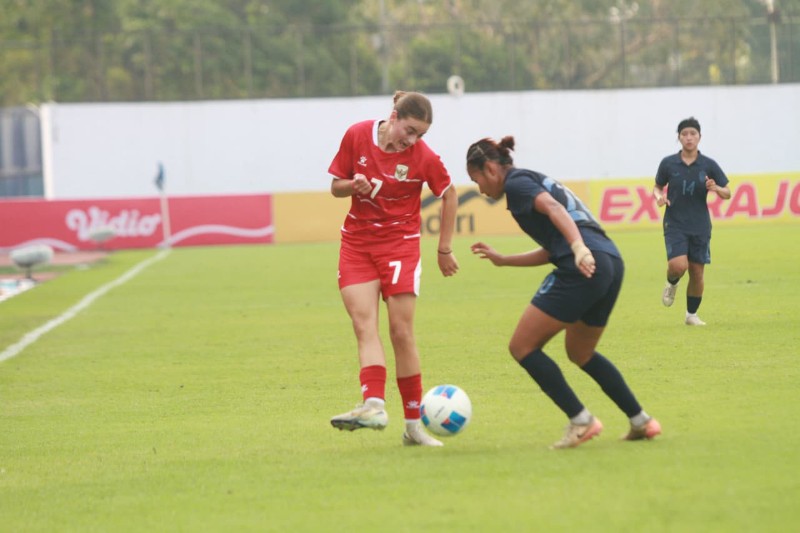
The Indonesian Women’s National Team failed to secure a victory again during the FIFA Matchday in June 2026. Facing Cambodia at Arcamanik Stadium, Bandung, on Tuesday (June 9, 2026), the squad had to settle for a 1-1 draw.
This result continues an unsatisfactory trend for the team after losing 0-2 to Singapore in the previous match. From the two friendly matches played during this FIFA Matchday, Indonesia has yet to achieve a win.
In the match against Cambodia, the Indonesian Women’s National Team actually showed promising performance. After a goalless first half, they broke the deadlock early in the second half.
Indonesia’s goal was scored by Rosdilah Siti Nurrohmah. The agile winger successfully capitalized on an opportunity to give the hosts a 1-0 lead, boosting the spirits of the supporters present at Arcamanik Stadium.
However, the lead did not last long. Cambodia quickly responded through Chhit Sapheourn, who scored the equalizer. The Cambodian player’s strike changed the score to 1-1, which remained until the final whistle.
The coach of the Indonesian Women’s National Team expressed disappointment that his team failed to secure a victory despite displaying fairly good play.
“First of all, we played well against a strong opponent, Cambodia. But it’s truly regrettable because we should have won. Both diaspora players and local players fought well, and I am very grateful,” he said after the match.
Meanwhile, Indonesia’s goal scorer, Rosdilah Siti Nurrohmah, appreciated her teammates’ efforts despite failing to achieve the maximum result.
“Thank God we were able to play to the best of our ability. Even though the result was a draw, we gave it our all,” said Rosdilah.
Although they have not won during the June 2026 FIFA Matchday, the result against Cambodia serves as an important evaluation for the Indonesian Women’s National Team. There is still time to improve several aspects of the game before facing the next competitive agenda, including preparations for the 2026 AFF Women’s Championship.
Arcamanik Stadium
Arcamanik Stadium, located in Bandung, Indonesia, is a multi-purpose sports venue primarily used for football matches. It was constructed in the early 1980s and officially opened in 1985, serving as the home ground for local clubs such as Persib Bandung for a period. The stadium has hosted various regional and national sporting events, contributing to the area’s sports history.
Bandung
Bandung is the capital of West Java, Indonesia, known for its cool climate and colonial architecture. It was an important center of the Dutch East Indies in the early 20th century, earning the nickname “Paris of Java.” The city also hosted the historic 1955 Asia-Africa Conference, a landmark event in the Non-Aligned Movement.
Arcamanik Stadium
Arcamanik Stadium is a multi-purpose sports venue located in Bandung, West Java, Indonesia. Originally built in the early 20th century during the Dutch colonial era, it has historically served as a key site for local football matches and community events. Today, the stadium remains an important cultural landmark, reflecting the region’s sporting heritage and colonial architectural influences.
<
Arcamanik Stadium
Arcamanik Stadium is a multi-purpose sports venue located in Bandung, Indonesia, primarily used for football matches and athletics. Originally built in the 1980s, it has served as a home ground for local football clubs and hosted various sporting events in the region. The stadium is named after the Arcamanik district, reflecting its role as a community sports hub in the city’s eastern area.
Bandung
Bandung is the capital of West Java, Indonesia, known for its cool climate, colonial architecture, and vibrant arts scene. It gained historical significance as the host of the 1955 Asia-Africa Conference, a landmark event that united newly independent nations against colonialism. Today, Bandung is a popular destination for its cultural heritage, shopping, and natural surroundings.
Paris of Java
“Paris of Java” is a nickname for Bandung, the capital of West Java, Indonesia, earned during the Dutch colonial era for its cool climate, tree-lined boulevards, and elegant Art Deco architecture. In the 1920s and 1930s, the city was developed as a planned European-style resort and administrative hub, attracting wealthy planters and intellectuals. Today, it remains a vibrant cultural and creative center, blending colonial heritage with modern cafes, shopping, and art scenes.
Asia-Africa Conference
The Asia-Africa Conference, also known as the Bandung Conference, was a historic meeting held in Bandung, Indonesia, in April 1955. It brought together leaders from 29 newly independent Asian and African nations to promote economic and cultural cooperation and to oppose colonialism and neocolonialism. The conference laid the groundwork for the Non-Aligned Movement and marked a pivotal moment in the post-World War II struggle for decolonization and global solidarity among developing countries.
Non-Aligned Movement
The Non-Aligned Movement (NAM) is a forum of 120 developing countries that are not formally aligned with any major power bloc. Founded in 1961 during the Cold War, it was established by leaders such as Josip Broz Tito of Yugoslavia, Jawaharlal Nehru of India, and Gamal Abdel Nasser of Egypt to promote the independence of newly decolonized nations and to resist pressure from either the United States or the Soviet Union. Its core principles include mutual respect for sovereignty, non-interference, and peaceful coexistence.