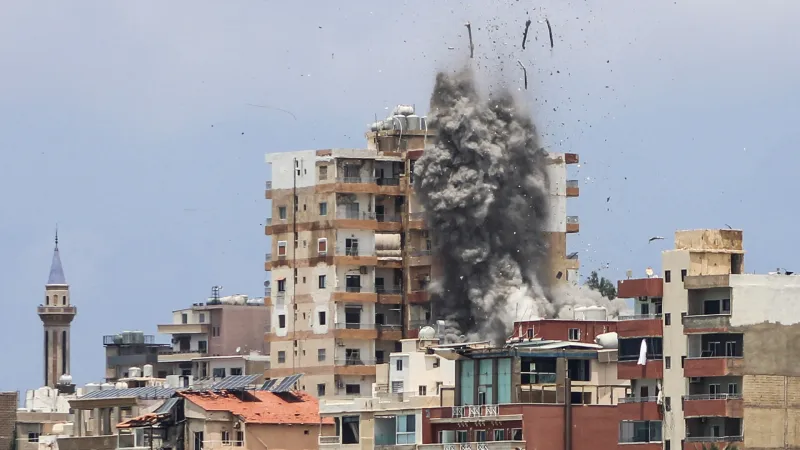
In the last 24 hours, Israeli forces have killed nine people in the city of Tyre. This incident occurred after the forces issued evacuation orders and continued deadly attacks on southern Lebanon. These actions have further escalated tension in the area and created an atmosphere of fear among locals.

According to received information, Israeli forces ordered residents of Tyre to leave their homes. Immediately after these orders, attacks intensified, resulting in the deaths of nine innocent people. This incident has become a matter of international concern.

The ongoing attacks in southern Lebanon pose a serious challenge to the peace process. This situation is being closely monitored, and continuous efforts are being made for further updates to ensure accurate and timely information reaches the readers.

Tyre

Tyre is an ancient Phoenician city located in present-day Lebanon, renowned for its historical significance as a major maritime and commercial power in the Mediterranean. Founded around 2750 BCE, it was famously besieged by Alexander the Great in 332 BCE, who built a causeway to conquer the island city. Today, its well-preserved Roman ruins, including a hippodrome and a triumphal arch, are recognized as a UNESCO World Heritage site.

Tyre

Tyre is an ancient Phoenician city located on the coast of modern-day Lebanon, renowned for its historical role as a major maritime and commercial power. Founded around 2750 BCE, it was famous for producing the prized Tyrian purple dye and later faced sieges by Alexander the Great. Today, its archaeological ruins, including a Roman hippodrome and a crusader cathedral, are a UNESCO World Heritage Site.

Phoenician city

The term “Phoenician city” refers to the ancient urban centers of the Phoenician civilization, such as Tyre, Sidon, and Byblos, which flourished along the eastern Mediterranean coast from around 1500 BCE. These cities were renowned as powerful maritime trading hubs, spreading their alphabet, purple dye, and cultural influences across the Mediterranean world. Many were later conquered by empires like the Assyrians, Babylonians, and Romans, but their legacy endures through archaeological remains and their pivotal role in early global trade.

Lebanon

Lebanon is a country in the Middle East with a rich history dating back thousands of years, once home to the ancient Phoenicians and later part of the Roman, Byzantine, and Ottoman empires. It gained independence in 1943 and became known as the “Switzerland of the East” for its cultural diversity and thriving economy, though it endured a devastating civil war from 1975 to 1990. Today, Lebanon is celebrated for its vibrant cities like Beirut, historical sites such as Baalbek and Byblos, and its resilient, multicultural society.

Mediterranean

The Mediterranean refers to the sea and the vast region surrounding it, which has served as a cradle of civilization for millennia. Its history is defined by the rise and fall of powerful empires, including the Phoenicians, Greeks, Romans, and Ottomans, who used its waters for trade, conquest, and cultural exchange. Today, the region’s diverse cultures, ancient ruins, and iconic coastal landscapes make it a globally significant historical and tourist destination

Tyre

Tyre is an ancient Phoenician city located in modern-day Lebanon, renowned for its historical role as a major maritime and trade hub. Founded around 2750 BCE, it was famous for producing Tyrian purple dye and withstanding sieges by Alexander the Great in 332 BCE after a seven-month blockade. Today, its UNESCO World Heritage site features Roman ruins, including a hippodrome and a triumphal arch, reflecting its layered history through Phoenician, Greek, Roman, and Byzantine civilizations.

Phoenician city

The Phoenician city refers to one of the ancient city-states established by the Phoenician civilization, such as Tyre, Sidon, or Byblos, which flourished along the eastern Mediterranean coast from around 1500 BCE. These cities were major maritime and trade hubs, known for their purple dye, glassware, and the development of the alphabet, which influenced later writing systems. Byblos, for example, is one of the oldest continuously inhabited cities in the world, with a history spanning over 7,000 years, and its name gave rise to the word “Bible.”

Lebanon

Lebanon is a small but historically rich country on the eastern coast of the Mediterranean Sea, known for its diverse cultural heritage that blends Phoenician, Roman, Ottoman, and French influences. Its history includes being the home of the ancient Phoenician civilization, a crossroads of empires, and a major center of trade and culture. Despite periods of conflict, such as the Lebanese Civil War (1975–1990), the country remains famous for its vibrant cities like Beirut, as well as landmarks such as the ruins of Baalbek and the Jeita Grotto.

Mediterranean

The Mediterranean is not a single cultural site but a vast sea region that has served as a cradle for several major civilizations, including the Ancient Greeks, Romans, and Phoenicians. Its history is defined by centuries of maritime trade, cultural exchange, and conflict, shaping the development of Western civilization. Today, the Mediterranean remains a vital cultural and economic hub, renowned for its diverse cuisines, languages, and historical landmarks.

Related news

Surat: Mega Tree Plantation at Surat Airport Campus on Passenger Service Day

On the occasion of Passenger Service Day, a mega t...

Surat: Major action against child labor in Varachha, 14 children freed

Surat. Under the child labor eradication campaign,...

SGCCI’s grand art exhibition in Mumbai successfully concluded.

47 artworks by 24 artists showcased at Nehru Centr...

Pirana dumping site will become a green zone, AMC will plant 50,000 trees.

The Pirana dumping site is set to be turned into a...