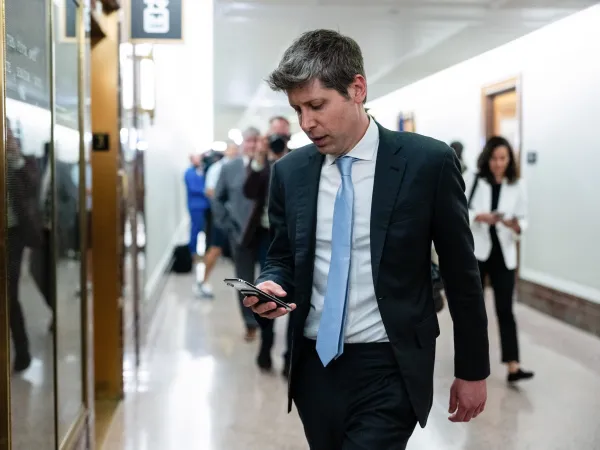
OpenAI CEO Sam Altman is at a crucial stage as he moves toward an IPO. OpenAI announced on Monday that it had taken its first official step toward an IPO. This means that three major AI companies are now in the process of going public, possibly within the same year. Financial analysts described this IPO race as another front in the AI competition.
The next phase of the AI competition has begun. OpenAI’s confidential S-1 filing on Monday, following Anthropic’s lead, means these two major AI labs are officially in the IPO race. SpaceX, which includes Elon Musk’s xAI, has an early advantage and will go public later this week.
While OpenAI left its timeline open, warning that “it may take some time” before its shares are publicly listed, AI labs are transitioning from an era of operating behind closed doors as private companies to a world of public earnings calls, financial disclosures, and the regulation that comes with being a publicly traded company.
Does it reflect how much cash they are all burning? An opportunity to reward loyal employees and retain key AI talent? Something else? Here’s what insiders from Wall Street, tech, and the broader business world think about the ChatGPT maker’s latest move:
Perplexity CEO Aravind Srinivas
Perplexity CEO Aravind Srinivas said his AI company is still targeting its IPO for 2028. Srinivas stated, “Independently of these two companies, we were planning something in 2028, so that remains unchanged.” Srinivas said that the IPOs of OpenAI, Anthropic, and SpaceX will be important for the broader industry. He added, “I definitely believe that if they don’t go well, there will be ripple effects, no doubt about it.”
OpenAI
OpenAI is an artificial intelligence research organization founded in December 2015, originally as a non-profit with the mission of ensuring that AGI (artificial general intelligence) benefits all of humanity. It transitioned to a “capped-profit” model in 2019 to attract more investment, and has since become widely known for developing advanced AI models like GPT-3, GPT-4, and ChatGPT. The company has played a pivotal role in the recent surge of generative AI technology, sparking both innovation and debate around AI safety and ethics.
Anthropic
The term “Anthropic” often refers to the Anthropic Principle, a philosophical concept in cosmology and physics that suggests the universe’s physical laws and constants are finely tuned to allow for the existence of life, particularly human observers. The idea gained prominence in the 1970s, with physicist Brandon Carter coining the term, and it has since sparked debates between scientific, philosophical, and theological perspectives. While not a physical place, it represents a key cultural and scientific idea about humanity’s place in the cosmos.
SpaceX
SpaceX, short for Space Exploration Technologies Corp., was founded in 2002 by Elon Musk with the goal of reducing space transportation costs and enabling the colonization of Mars. The company made history in 2012 when its Dragon spacecraft became the first commercial vehicle to dock with the International Space Station, and it has since pioneered reusable rocket technology with the Falcon 9 and Falcon Heavy. Today, SpaceX continues to lead in commercial spaceflight, launching satellites, crewed missions, and developing the Starship spacecraft for deep-space exploration.
xAI
<div class="text-gray-800
OpenAI
OpenAI is an artificial intelligence research organization founded in December 2015, originally as a non-profit with the mission of ensuring that AGI (artificial general intelligence) benefits all of humanity. It transitioned to a “capped-profit” model in 2019 to attract more funding, and has since become known for developing advanced AI models like GPT-3, DALL-E, and ChatGPT. The company has played a pivotal role in advancing generative AI, sparking widespread discussion about both the potential and risks of powerful AI systems.
Anthropic
The term “Anthropic” does not refer to a specific place or cultural site, but rather relates to the Anthropic Principle in cosmology and philosophy, which explores the relationship between human existence and the universe’s physical laws. Alternatively, “anthropic” can describe landscapes or features shaped by human activity, such as archaeological sites or terraformed environments. Without a specific location, no historical summary can be provided.
SpaceX
SpaceX, founded by Elon Musk in 2002, is a private American aerospace manufacturer and space transportation company. Its history includes pioneering the first privately funded liquid-propellant rocket to reach orbit (Falcon 1 in 2008) and revolutionizing spaceflight with reusable rocket technology, such as the Falcon 9. The company now plays a key role in NASA missions, commercial satellite launches, and Musk’s long-term goal of enabling human colonization on Mars.
xAI
xAI is an artificial intelligence company founded by Elon Musk in 2023, with the stated goal of understanding the true nature of the universe. The company was created partly as a response to Musk’s concerns about the safety and direction of other AI organizations, such as OpenAI, which he co-founded but later left. xAI is best known for developing the Grok chatbot, which is designed to offer a more conversational and less filtered AI experience, integrated with Musk’s social media platform, X.