Trump warns Netanyahu: You’ll be alone against Iran—stop the escalation.
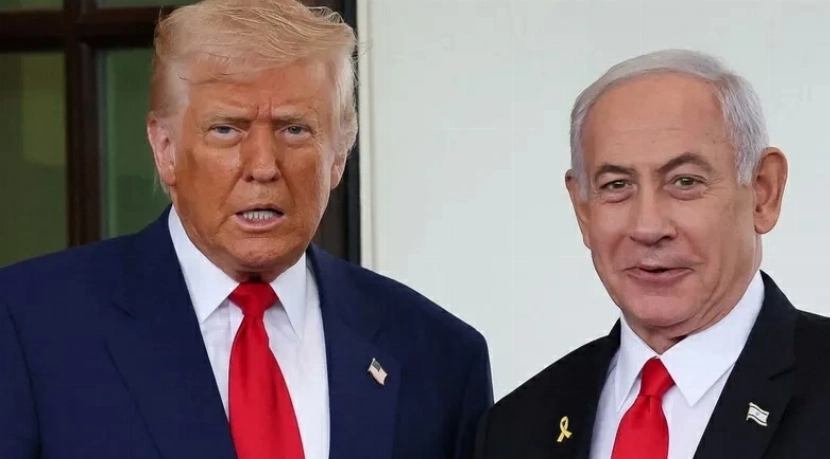
U.S. President Donald Trump threatened Israeli Prime Minister Benjamin Netanyahu on Monday, warning that he would leave him alone to face Iran if he escalated the war.
Trump told an Israeli channel: “I warned Netanyahu that if he turns the escalation into a war, he will be left alone against Iran,” explaining that he had asked Netanyahu late last night not to respond to Iranian attacks.
He added: “I tried to reduce the scale of the Israeli response to Iran, and five regional countries asked me to pressure Netanyahu,” stressing that Iran is interested in signing an agreement.
He noted that Netanyahu informed him late about the decision to strike Iran, but he managed to reduce the scale of the attack.
An Israeli source said that Trump ordered Netanyahu during their call to stop the attack on Iran while the fighter jets were on standby.
Israeli Prime Minister Benjamin Netanyahu had said that Israel would respond forcefully if Iran attacked it again, considering that Tehran and the Lebanese Hezbollah are weaker than ever.
Netanyahu stressed that the confrontation with them is not over yet, noting that he told U.S. President Donald Trump that Tel Aviv has the full right to defend itself.
He indicated that Israel is currently refraining from striking Iran, adding that Iran and Hezbollah tried to impose a new and unacceptable equation on Israel.
He affirmed: “For now, this front has been contained, but we will respond forcefully if we are attacked again.”
In contrast, Iran lifted restrictions on air traffic as its airspace returned to normal, according to Iranian media.
Meanwhile, Iranian Parliament Speaker Mohammad Qalibaf said that Trump’s statements regarding the memorandum of understanding violated agreed-upon clauses.
On another note, the U.S. military announced that its forces prevented the passage of the oil tanker “Marivex,” flying the flag of Palau, in the Gulf of Oman today as it headed toward Iran, stating that the tanker was not carrying any cargo.
In turn, the Lebanese Ministry of Health announced the killing of 7 people and the injury of 8 others in an Israeli raid early today on the town of Zifta in the Nabatieh district in southern Lebanon, confirming that the number of casualties in the war between Israel and Hezbollah has risen to 3,637 dead and 11,188 wounded since March 2.
Meanwhile, the Lebanese Red Cross confirmed that 4 paramedics were injured in an Israeli raid that occurred in front of one of its centers in the city of Tyre in southern Lebanon.
Tel Aviv
Tel Aviv, founded in 1909 as a modern garden suburb of the ancient port city of Jaffa, quickly grew into a bustling metropolis and Israel’s economic and cultural hub. Its history is marked by rapid development, particularly after Israel’s independence in 1948, and it is known for its Bauhaus architecture, earning UNESCO World Heritage status. Today, Tel Aviv is celebrated for its vibrant nightlife, beaches, and status as a center for innovation and high-tech industry.
Iran
Iran is a country in Western Asia with a rich history dating back thousands of years, once the center of the ancient Persian Empire. Its cultural sites include the ruins of Persepolis, the grand capital of the Achaemenid Empire, and stunning Islamic architecture in cities like Isfahan and Shiraz. Today, Iran is known for its deep traditions in poetry, art, and Persian culture, despite political complexities.
Lebanon
Lebanon is a country in the Middle East with a rich history dating back thousands of years, home to ancient civilizations like the Phoenicians, and known for its cultural diversity and resilience.</
Tel Aviv
Tel Aviv, founded in 1909 as a modern Jewish suburb of the ancient port city of Jaffa, has grown into Israel’s vibrant cultural and economic hub. Known for its Bauhaus architecture, Mediterranean beaches, and lively nightlife, the city played a key role in the establishment of the State of Israel in 1948. Today, it stands as a symbol of innovation and diversity, blending a rich history with a forward-looking spirit.
Iran
Iran, historically known as Persia, is a country in Western Asia with a rich cultural heritage dating back thousands of years to ancient civilizations like the Elamites and the Achaemenid Empire. It was a major center of art, science, and philosophy during the Islamic Golden Age, and its modern history includes the 1979 Islamic Revolution that established the current Islamic Republic. Today, Iran is renowned for its stunning architecture, such as Persepolis and Isfahan’s mosques, as well as its contributions to poetry, carpets, and cinema.
Lebanon
Lebanon is a country in the Middle East with a rich history dating back thousands of years, home to ancient civilizations like the Phoenicians, who established powerful city-states such as Tyre and Byblos. It was later part of the Roman, Byzantine, and Ottoman empires, and gained independence in 1943. Despite a devastating civil war from 1975 to 1990, Lebanon remains known for its vibrant culture, diverse religious communities, and historical landmarks like the ruins of Baalbek and the Jeita Grotto.
Persepolis
Persepolis was the ceremonial capital of the Achaemenid Empire, founded by Darius I in the 6th century BCE. It served as a grand center for royal receptions and the celebration of Nowruz, the Persian New Year, until it was sacked and burned by Alexander the Great in 330 BCE. Today, its impressive ruins in Iran are a UNESCO World Heritage site, offering a glimpse into the power and artistry of ancient Persia.
Isfahan
Isfahan is a historic city in central Iran, renowned for its stunning Islamic architecture, particularly from the Safavid era when it served as the empire’s capital in the 16th and 17th centuries. The city’s famed Naqsh-e Jahan Square, a UNESCO World Heritage site, is surrounded by masterpieces like the Shah Mosque and Ali Qapu Palace. Once a major stop along the Silk Road, Isfahan’s rich cultural heritage and beautiful bridges and gardens have earned it the Persian nickname “Nesf-e-Jahan,” meaning “Half of the World.”
Shiraz
Shiraz is a historic city in southern Iran, known as the cultural capital of the country and home to the tombs of the famous Persian poets Hafez and Saadi. It rose to prominence as the provincial capital during the Zand dynasty in the 18th century, when many of its iconic structures, such as the Arg of Karim Khan and the Vakil Bazaar, were built. Today, Shiraz is celebrated for its beautiful gardens, vibrant literary heritage, and proximity to the ancient ruins of Persepolis.
Gulf of Oman
The Gulf of Oman is a strategic body of water connecting the Arabian Sea to the Strait of Hormuz, bordered by Iran, Oman, and the United Arab Emirates. Historically, it has been a vital maritime trade route for centuries, linking the Indian Ocean with the Persian Gulf and facilitating the exchange of goods like spices, pearls, and textiles. Its significance grew in the modern era due to its role in global oil shipments, though it has also been a site of geopolitical tensions and naval presence.
Tyre
Tyre is an ancient Phoenician city located in modern-day Lebanon, renowned for its historical role as a major maritime and trading power. Founded around 2750 BCE, it was famously besieged by Alexander the Great in 332 BCE, who built a causeway to conquer the island city. Today, its UNESCO World Heritage site features well-preserved Roman ruins, including a hippodrome and triumphal arch, reflecting its layered history.