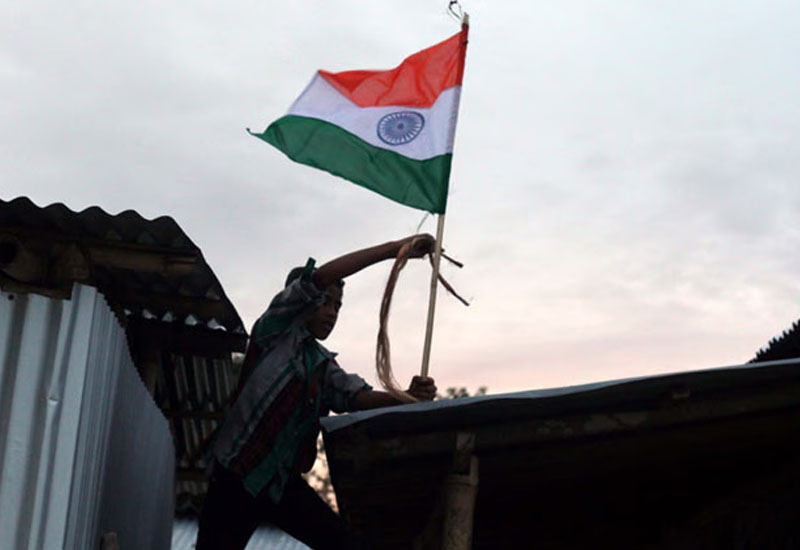
They are no longer enclave residents on paper. All are Indian citizens. But the reality of their daily lives shows that even 11 years after the exchange of enclaves, not much has changed for the residents. Although 11 years have passed since the former enclave residents were incorporated into India, they still have not received their land ownership documents. Now, the former enclave residents are banding together to finally get their land papers.
The exchange of enclaves between India and Bangladesh took place at midnight on July 31, 2015. One hundred sixty-two enclaves of India and Bangladesh were merged into the main territories of the two countries. Under the agreement, 51 enclaves on the Indian side cover 7,110 acres of land. The residents there are the owners of this land. However, the land records have still not been registered with the Land and Land Revenue Department. As a result, these citizens’ land documents still contain information from Bangladesh. Meanwhile, the residents of the former enclaves that went into Bangladesh received their documents a long time ago.
According to the agreement, the responsibility of handing over land documents to the citizens rested with the state government. The previous government did not do this work in the last 11 years. As a result, the local residents are in trouble.
Subal Roy, a resident of the former enclave Nalgram, said, “Our land is triple-cropped. Crops are grown on that land. Yet we cannot sell the land for our children’s weddings or medical needs. Because there is no record of our land in the state’s land department. So, when needed, the land is being transferred for a pittance.”
Sources from the Land and Land Revenue Department said that to survey the land of former enclave residents based on old documents, a survey must be conducted. In the last 11 years, the concerned department has not even started that survey work.
The former enclave residents say they were promised land papers would be handed over within three years. Initially, government officials came to conduct surveys in some areas. Later, that stopped for unknown reasons.
Development in the enclaves that remained on the Indian side has still not started. However, the enclaves that became part of Bangladesh have been transformed. Almost all roads are being paved. Many bridges and culverts have been built. Not only primary, secondary, and higher secondary schools or madrasas, but even colleges have been established.
Meanwhile, another former enclave resident, Anwar Hossain from Poyaturkuthi, said, “In the last 11 years, we have approached the administration many times asking for our land papers. We have submitted memorandums to everyone, from MLAs and MPs to ministers, with the same demand. We have received nothing but promises and assurances.” Suleman Mia, a resident of Nalgram, said, “The administration did give us a paper stating how much land each of us has. But that is not a document from the Land and Land Revenue Department. Land sale and purchase registrations cannot be done with that. Similarly, when we go to work as laborers in other states, we cannot prove that we are Indian citizens and have land and homes in India.”
Coming to Cooch Behar to attend a party program, a state secretary said on Monday, “The red flag will be with the former enclave residents in their fight for their land parch and khatian. The BJP government in Delhi must also answer why the residents of former enclaves and Berubari have not received their promised land parch even after so long. Because the enclave exchange agreement was between the governments of India and Bangladesh.”
He said, “The agreement stated that within three years, every citizen would be given their own land parch and khatian. Why, even after 11 years, must the citizens there fight for their rights?”
It is claimed that at the time of the enclave exchange, the central government gave the state government a package of nearly a thousand crore rupees. The proper infrastructure development of the former enclaves did not happen with that money. The money was looted. Let the state’s BJP government publish a white paper on the package.
Nalgram
Nalgram
Poyaturkuthi
Cooch Behar
Berubari
Related news

Hindu sects must unite and open temple doors for each other: Justice B.V. Nagarathna
Why did the High Court order the demolition of a 26-story tower with 233 apartments and parking for 269 cars?

‘Let CBI Investigating Officer Seema come under investigation’: Explosive claim by Abhijit in RG Kar case
DYFI calls for marches and rallies in all districts on June 9.