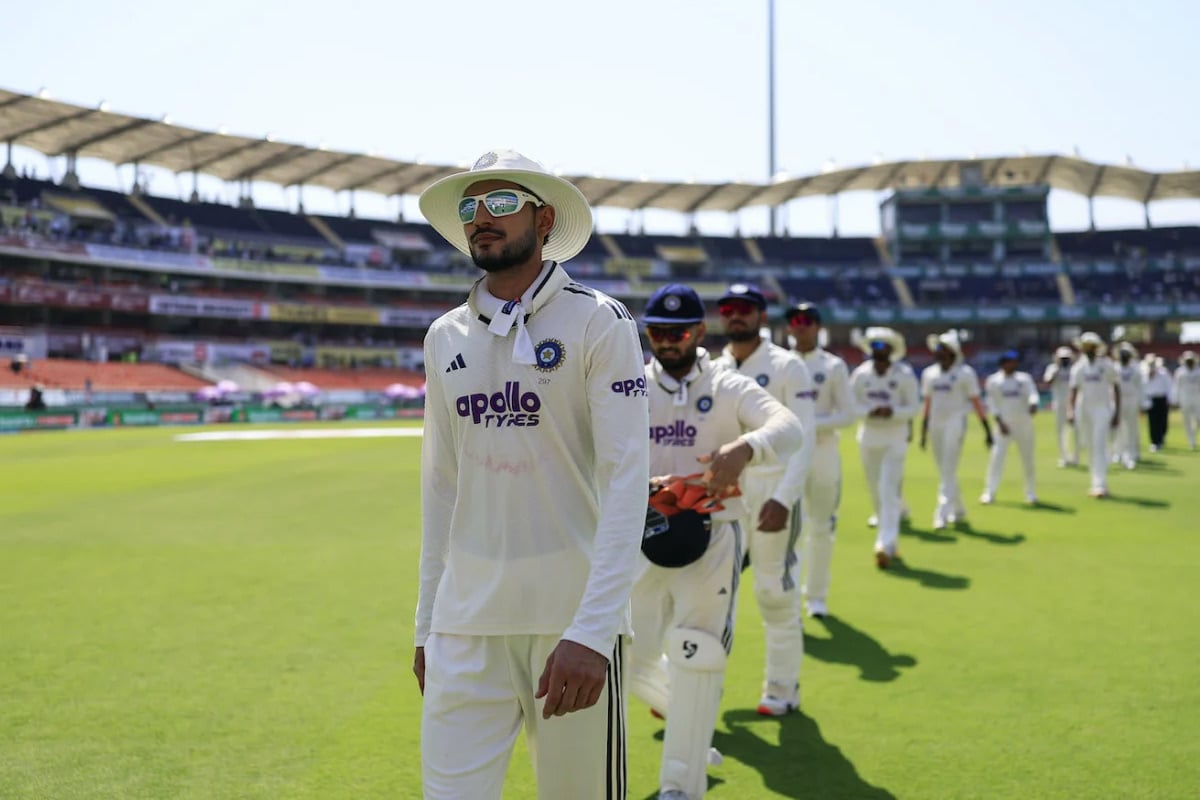
India created a new record in Test cricket. Shubman Gill and his team achieved the largest victory margin by innings and runs. On Monday, India beat Afghanistan by an innings and 300 runs at home. Despite this historic win, India did not significantly improve their position in the World Test Championship standings. India remains in sixth place on the WTC points table.
The World Test Championship final will be held in England in June next year. India failed to reach the final in the previous cycle. This time, the path to the final is quite difficult for India. India is in sixth place on the points table. After playing 9 Tests, Shubman’s team has a points percentage of 48.15. Australia is at the top of the table. The top five also include last cycle’s champion South Africa, Sri Lanka, New Zealand, and Bangladesh. Notably, India’s position was the same before the match against Afghanistan.
India’s hopes of reaching the final may remain alive, but they will have to depend on other teams’ results as well. Can India, riding on the confidence from the Afghanistan match, win their upcoming games and make it to the final?
But why didn’t India improve their points table position despite the historic win? This match against Afghanistan is actually not part of the World Test Championship cycle. The Indian team viewed this match primarily as preparation for Test cricket after the IPL. India’s gains from this Test are significant. Rishabh Pant has returned to form. KL Rahul scored a century. Captain Shubman Gill has maintained his excellent IPL form. Washington Sundar also succeeded with both bat and ball.
India’s next challenge in red-ball cricket is against Sri Lanka. India will play a two-Test series in Sri Lanka in August. In November, the Indian team will tour New Zealand. After that, they will play the five-Test Border-Gavaskar Trophy at home. India’s hopes of reaching the final may remain alive until this series against Australia. However, they will have to depend on other teams’ results as well. Can India, riding on the confidence from the Afghanistan match, win their upcoming games and make it to the final?
England
England is a country that forms part of the United Kingdom, with a rich history dating back thousands of years, from ancient Celtic tribes and Roman occupation to the medieval period and the formation of the British Empire. Its cultural landmarks include iconic sites such as Stonehenge, the Tower of London, and the historic city of Bath, as well as contributions to literature, music, and democracy. Today, England is known for its blend of historic tradition and modern innovation, with London as its vibrant capital.
Australia
Australia is a vast island continent and country, originally inhabited by Aboriginal peoples for over 65,000 years. It was colonized by the British in 1788, initially as a penal colony, and later became a federation of six states in 1901. Today, it is known for its diverse landscapes, unique wildlife, and multicultural society, with iconic landmarks like the Sydney Opera House and the Great Barrier Reef.
South Africa
South Africa is a country at the southern tip of Africa, known for its diverse cultures and dramatic landscapes. Its history includes centuries of colonialism, the apartheid system of racial segregation (1948-1994), and a peaceful transition to democracy led by Nelson Mandela. Today, it is celebrated for its “Rainbow Nation” identity, though it continues to address deep social and economic inequalities.
<h3 class="text-lg font-semibold
England
England is a country that forms part of the United Kingdom, with a rich history dating back thousands of years, from ancient Celtic tribes and Roman occupation to the medieval period and the establishment of the British Empire. It is home to iconic cultural sites such as Stonehenge, a prehistoric monument, and the Tower of London, a historic castle that has served as a royal palace and prison. Today, England is known for its influential contributions to literature, industry, and democracy, with London as its bustling capital.
Australia
Australia is a country and continent in the Southern Hemisphere, known for its diverse landscapes, unique wildlife, and vibrant cities like Sydney and Melbourne. Its history dates back over 65,000 years with Indigenous Aboriginal and Torres Strait Islander peoples, who have deep cultural traditions. European settlement began in 1788 with British colonization, leading to the nation’s federation in 1901 and its development into a multicultural society.
South Africa
South Africa is a culturally and geographically diverse nation located at the southern tip of Africa, known for its dramatic landscapes and rich history. Its modern history is deeply shaped by the apartheid era (1948-1994), a system of racial segregation and discrimination that ended with the election of Nelson Mandela as the country’s first Black president. Today, it is celebrated as the “Rainbow Nation” for its multicultural society, with 11 official languages and significant landmarks like Table Mountain and Robben Island.
Sri Lanka
Sri Lanka is an island nation in South Asia with a rich history dating back over 2,500 years, once home to ancient kingdoms like Anuradhapura and Polonnaruwa. It is renowned for its cultural sites such as the Sigiriya rock fortress and the Temple of the Tooth in Kandy, a sacred Buddhist relic. The country’s diverse heritage also reflects influences from Portuguese, Dutch, and British colonial periods.
New Zealand
New Zealand is an island nation in the southwestern Pacific Ocean, originally settled by the Māori people around the 13th century. It became a British colony in 1840 with the signing of the Treaty of Waitangi, which established a partnership between the Crown and Māori. Today, it is known for its stunning natural landscapes, rich Māori culture, and as a modern, independent country within the Commonwealth.
Bangladesh
Bangladesh, located in South Asia, is a country with a rich history that includes being part of ancient Bengal, a region known for its prosperous trade and cultural achievements. It was under British colonial rule as part of India until 1947, then became East Pakistan, and after a brutal war of independence in 1971, it emerged as the sovereign nation of Bangladesh. Today, it is known for its vibrant culture, the Sundarbans mangrove forest, and the world’s longest sea beach, Cox’s Bazar.