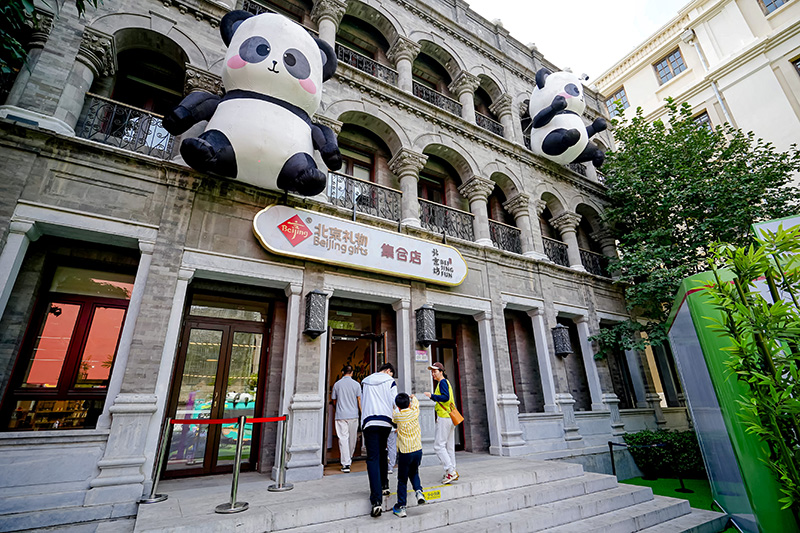
The 2026 Beijing Inbound Tourism Development Conference was held in Beijing from June 1 to 6. During the conference, the Xiannong Altar hosted an inspection tour for overseas travel buyers, while Guang’an Holding Group (Beijing Fun) and Tianqiao Shengshi Group participated in a trade fair to showcase Xicheng District’s cultural and tourism resources to the world.
In recent years, Xicheng District has focused on improving the travel experience for inbound tourists, including convenient payment and tax refunds for departure. A series of measures have made it more comfortable for overseas visitors to stay and shop in Xicheng. As of now, the district has 294 registered tax refund stores for departure, with refund services also extending to hotels.
Enhancing the “Play” Experience: Special Routes and Intangible Cultural Heritage Activities
Xicheng District continues to optimize its “4+3+2” route system, launching special routes such as Gongmenkou East-West Fork – Baitasi – Temple of Ancient Monarchs, Lao She Teahouse – Beijing Roast Duck Restaurant, and Beijing Aquarium – Beijing Exhibition Center. Based on its intangible cultural heritage resources, it also offers immersive experiences like brush making, woodblock water printing, and facial makeup painting.
To support the “play” experience, supporting services have been upgraded. Xicheng has updated 320 multilingual signs along the Central Axis and provided barrier-free audio guides at 4A-level scenic spots. Additionally, over 2,000 copies of the “Xicheng Travel” brochure have been distributed at Beijing Capital International Airport and major hotels. Promotional efforts are also carried out via the “Cultural Xicheng” WeChat public account and Xicheng’s overseas social media accounts on Facebook and X, with the brochure distributed as a promotional item in countries like Malaysia and Greece.
For this conference, the “Stay in Xicheng” themed guide brochure debuted on June 2 at the Xicheng exhibition area. It selects seven key hotels for inbound tourists, featuring hand-drawn maps, special introductions, and practical tips to precisely promote Xicheng’s cultural, commercial, and tourism resources.
Comprehensive Payment Coverage: Key Scenarios in Business Districts, Scenic Areas, and Hotels
Enjoying the experience also requires smooth payments. As of now, Xicheng has partnered with VISA and UnionPay for special training at merchants in the “Dashilan + Beijing Fun” area, helping over 2,000 merchants upgrade their payment systems, with 1,086 merchants designated as “Barrier-Free Merchants along the Central Axis.” Additionally, 80 key hotels and all 7 4A-level and above scenic spots in the district now accept foreign card payments, while 32 hotels offer foreign currency exchange points or real-time exchange rate services. A convenient payment network covering key scenarios such as business districts, scenic areas, and hotels has been established.
Beyond payments, ticket purchasing has also been made easier. The official ticketing platform for municipal parks now supports Chinese and English services and passport-based purchases. Inbound tourists can buy tickets online through the “Changyou Park” WeChat public account, mini-program, and Jingtong mini-program. Scenic spots along the Central Axis, including Prince Gong’s Mansion Museum, Beihai Park, and Jingshan Park, as well as seven 4A-level ticketed scenic spots, now accept various payment methods such as foreign card POS machines, cash, Alipay, and WeChat Pay. Beihai Park, Jingshan Park, Beijing Zoo, Taoranting Park, and Xiannong Altar also support ticket purchases using the “BEIJING PASS” card.
With payment and purchasing issues addressed, the accommodation experience is also improving. Front desk staff at mid-to-high-end hotels generally have foreign language communication skills and can provide additional language support based on guest markets. Hotels also offer multilingual service hotlines or online customer service to assist foreign visitors. Xicheng is promoting the addition of duty-free facilities at high-end hotels, introducing cultural and creative product stores, and placing promotional materials about nearby scenic spots, intangible cultural heritage experiences, dining, exhibitions, performances, and short-distance travel routes to facilitate foreign tourists’ visits.
Accelerated Tax Refunds: 294 Registered Tax Refund Stores in the District
After payment, tax refunds are also hassle-free. As of now, the district has 294 registered tax refund stores for departure, with refund services extending to hotels. Just before the conference, a centralized tax refund