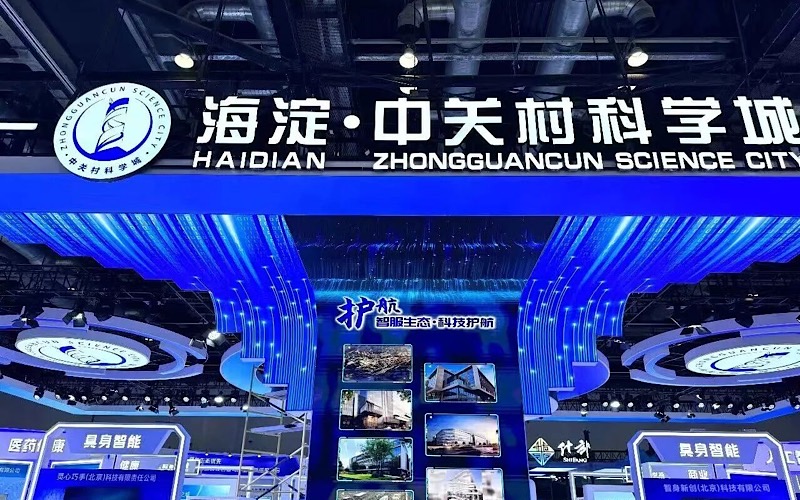
The 28th Beijing Science and Technology Expo is being held at the National Convention Center from May 8 to 10. At this expo, the Haidian district has set up three exhibition areas at both Phase I and Phase II of the convention center: Zhongguancun Science City, Shangdi, and Dongsheng. These areas showcase the latest achievements in deep tech innovation, global talent aggregation, and industrial upgrading.
At the Zhongguancun Science City exhibition area in Phase I, the entire space resembles a giant ship ready to set sail. A curved waterfall screen streams a “wave of technology,” with design elements like engine rooms, thrusters, and bridge structures integrated into the walls. The combination of tech blue and futuristic white creates a sleek, modern feel. This area highlights seven frontier tech fields, including embodied intelligence, artificial intelligence, healthcare, commercial aerospace, integrated circuits, and industrial software.
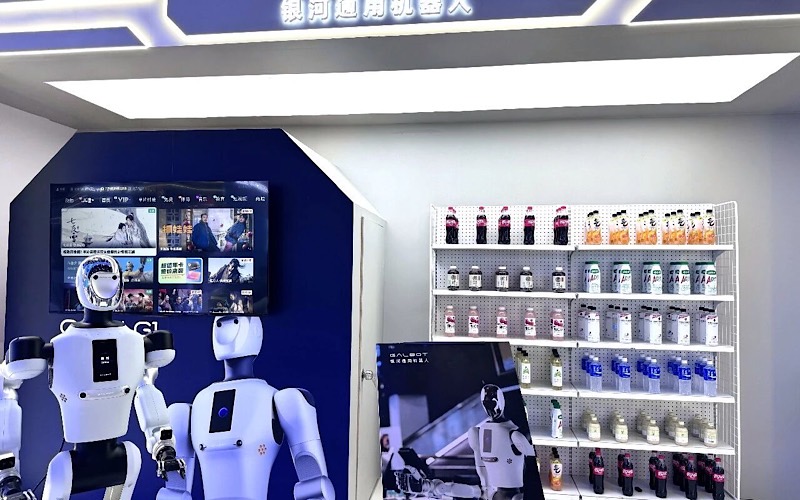
In embodied intelligence, robots are playing music and dancing on site, drawing many visitors. The Galbot G1 robot from Galaxy General is running a convenience store, serving passersby. It is already working in over a hundred “Galaxy Capsule” instant retail warehouses across more than 20 cities nationwide, featuring a wheeled, dual-arm design that is flexible and dexterous. Nearby, the “Lingxin Yuefu” piano robot from Lingxin Qiaoshou uses a high-degree-of-freedom dexterous hand to press keys precisely, playing classic pieces like “Beijing Welcomes You.” The rapidly evolving BOOSTER K1, weighing only 19.5 kg, can drag code, deploy complex AI models, and is a “little giant” for research and education.
In artificial intelligence, Zhongke Brain is showcasing its “Dual Intelligence” AI traffic control agent. According to staff, this agent has been trialed at Dazhongsi subway station and surrounding areas, generating 200 traffic timing plans within 50 seconds to make traffic lights smarter and roads smoother. In integrated circuits, an artistic “chip wall” stands out. It features the fourth-generation DPU chip K3 from Zhongke Yushu, the reconfigurable AI chip from Qingwei Micro that does not rely on advanced processes, and the storage-computing integrated chip from Pingxin Technology, all representing the computing power foundation of the digital age.
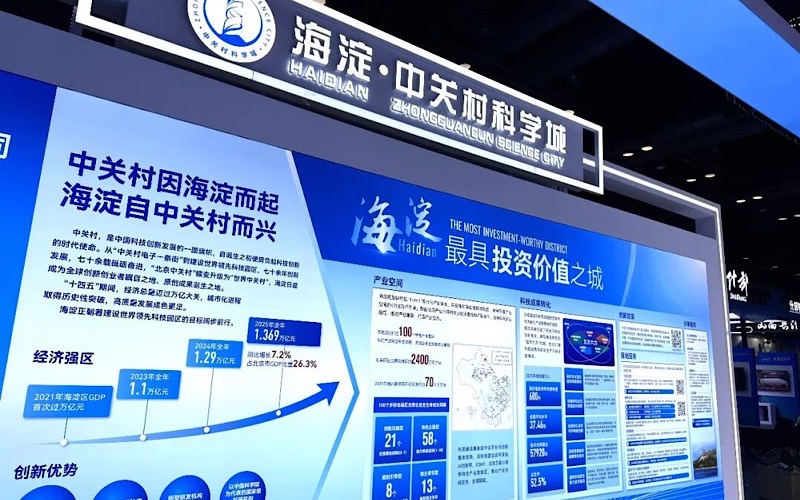
Beyond frontier tech, the Zhongguancun Science City area also includes a technology services section, using data, graphics, and case studies to systematically showcase Haidian’s high-quality innovation ecosystem as a “city of the highest investment value.” From policy support to capital empowerment, incubators to industrial clusters, visitors can get a one-stop understanding of why Haidian consistently leads in China’s tech innovation.
At the Shangdi exhibition area in Phase II, themed “HELLO AI,” visitors are taken on a journey of how this land transformed from farmland into a tech innovation hub. Since the first batch of national high-tech enterprises settled here in 1991, Shangdi has gathered over a thousand such enterprises, hundreds of specialized and new “little giant” firms, and nearly 40 listed companies. The area features a “35-Year Enterprise Logo Wall” and a “Shangdi Imprints” timeline, showcasing names like Baidu, Lenovo, Hanwang, and Didi, all of which started in Shangdi and went global.
Additionally, the area introduces Beijing’s first AI OPC innovation block, based on the concept “One person + AI + Shangdi = Infinite possibilities,” creating an ecological community where large and small enterprises, entrepreneurs, investors, and research institutions can freely interact. The Shangdi Science and Innovation Service Center offers six major services, including one-stop startup services, an AI platform plan, specialized financial services, and overseas expansion support, truly achieving “helping, retaining, and attracting enterprises.”
The Dongsheng exhibition area, themed “Wisdom Ignites the Origin, Defining the Future,” is divided into three core sections: “AI Origin Community,” “Zhongguancun Dongsheng Science Park,” and “Dongsheng Cup International Entrepreneurship Competition.” It systematically presents the full-chain innovation development system of Dongsheng town, from carrier space and resource aggregation to project implementation, fully demonstrating the area’s capacity for science and technology innovation, ecological appeal,