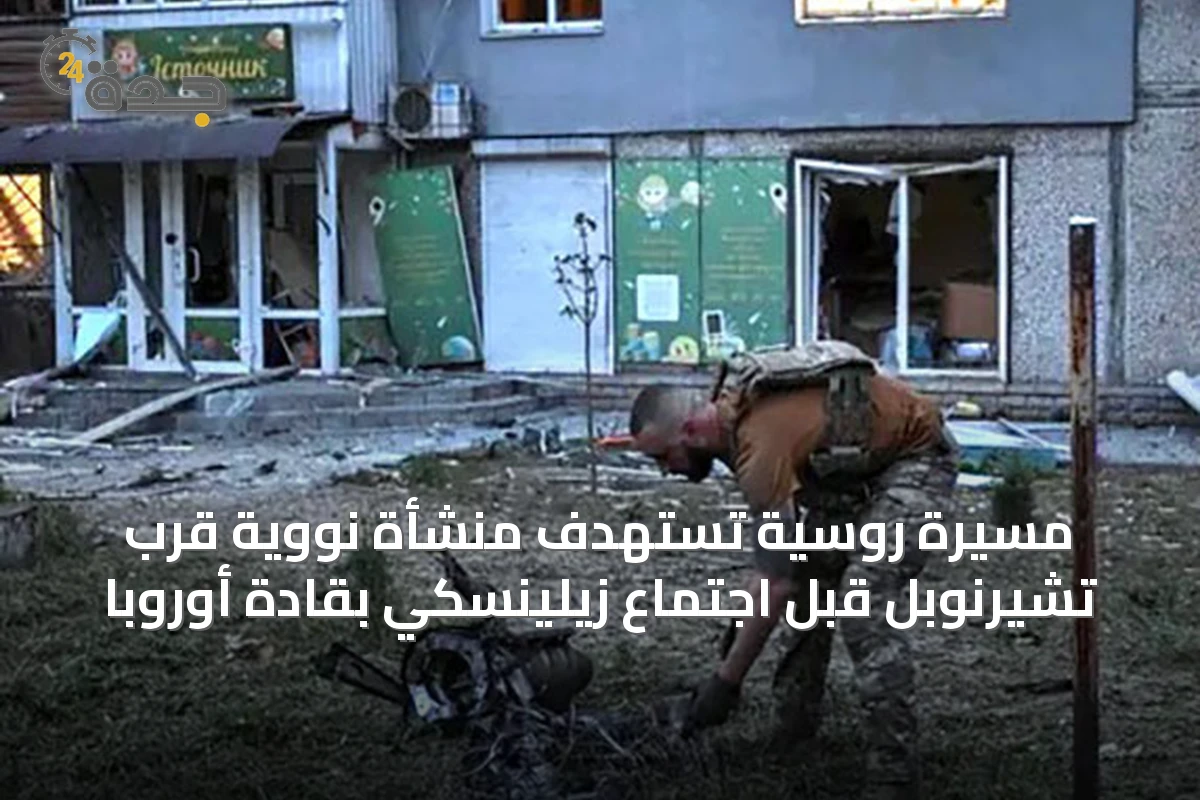
Russian attack on nuclear fuel storage facility near Chernobyl

Kyiv reported that a drone launched by Russian forces struck a facility designed to store spent nuclear waste near the Chernobyl nuclear power plant.

The General Staff and the nuclear agency stated that the explosion did not register any change in radiation levels, and readings remain within normal limits, under continuous monitoring by specialists.

Sources also confirmed no casualties resulted from the attack, and assessment teams continue to inspect damage and verify safety conditions at the site.

Zelenskyy accusations and drone details

President Volodymyr Zelenskyy accused Russia of deliberately targeting the facility, describing the act as “particularly vile,” and confirmed that the drone used was a Shahed-type, striking a building storing spent nuclear fuel within the exclusion zone around Chernobyl.

Other Russian attacks cause deaths in southern and central Ukraine

In a related context, separate Russian strikes resulted in two deaths in southeastern and central Ukraine, according to rescue teams and local authorities.

In the Zaporizhzhia region of southeastern Ukraine, a drone attack killed the driver of a minibus parked at a transfer station, while another man was killed in the Dnipropetrovsk region of central Ukraine due to similar attacks involving drones and airstrikes, according to the local military administration, which also reported another person injured.

Developments before London meeting and Russian response

These military developments come hours before an important political meeting in London, bringing together Zelenskyy with European leaders, including French President Emmanuel Macron, German Chancellor Friedrich Merz, and British Prime Minister Keir Starmer, to discuss ways to achieve a “just and lasting peace” in Ukraine, according to the French presidency.

Meanwhile, the Russian Defense Ministry announced it intercepted 95 Ukrainian drones overnight, describing it as part of a mutual escalation of aerial attacks between both sides.

Chernobyl nuclear power plant

The Chernobyl Nuclear Power Plant, located near the town of Pripyat in northern Ukraine, was the site of the catastrophic 1986 nuclear disaster, the worst in history. An explosion and fire in reactor No. 4 released massive amounts of radioactive material, forcing the evacuation of over 100,000 people and creating an exclusion zone. Today, the plant and its surrounding area remain largely uninhabited, serving as a somber reminder of the risks of nuclear energy and a site for scientific study.

Zaporizhzhia region

The Zaporizhzhia region in southeastern Ukraine is historically significant as the heartland of the Zaporozhian Cossacks, who established a semi-autonomous military state there in the 16th century. The region is also home to the island of Khortytsia, a major cultural and historical reserve, and the Dnipro Hydroelectric Station, a key industrial site. Today, it remains an important industrial and agricultural center, though it has been heavily impacted by the ongoing Russo-Ukrainian war.

Dnipropetrovsk region

The Dnipropetrovsk region, located in central-eastern Ukraine, is a major industrial and cultural hub, historically known as Katerynoslav before being renamed Dnipropetrovsk in 1926 (and later Dnipro for its capital city). Its history dates back to the late 18th century when it was founded by Russian empress Catherine the Great, and it played a key role in the Soviet Union’s industrialization, with the Dnipro River facilitating heavy industry, metallurgy, and space rocket manufacturing. Today, the region remains a vital economic center, though its name was

Chernobyl nuclear power plant

The Chernobyl Nuclear Power Plant, located near the town of Pripyat in northern Ukraine, was the site of a catastrophic nuclear accident on April 26, 1986, when Reactor No. 4 exploded during a safety test, releasing massive amounts of radioactive material. This disaster is considered the worst nuclear accident in history, leading to the evacuation of over 100,000 people and the creation of a 30-kilometer Exclusion Zone. Today, the site is managed as a controlled area for research and tourism, with the reactor covered by the New Safe Confinement structure to prevent further radiation leaks.

Zaporizhzhia region

The Zaporizhzhia region in southeastern Ukraine is historically significant as the heartland of the Zaporozhian Cossacks, who established a semi-independent warrior society on the Dnipro River’s islands in the 16th century. The region’s name derives from the Cossack stronghold “beyond the rapids” (za porohy), and it later became a key industrial and agricultural center, especially after the construction of the Dnipro Hydroelectric Station in the 1930s. Today, Zaporizhzhia is known for its rich cultural heritage and the island of Khortytsia, a national reserve that preserves Cossack history and natural landscapes.

Dnipropetrovsk region

The Dnipropetrovsk region, located in east-central Ukraine, is a major industrial and economic hub centered around the Dnipro River. Historically, it was part of the Zaporozhian Cossack lands and later the Russian Empire, with the city of Dnipro (formerly Dnipropetrovsk) serving as a key center for metallurgy and aerospace manufacturing during the Soviet era. Today, the region remains vital to Ukraine’s economy, known for its heavy industry, agriculture, and cultural heritage.

Pripyat

Pripyat is a ghost city in northern Ukraine, founded in 1970 to house workers of the nearby Chernobyl Nuclear Power Plant. It was evacuated just 36 hours after the catastrophic nuclear disaster on April 26, 1986, and has remained abandoned ever since. Today, it stands as a haunting, time-capsule reminder of the disaster, slowly reclaimed by nature.

Khortytsia

Khortytsia is a large island on the Dnipro River in Ukraine, renowned for its historical significance as a stronghold of the Zaporozhian Cossacks from the 16th to 18th centuries. It served as a key defensive site and a center of Cossack culture and governance, with the famous Zaporozhian Sich once located nearby. Today, the island is a national reserve and museum complex, preserving its natural landscape and the legacy of Cossack history.

Dnipro Hydroelectric Station

The Dnipro Hydroelectric Station (DniproHES) is a major dam and hydroelectric power plant on the Dnipro River in Zaporizhzhia, Ukraine. Construction began in 1927 during the Soviet era, and it was a flagship project of Stalin’s industrialization plan, completed in 1932. During World War II, the station was partially destroyed by retreating Soviet forces, later rebuilt and expanded, and today remains a key part of Ukraine’s energy infrastructure.

Dnipro River

The Dnipro River is one of the longest rivers in Europe, flowing over 2,200 kilometers through Russia, Belarus, and Ukraine before emptying into the Black Sea. Historically, it served as a vital trade route for the Vikings and Kyivan Rus’, linking the Baltic Sea to the Byzantine Empire. Today, it is a central geographic and cultural feature of Ukraine, with the city of Kyiv located along its banks.

London

London is the capital city of England and the United Kingdom, with a history spanning nearly two millennia since its founding by the Romans as Londinium around 43 AD. It has grown from a small settlement into a global hub of finance, culture, and politics, surviving events like the Great Fire of 1666 and the Blitz of World War II. Today, London is renowned for iconic landmarks such as the Tower of London, Buckingham Palace, and the Houses of Parliament, reflecting its rich and layered past.

Related news