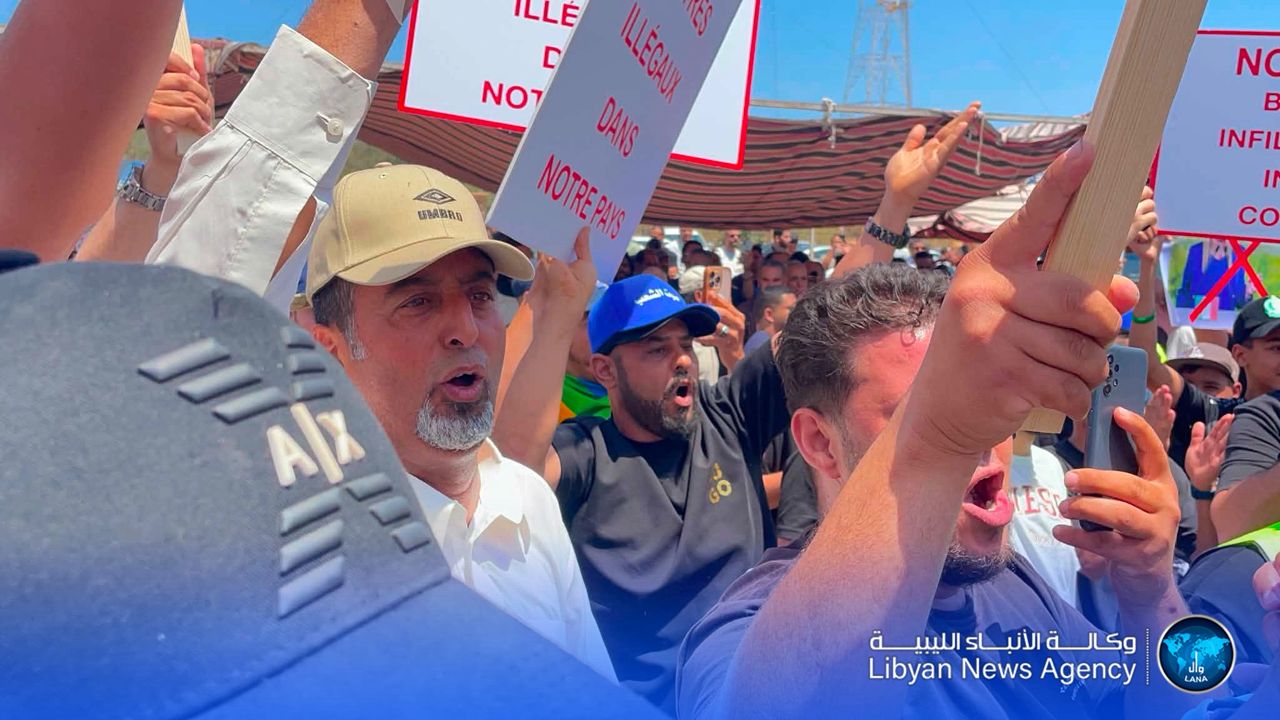
On Thursday, the capital Tripoli witnessed large peaceful demonstrations in which citizens from several Libyan regions and cities participated. The crowds gathered in front of the headquarters of the United Nations High Commissioner for Refugees in the al-Sarraj area, demanding the closure of the office and the cessation of its activities inside the country. They rejected what the protesters described as “settlement projects” and the continued influx of irregular migrants into Libya.
Despite the peaceful nature of the movements, they reflected the growing public concern over the file of irregular migration, which has become one of the most sensitive and controversial issues in Libyan society in recent years, with its security, economic, social, and humanitarian dimensions intertwined.
In the days leading up to the demonstrations, Libyan social media platforms witnessed extensive mobilization campaigns criticizing the performance of the UNHCR, and calling for the rejection of any policies believed to lead to the permanent settlement of migrants inside Libya. These campaigns were accompanied by calls to deport irregular migrants, tighten border controls, and combat human trafficking networks.
One of the main challenges facing decision-makers and researchers in this file is the absence of accurate or even semi-accurate numbers regarding the irregular migrants present in Libya. No official or international body has a full consensus on the scale of the phenomenon, especially since migrants come not only from sub-Saharan African countries but also from various Asian and Arab countries, making it extremely difficult to estimate the true numbers.
The reality remains that Libya is both a destination and a transit country. The Libyan economy, particularly the private sector, has relied for decades on foreign labor in the construction, agriculture, industry, and services sectors. Observers estimate the number of foreign workers residing in Libya legally or in a semi-stable manner to be between 1.2 and 1.5 million workers of multiple nationalities. They live among Libyans and contribute to economic activity, while most transfer part of their income to their families through cross-border financial networks.
However, what is causing concern today is the noticeable increase in the number of irregular migrants who do not intend to settle permanently in Libya but rather seek to raise the necessary funds to continue their journey to Europe. Many of them, especially women, work temporary jobs to pay for the journey that brought them to Tripoli or to gather the required amounts to cross to the northern shore of the Mediterranean.
Simultaneously with the calls to protest, residents of Tripoli and other cities noticed the disappearance of large numbers of irregular migrants from the streets, workplaces, and markets. This caused a state of confusion in some economic activities that rely on this labor. Although the demonstrations took place peacefully, fears remain of possible individual clashes or attempts to exploit this file politically or security-wise, given the state of polarization the country is experiencing.
Among the indicators that sounded the alarm for wide segments of Libyans is the increase in the number of migrant children on the streets of major cities. Daily scenes of young children accompanying women in begging, or selling water and tissues at traffic lights, have become more common than before. Meanwhile, some children aged between 12 and 15 work in various jobs, some of which may be outside legal or regulatory frameworks.
This reality raises serious questions about the future of these children in a few years if they remain outside the educational and rehabilitation system. A number of observers warn that the continuation of this situation could create a fertile environment for exploitation by organized crime networks or local and cross-border armed groups, especially given the fragility of security conditions in some areas.
Another more complex issue also emerges: children born in Libya to migrant families, especially those of unknown parentage or lacking clear documentation. This poses long-term legal, humanitarian, and social challenges related to identity, education, healthcare, and social integration.
In light of these accumulated challenges, it appears that addressing the file cannot be achieved through slogans or security solutions alone. It requires a comprehensive national strategy that combines border control, combating smuggling and human trafficking networks, regulating the labor market, updating rules for registering and counting foreign labor, while enhancing cooperation with countries of origin and transit, and relevant international organizations.
Observers of Libyan affairs believe that Libya, due to its geographical location and economic conditions, will remain part of the regional and international migration equation. However, protecting national sovereignty and maintaining social stability requires managing this file according to a realistic and balanced vision that takes into account national interests on one hand, and humanitarian and legal considerations on the other, before current challenges turn into more complex crises in the future.