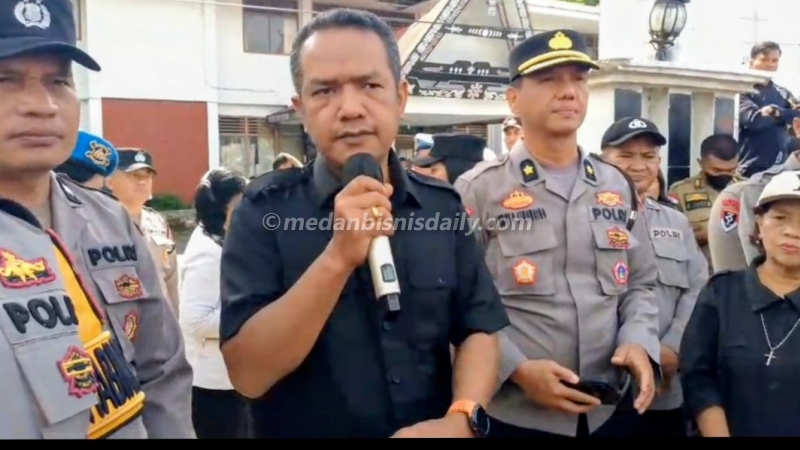
Hundreds of residents, part of the Civil Coalition of Institutions, protested in front of the Dairi Regional House of Representatives office on Jalan Sisingamangaraja, Sidikalang, on Thursday, June 4, 2026, coinciding with World Environment Day.
The action, involving organizations such as Petrasa, the Diakonia Pelangi Kasih Foundation, APUK, GMNI, PMII, and APSS, voiced opposition to the issuance of a new environmental permit for the mining company PT Dairi Prima Mineral.
During the protest, the crowd expressed disappointment because only one of the 35 DPRD members met with them. The demonstrators considered the low attendance of representatives as a lack of attention to community concerns, particularly for residents living near the mining area in Silima Pungga-Pungga District.
Through various speeches, the civil coalition emphasized that Dairi Regency is an earthquake-prone area, making it unsuitable for large-scale mining activities. They also urged the Dairi District Government to maintain Silima Pungga-Pungga District as an agricultural zone, in accordance with Regional Regulation No. 7 of 2014 on the Spatial Planning of Dairi Regency.
“Silima Pungga-Pungga is an agricultural area that must be preserved and should not be converted,” stated Duat Sihombing, a representative of the protest group.
During the demonstration, Dairi DPRD member Hendra J. Sinaga from the Indonesian Solidarity Party faction was the only legislator who directly met with the demonstrators and received their demands.
According to Hendra, receiving and listening to the people’s aspirations is an inherent duty of every council member.
“I represent my colleagues in the DPRD to accept these aspirations. The DPRD is the people’s house, so there is no reason to reject citizens who want to express their opinions,” he said.
Hendra confirmed that all demands presented by the crowd have been recorded and will be forwarded to the DPRD leadership for further discussion.
“I will convey all these aspirations to the leadership so they can serve as material for discussion and joint decisions. If necessary, these aspirations can also be forwarded to the central government,” he said.
Responding to public concerns about mining activities, Hendra considered the residents’ stance reasonable. According to him, various experiences in several regions show that mining activities can cause environmental impacts if not managed properly.
“We cannot ignore that some areas have suffered disasters due to mining activities. Therefore, the community’s concerns must be respected and become a shared concern,” he stated.
However, Hendra also reminded that the region still needs investment to drive economic growth and create jobs. Therefore, he said, a balance is needed between economic development interests and environmental protection.
“Like a lamp, it needs positive and negative poles to shine. The same goes for development. Economic interests and job creation must go hand in hand with efforts to protect the environment and safeguard community farmland. Our challenge is to find a balance point between the two,” Hendra concluded.