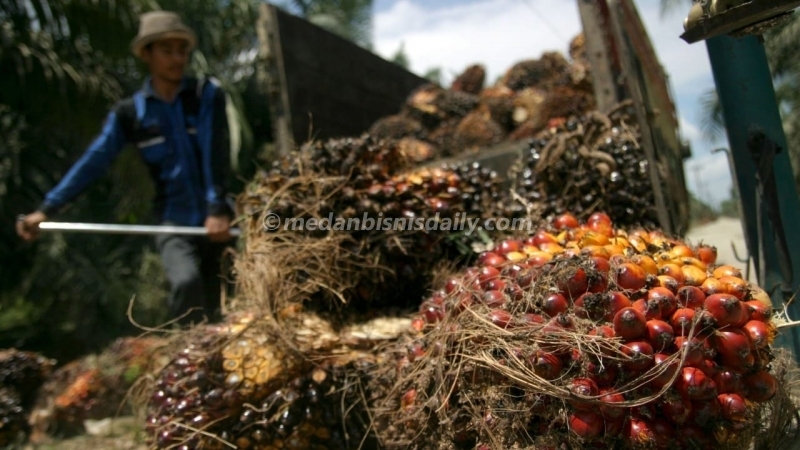
The price of fresh fruit bunches (FFB) of oil palm in producing regions of North Sumatra this week has mostly decreased.
Although the highest price received by farmers in Serdang Bedagai actually rose to IDR 3,950 from the previous IDR 3,340/kg. Meanwhile, the lowest price in Batubara was IDR 2,100/kg, compared to last week’s IDR 3,100/kg.
In detail, the FFB prices in 15 oil palm producing regions of North Sumatra this week are:
1. Langkat IDR 2,455 from the previous IDR 3,155/kg
2. Deli Serdang IDR 2,350 from the previous IDR 3,130/kg
3. Serdang Bedagai IDR 3,950 from the previous IDR 3,280/kg
4. Simalungun IDR 2,225 from the previous IDR 3,025/kg
5. Batubara IDR 2,100 from the previous IDR 3,100/kg
6. Asahan IDR 2,140 from the previous IDR 3,140/kg
7. North Labuhanbatu IDR 2,540 from the previous IDR 3,175/kg
8. Labuhanbatu IDR 2,420 from the previous IDR 3,180/kg
9. South Labuhanbatu remained at IDR 3,120/kg
10. North Padanglawas IDR 2,590 from the previous IDR 3,115/kg
11. Padanglawas IDR 3,130 from the previous IDR 3,340/kg
12. South Tapanuli remained at IDR 3,036/kg
13. Central Tapanuli IDR 2,270 from the previous IDR 3,070/kg
14. Mandailing Natal IDR 3,120 from the previous IDR 3,320/kg
15. Pakpak Bharat IDR 2,500 from the previous IDR 3,000/kg
Meanwhile, the average FFB price in oil palm producing regions of North Sumatra this week ranges from IDR 2,100 to IDR 3,950, compared to last week’s IDR 3,000 to IDR 3,340/kg.
“This week’s prices are quite fluctuating. It is evident from several regions where this week’s prices are below IDR 3,000/kg,” said the Chairman of the North Sumatra Regional Council of the Indonesian Palm Oil Farmers Association (Apkasindo), Gus Dalhari Harahap, on Thursday (June 4, 2026).
Gus said that this week’s prices have seen the most changes after previously being relatively stable despite some declines.
A North Sumatra economic observer, Gunawan Benjamin, said that in the past week of last month, FFB prices began to decline significantly after the government announced the establishment of PT Danantara Sumberdaya Indonesia (DSI).
This decline was not accompanied by a similar correction in world CPO prices. FFB prices plummeted after the government announced that future palm oil exports would be conducted through a single channel via DSI.
Based on direct observations of several oil palm farmers in Langkat Regency, farmers revealed that FFB prices had dropped to as low as IDR 1,800/kg, after previously being stable around IDR 2,800/kg. Currently, prices have started to recover to around IDR 2,200-2,300/kg.
The previous decline in FFB prices was not in line with the decline in CPO prices. Before the announcement of PT DSI, CPO was traded around RM 4,580/ton, then briefly fell to around RM 4,450, and is now sharply higher at around RM 4,677/ton.
“With CPO prices having recovered, even higher than before the introduction of PT DSI, fundamentally, FFB prices should be higher than before PT DSI was introduced to the public. When
Serdang Bedagai
Serdang Bedagai is a regency in North Sumatra, Indonesia, established in 2003 after being split from Deli Serdang. Its history is rooted in the former Serdang Sultanate, a Malay kingdom that flourished in the 17th to 19th centuries, known for trade and cultural heritage. Today, the area is recognized for its natural attractions, such as beaches and waterfalls, as well as its diverse ethnic traditions.
Batubara
Batubara is a regency in North Sumatra, Indonesia, known for its historical role as a major coal mining region during the Dutch colonial era, which gave the area its name (meaning “coal” in Indonesian). Today, it is a center for agriculture, particularly palm oil and rubber, and features cultural sites like the remnants of colonial-era railways and the natural beauty of its coastal areas along the Malacca Strait.
Langkat
Langkat is a regency in North Sumatra, Indonesia, historically known as the site of the powerful Malay Sultanate of Langkat, which thrived in the 19th century due to its lucrative pepper and rubber trade. The region is home to the grand Istana Maimun and the Great Mosque of Azizi, reflecting its royal heritage. Today, Langkat is recognized for its natural attractions, including the Bukit Lawang ecotourism area, which serves as a gateway to the Gunung Leuser National Park and its famous orangutan conservation efforts.
Deli Serdang
Deli Serdang is a regency in North Sumatra, Indonesia, historically connected to the powerful Deli Sultanate, which rose to prominence in the 19th century due to the booming tobacco and rubber trade. The region features a blend of Malay, Batak, and colonial Dutch influences, with notable sites like the Maimun Palace and Great Mosque of Medan reflecting its royal heritage. Today, it serves as a key economic and cultural area surrounding the city of Medan.
Simalungun
Simalungun is a regency in North Sumatra, Indonesia, known for its rich Batak cultural heritage, particularly the Simalungun Batak people. Historically, it was part of the ancient Kingdom of Simalungun, which existed before Dutch colonial rule and was known for its distinct language, traditional houses, and the practice of *mangokal holi* (ancestral bone reburial ceremonies). Today, the area is also recognized for its scenic Lake Toba views and the traditional Simalungun woven cloth, *Ulos*.
Asahan
Asahan is a region in North Sumatra, Indonesia, historically known as the Sultanate of Asahan, a Malay kingdom established in the 17th century. The sultanate played a significant role in the region’s trade and politics until its dissolution after Indonesian independence. Today, the area is recognized for its cultural heritage and the remnants of its royal history, including the former sultan’s palace.
Labuhanbatu
Labuhanbatu is a regency in North Sumatra, Indonesia, historically known as a key port on the eastern coast of Sumatra, facilitating trade and cultural exchange in the region. Its name, meaning “harbor of stones,” reflects its maritime significance and the presence of stone formations along its coastline. Today, the area is recognized for its diverse cultural heritage, including influences from Malay, Batak, and Chinese communities, as well as its natural attractions like beaches and rivers.
Tapanuli
Tapanuli is a region in North Sumatra, Indonesia, historically known for its role in the Batak kingdoms and later as a Dutch colonial administrative area. It encompasses diverse cultures, including the Batak Toba, Angkola, and Mandailing peoples, and is famous for its natural landscapes like Lake Toba. In 2020, the region gained international attention with the discovery of the Tapanuli orangutan, a new great ape species.