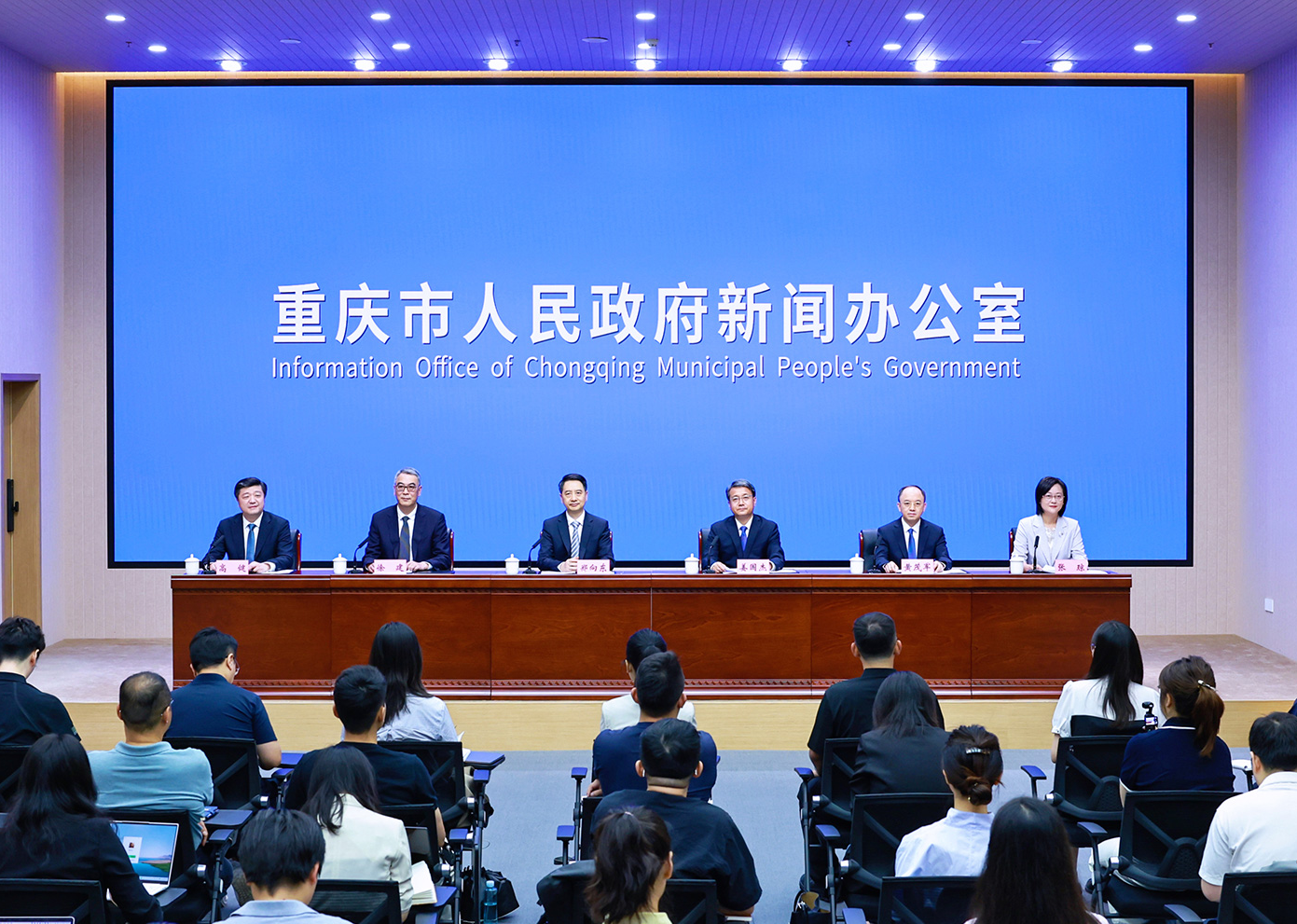
Summary: At 9:30 a.m. on May 27, the Chongqing Municipal Government Information Office held a press conference titled “Starting the 15th Five-Year Plan – Accelerating the Construction of an Important Strategic Support for the New Era Western Development and a Comprehensive Hub for Inland Opening-Up.” Officials introduced the city’s 15th Five-Year Plan outline and answered questions from reporters.
-
09:30:45 Ladies and gentlemen, friends from the media: Good morning! Welcome to the press conference held by the Chongqing Municipal People’s Government Information Office. This year marks the start of the 15th Five-Year Plan and a critical year for high-quality and comprehensive advancement in building a modern new Chongqing. Based on the new development stage, Chongqing closely follows the overall guideline of striving to write a chapter of Chinese-style modernization in Chongqing, focuses on solidifying the “two major positions” and leveraging the “three roles,” deeply advances the construction of the “six districts and one highland,” and has formulated and released the “15th Five-Year Plan Outline for Chongqing’s National Economic and Social Development,” outlining the blueprint for economic and social development over the next five years.
-
09:31:36 In accordance with the unified deployment of the State Council Information Office, we are holding this special press conference today on “Starting the 15th Five-Year Plan” in Chongqing. Centered on the theme of “Accelerating the Construction of an Important Strategic Support for the New Era Western Development and a Comprehensive Hub for Inland Opening-Up,” we will explain the core content of the Outline, introduce the overall thinking, main goals, and key tasks for Chongqing’s economic and social development over the next five years, and also answer questions of concern to our friends in the media.
-
09:32:24 Present at today’s press conference are: Mr. Zheng Xiangdong, Vice Mayor of the Chongqing Municipal People’s Government; Mr. Jiang Guojie, Vice Mayor of the Chongqing Municipal People’s Government; Mr. Xu Jian, Vice Mayor of the Chongqing Municipal People’s Government; Mr. Huang Maojun, Vice Mayor of the Chongqing Municipal People’s Government; and Mr. Gao Jian, Director of the Chongqing Municipal Development and Reform Commission. First, please let Mr. Zheng Xiangdong introduce the relevant situation.
-
09:32:47 Dear friends from the media: Good morning! Thank you all for attending today’s press conference. I am very pleased to introduce the relevant situation of Chongqing’s 15th Five-Year Plan outline.
-
09:33:38 Chongqing is the only municipality directly under the central government in the central and western regions. General Secretary Xi Jinping highly values and has high hopes for it, endowing Chongqing with the “two major positions” of building an important strategic support for the new era western development and a comprehensive hub for inland opening-up. He requires Chongqing to play a supporting role in advancing the new era western development, a driving role in promoting the joint construction of the “Belt and Road,” and a demonstrative role in promoting the green development of the Yangtze River Economic Belt, setting the era coordinates and injecting strong impetus for building a modern new Chongqing.
-
09:34:34 The 15th Five-Year Plan period is a critical stage for the accumulation of strength and overall leap in building a modern new Chongqing. We firmly support the “two establishments” and resolutely achieve the “two safeguards,” always keeping in mind General Secretary Xi Jinping’s earnest instructions. In the process of compiling the 15th Five-Year Plan outline, we closely follow the overall guideline of “striving to write a chapter of Chinese-style modernization in Chongqing,” focus on solidifying the “two major positions” and leveraging the “three roles,” refine the carriers for building the “six districts and one highland,” set 24 indicators in 5 categories, deploy 392 key tasks in 14 aspects, and strive to accelerate the emergence of a vivid picture of high-quality development, high-level opening-up, high-quality life, and high-efficiency governance across the city.
-
09:35:58 First, strive for a new position in the national high-quality development landscape. Through the efforts of the 14th Five-Year Plan, Chongqing has become the first city in the central and western regions with a total economic output exceeding 3 trillion yuan, with a per capita GDP exceeding 100,000 yuan, significantly enhancing its strategic position in the national landscape. Looking towards the 15th Five
Chongqing
Chongqing is a major city in southwestern China known for its dramatic mountainous terrain and status as a key industrial and transportation hub. Historically, it served as the wartime capital of China during the Second Sino-Japanese War (1937–1945) and was a crucial base for the Chinese resistance. Today, it is famous for its spicy hotpot cuisine, vibrant night scenery along the Yangtze and Jialing rivers, and the unique Dazu Rock Carvings, a UNESCO World Heritage site.Belt and Road
The “Belt and Road” is a major global infrastructure and economic development initiative proposed by China in 2013. It consists of the Silk Road Economic Belt and the 21st Century Maritime Silk Road, aiming to enhance regional connectivity, trade, and cultural exchange by reviving ancient trade routes. The initiative draws inspiration from the historical Silk Road, which facilitated commerce and cultural interaction between East and West for centuries.Yangtze River Economic Belt
The Yangtze River Economic Belt is a major regional development strategy in China, encompassing 11 provinces and municipalities along the Yangtze River. It aims to leverage the river’s historical role as a key transportation and economic corridor to promote integrated growth, innovation, and ecological protection. The initiative builds on the river’s millennia-long history as a cradle of Chinese civilization and a vital trade route, with modern efforts focusing on sustainable development and reducing regional disparities.