In early summer, the hinterland of the Wuling Mountains is lush green. Driving along the Chongqing-Hunan Expressway into Xiushan Tujia and Miao Autonomous County in Chongqing, the stilted buildings of Hong’an Border Town line the river, the Three-Province Ethnic Street is bustling with tourists, Tujia brocade workshops are busy with needles and threads, and Miao folk songs echo along the Mei River.
Located at the junction of four provinces (municipalities)—Chongqing, Hunan, Guizhou, and Hubei—Xiushan is home to 31 ethnic groups, including Tujia, Miao, and Han, with ethnic minorities accounting for 59.47% of the total population. Once a remote border area, it is now transforming the inter-provincial fringe into a frontier for ethnic interaction, exchange, integration, co-construction, and shared governance, forging a new path for modernization in ethnic regions through unity, industrial prosperity, and border governance.
Revitalizing Intangible Heritage: From Handicraft Skills to Bonds of Unity
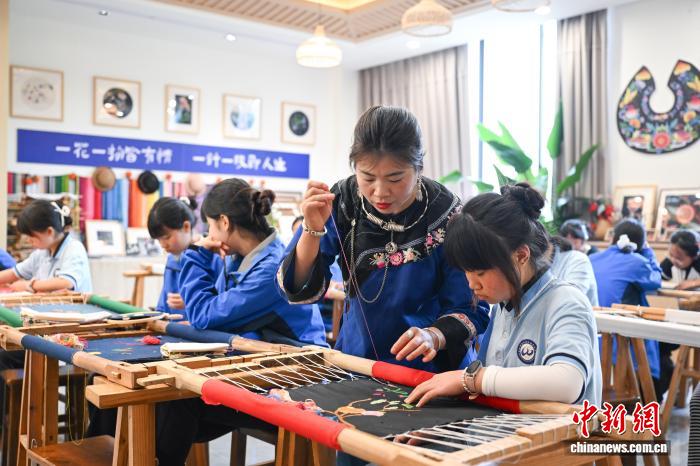
At the intangible cultural heritage creative base of Xiushan Vocational Education Center, 14 heritage skill workshops are lined up. In the Dragon and Phoenix Candle workshop, students mold pink flower candles, carving petals with knives and adding wax stamens. In the Miao Embroidery workshop, embroiderers’ fingers dance, stitching ancient totems thread by thread.
“We rely on a model of ‘heritage + education + research,’ integrating teaching, creative development, and skill experiences. This keeps intangible heritage alive and helps students from various ethnic groups bond through shared learning and creation,” said the base’s head.
Xiushan boasts rich intangible cultural heritage resources, including three national-level representative projects—Xiushan Lantern Festival, Xiushan Folk Songs, and the Miao Sheep and Horse Festival—along with 22 municipal-level and 204 county-level projects. How to turn these “hidden” cultural assets into a glue for ethnic unity? Xiushan’s answer is a two-way empowerment through “heritage + industry + tourism.”
At the “Dragon and Phoenix Flower Sea·Rose Promise” scenic area, the “Kiss of Kinship” pomegranate garden features 56 pomegranate trees, symbolizing “all ethnic groups tightly clustered like pomegranate seeds.” Along the corridor, stories of ethnic unity are illustrated, attracting over 300,000 visits in 2025, 60% of whom were inter-provincial tourists. The Dazhai Village Ethnic Community Awareness Experience Hall includes a “History of Ethnic Groups” exhibit and a “Heritage Experience Zone,” hosting over 150 research groups and 5,000 students annually.
Heritage not only connects emotions but also fills pockets. Xiushan has explored a “heritor + cooperative + e-commerce” model, cultivating six leading heritage enterprises annually and forming a “design-production-sales” chain, employing over 2,000 ethnic minority workers. The Tujia Brocade Workshop received orders for over 5,000 creative shawls in 2025, employing more than 20 Tujia weavers. It has now documented over 100 traditional patterns and trained nearly 200 people, with each weaver earning an average monthly salary of 2,000 to 4,000 yuan.
“I used to think Miao embroidery was just a skill passed down from elders, but now it’s a way to earn money and make friends. Everyone wants to learn,” said a representative inheritor of Xiushan Jinzhu Miao embroidery, a municipal-level intangible cultural heritage project.
On the old street of Hong’an Border Town, where “one foot spans three provinces,” the “Border Town Without Night·Xiushan Has Drama” project began trial operations this Spring Festival, attracting over 500,000 visitors in 12 days, with 42% from outside the province. Xiushan Lantern Festival, Nuo opera, Miao opera, brocade, Miao embroidery, and tie-dye are fused together, allowing Tujia, Miao, and Han tourists to enjoy a show under the same lantern and share a meal of “one pot cooking three provinces.”
“Cultural identity is the deepest form of identity,” said the director of the Xiushan County Ethnic and Religious Affairs Committee. “When people from different ethnic groups naturally interact while embroidering a tapestry, dancing together, or preparing a meal, ethnic unity shifts from
Wuling Mountains
The Wuling Mountains are a mountain range in central China that stretch across parts of Hunan, Hubei, Chongqing, and Guizhou provinces. Known for their dramatic karst landscapes, the range is home to the Wulingyuan Scenic Area, a UNESCO World Heritage site that inspired the floating mountains in the film *Avatar*. Historically, the region has been inhabited by ethnic minority groups such as the Tujia and Miao, and its rugged terrain has long served as a natural barrier and cultural crossroads.
Hong’an Border Town
Hong’an Border Town, located in Hunan Province near the border with Guizhou, is a historic and scenic destination known for its well-preserved ancient architecture and rich cultural heritage. Originally a vital trading post along the southern Silk Road, the town flourished during the Ming and Qing dynasties, serving as a key hub for merchants traveling between the two provinces. Today, its cobblestone streets, traditional stilt houses, and vibrant local customs offer visitors a glimpse into China’s frontier history and the blending of diverse ethnic cultures.
Three-Province Ethnic Street
Three-Province Ethnic Street is a cultural site located at the junction of Yunnan, Sichuan, and Tibet in China, showcasing the diverse traditions of the region’s ethnic minorities, such as the Yi, Tibetan, and Naxi peoples. Historically, it served as a vital stop on the ancient Tea Horse Road, facilitating trade and cultural exchange between these provinces. Today, the street preserves traditional architecture, local crafts, and cuisine, offering visitors a glimpse into the area’s rich multicultural heritage.
Mei River
The Mei River, also known as the Meijiang River, is a significant waterway in southern China, flowing through Jiangxi and Guangdong provinces. Historically, it served as a vital transportation route for trade and cultural exchange, particularly during the Tang and Song dynasties, connecting inland regions to the South China Sea. Today, it is renowned for its scenic beauty and is closely associated with the Hakka people, who settled along its banks and developed a rich cultural heritage.
Xiushan Lantern Festival
The Xiushan Lantern Festival is a vibrant traditional celebration held in Xiushan County, Chongqing, China, known for its elaborate lantern displays and folk performances. With a history spanning over a thousand years, it originated during the Tang Dynasty as a way to pray for good harvests and ward off evil spirits. Today, the festival showcases unique local crafts, such as intricate paper lanterns and dragon dances, reflecting the region’s rich cultural heritage.
Miao Sheep and Horse Festival
The Miao Sheep and Horse Festival is a traditional event celebrated by the Miao ethnic group in China, primarily in Guizhou Province, to honor their ancestors and pray for prosperity. The festival takes its name from the Chinese zodiac signs of the Sheep and Horse, with activities often held on specific days in the lunar calendar. Historically, it has served as a time for communal gatherings, livestock trading, and cultural performances, reflecting the Miao people’s deep connection to nature and agriculture.
Dragon and Phoenix Flower Sea·Rose Promise
Dragon and Phoenix Flower Sea·Rose Promise is a scenic floral park located in China, known for its vast fields of blooming roses and other flowers arranged in dragon and phoenix patterns, symbolizing harmony and prosperity in Chinese culture. The site often hosts romantic events and weddings, drawing on traditional symbolism of the dragon (representing the male) and phoenix (representing the female) to celebrate love and unity. Its design integrates modern horticulture with cultural motifs, making it a popular destination for tourists seeking natural beauty and cultural significance.
Dazhai Village Ethnic Community Awareness Experience Hall
The Dazhai Village Ethnic Community Awareness Experience Hall is a cultural site located in Yunnan Province, China, designed to showcase and preserve the heritage of local ethnic groups, particularly the Yi and Hani peoples. It features interactive exhibits, traditional artifacts, and immersive experiences that highlight the community’s customs, agriculture, and daily life. The hall was established to promote ethnic diversity and sustainable tourism, drawing on Dazhai’s history as a village that has maintained its cultural identity while adapting to modern times.