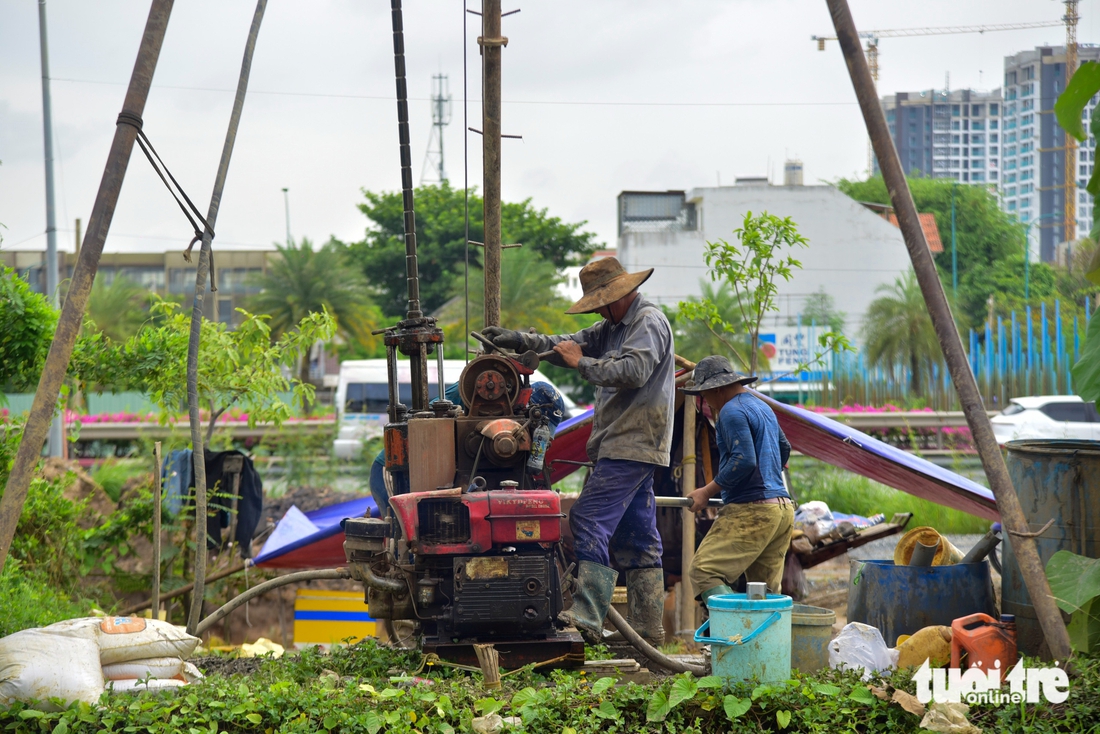
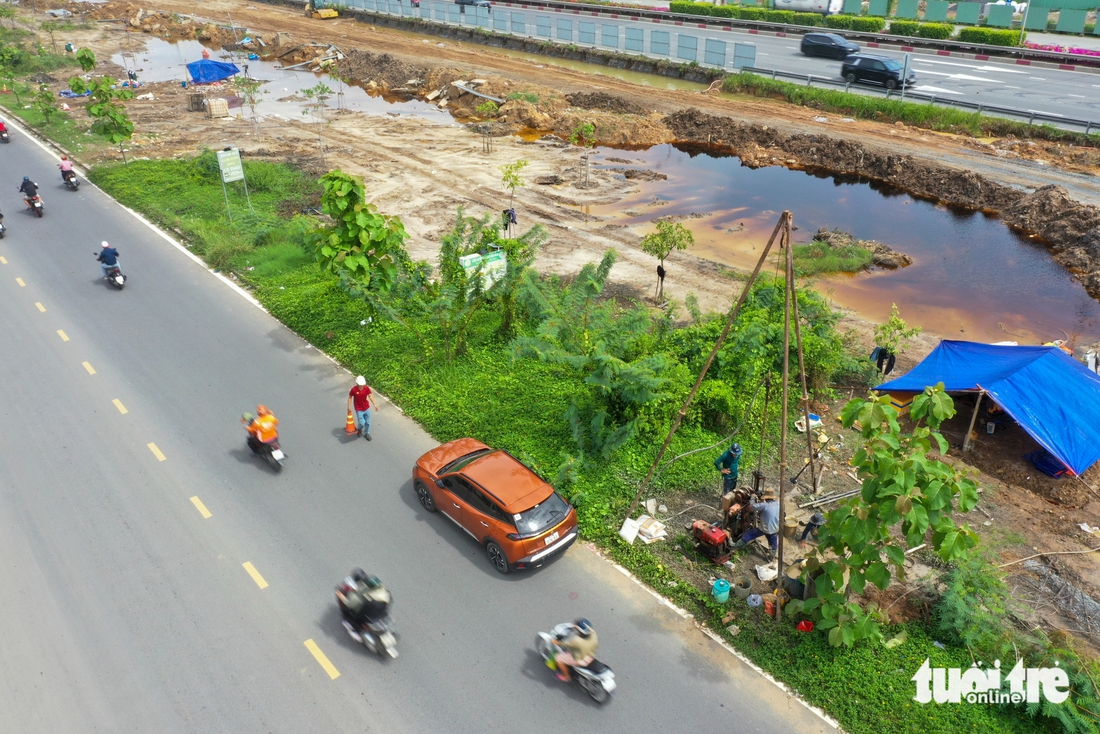
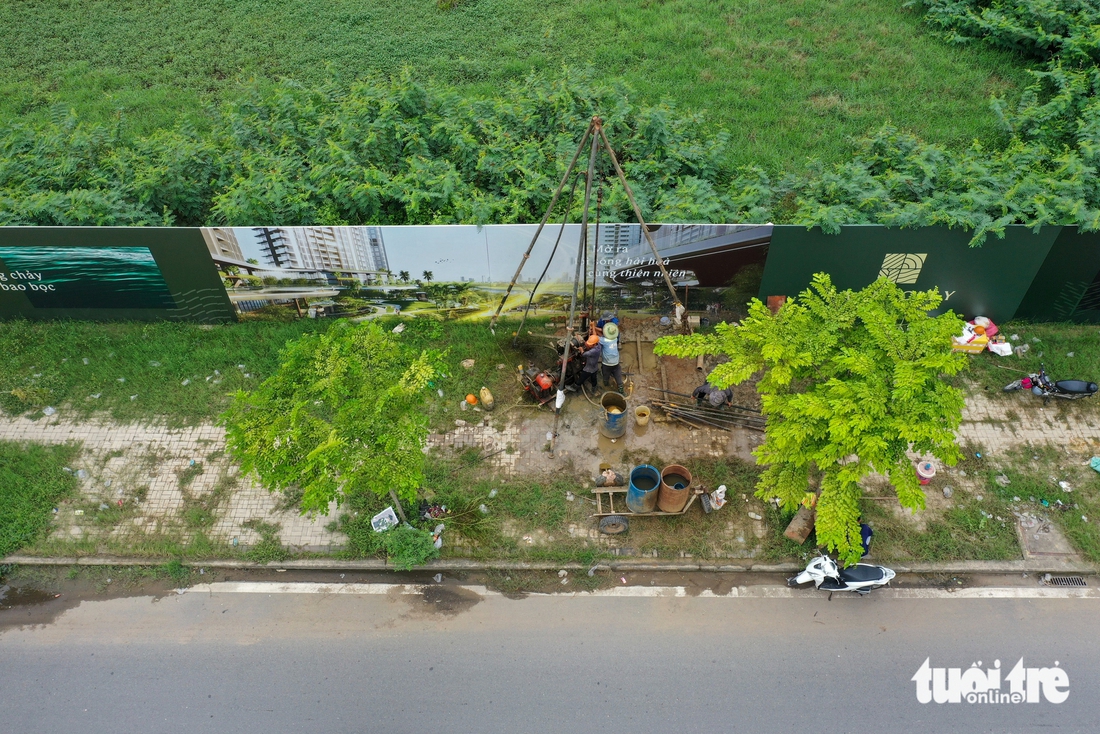
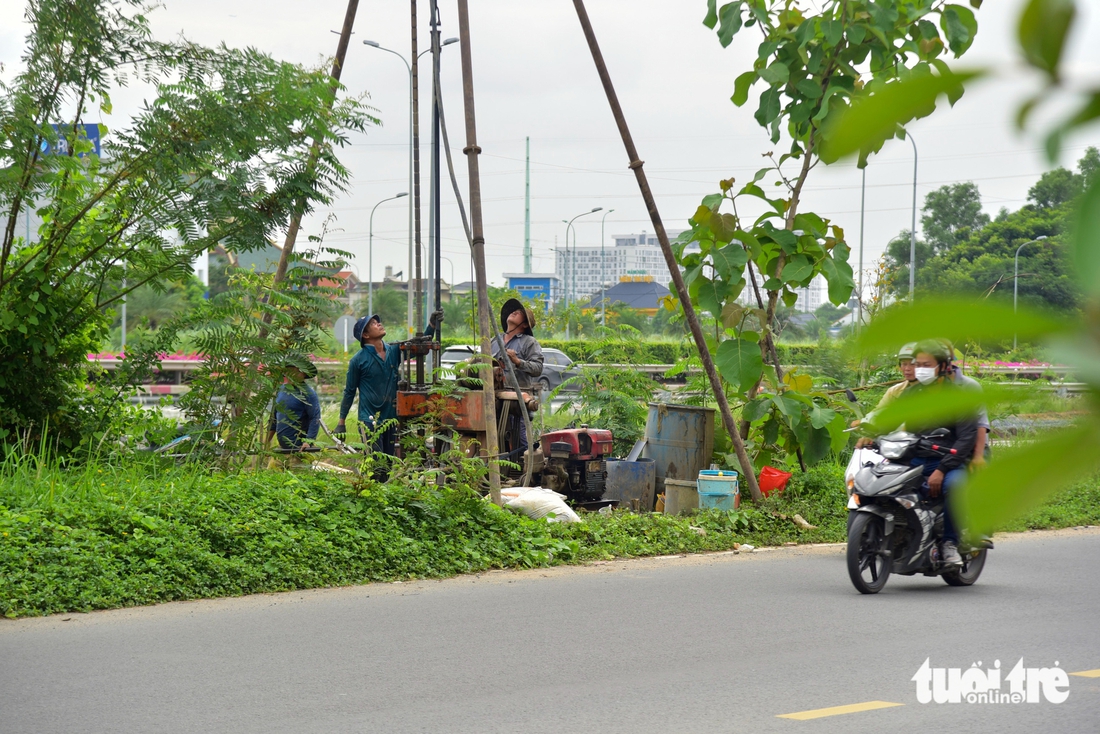
Close-up look at drilling 70-80m deep geological surveys for the Thu Thiem – Long Thanh metro.
These days, many construction teams are urgently drilling geological surveys along the Thu Thiem – Long Thanh metro route, laying the groundwork for design work and project implementation in the coming period.
On Song Hanh Street, Binh Trung Ward, Ho Chi Minh City, the construction unit is urgently drilling geological surveys along the route.
Drilling rigs are being deployed to collect soil and rock samples for studying the geological conditions of the area the route passes through.
A representative of the construction unit stated that geological surveying is one of the first but crucial stages.
Soil and rock samples taken from various depths will help determine the stratigraphic structure, assess the bearing capacity of the ground, and serve as a basis for the design and construction of the Thu Thiem – Long Thanh metro line.
According to the construction unit, each borehole has a depth of 70-80 meters and takes 2-3 days to complete, ensuring a full assessment of geological conditions along the route.
The Thu Thiem – Long Thanh metro line is 48 km long and plays a vital role in connecting Ho Chi Minh City center with Dong Nai Province and Long Thanh Airport. Currently, Dai Quang Minh Real Estate Investment Joint Stock Company is the investor assigned to prepare the feasibility study report.
Images of geological survey drilling to prepare for the Thu Thiem – Long Thanh metro:
According to the construction unit, each borehole is 70-80 meters deep and takes 2-3 days to ensure a full assessment of geological conditions along the route.Geological survey drilling is one of the important steps in construction.This is the basis for determining the stratigraphic structure, assessing the bearing capacity of the ground, and serving as a foundation for the design and construction of the Thu Thiem – Long Thanh metro line.The Thu Thiem – Long Thanh railway project is about 47.7 km long, of which the section through Ho Chi Minh City is 11.5 km and through Dong Nai is 36.2 km. The line is planned to have 19 stations, including 2 underground stations and 17 elevated stations.<img alt="Thu Thiem – Long Thanh metro – Image 6." data-original="https://cdn2
Thu Thiem
Thu Thiem is a rapidly developing urban area located in District 2, Ho Chi Minh City, Vietnam, situated along the Saigon River. Historically, it was a rural district known for its orchards and agricultural land, but in the early 21st century, it was designated as a key part of the city’s master plan for a new financial and commercial hub. Today, it is undergoing massive transformation with modern high-rise buildings, luxury residences, and infrastructure projects, symbolizing Ho Chi Minh City’s economic growth and modernization.
Long Thanh
Long Thanh is a district in Dong Nai Province, southern Vietnam, historically known for its role in the Vietnam War as the site of the Long Thanh Base, a major logistics hub for the U.S. Army. Today, it is primarily an agricultural area, renowned for its durian and other fruit orchards, and is also the location of the planned Long Thanh International Airport, which aims to become Vietnam’s largest airport.
Song Hanh Street
Song Hanh Street is a notable thoroughfare located in Ho Chi Minh City, Vietnam, known for its vibrant local commerce and residential areas. While not a major historical landmark, the street reflects the rapid urbanization and development of the city’s suburban districts, particularly since the late 20th century. Its name, “Song Hanh,” translates to “parallel,” often referencing its alignment with other key roads in the area.
Ho Chi Minh City
Ho Chi Minh City, formerly known as Saigon, is Vietnam’s largest city and economic hub. It played a pivotal role during the Vietnam War, serving as the capital of South Vietnam until the fall of Saigon in 1975. Today, it blends historic French colonial architecture with modern skyscrapers, reflecting its dynamic past and rapid development.
Dong Nai Province
Dong Nai Province, located in southern Vietnam, is a historically significant region that played a key role during the country’s development and the Vietnam War. It was once part of the ancient kingdom of Champa and later became a major agricultural and industrial hub under French colonial rule. Today, it is known for its economic growth, natural attractions like Cat Tien National Park, and cultural sites such as the Buu Long Pagoda.
Long Thanh Airport
Long Thanh Airport is a major international airport currently under construction in Dong Nai Province, Vietnam, intended to relieve overcrowding at Tan Son Nhat Airport in Ho Chi Minh City. Approved in 2015 with a projected cost of over $16 billion, it is designed to eventually handle 100 million passengers annually, with its first phase expected to open around 2026. The airport is named after the Long Thanh district and is a key infrastructure project to boost Vietnam’s economic growth and regional connectivity.