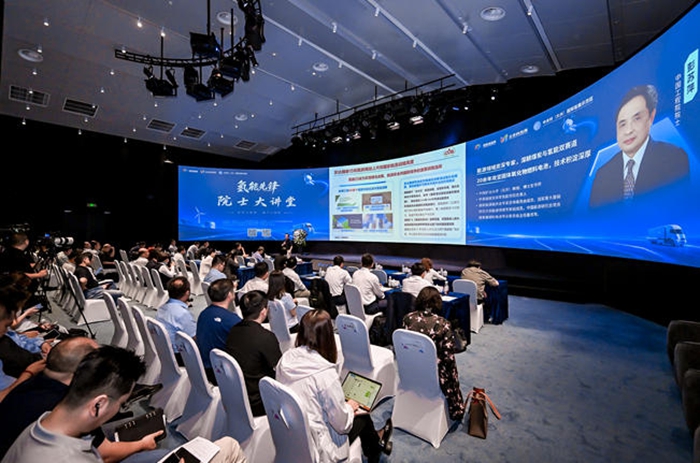
On June 3, the first session of the “Hydrogen Pioneer · Academician Lecture Hall” was held at the Zhongguancun (Daxing) International Hydrogen Energy Demonstration Zone. The event focused on empowering the hydrogen energy real economy and connecting high-level think tank resources. Peng Suping, an academician of the Chinese Academy of Engineering, was invited to give a special lecture. Leaders from the Daxing District, the Beijing Municipal Human Resources and Social Security Bureau, the Municipal Science and Technology Commission, the Zhongguancun Management Committee, and heads of various local departments, along with park enterprises, financial institutions, and industry representatives, gathered together.
During the event, Wang Ye, Secretary of the Party Leadership Group and Director of the Daxing District Economic and Information Technology Bureau, highlighted the advantages of Daxing’s full-chain hydrogen energy industry cluster. He elaborated on the district’s development plans to leverage the demonstration zone as a platform for hydrogen innovation, promote the industrialization of green hydrogen, and improve the supporting industrial ecosystem. He provided guidance for the development of park enterprises from three aspects: policy implementation, resource allocation, and scenario piloting.
In the keynote sharing session, Academician Peng Suping focused on the development direction of the hydrogen energy industry during the “15th Five-Year Plan” period. He conducted an in-depth analysis of the pan-hydrogen industry layout and key technologies for SOFC and SOEC energy conversion. Combining domestic and international industry data and technology iteration status, he outlined the development logic of the pan-hydrogen system composed of hydrogen, ammonia, and methanol. He compared the maturity and application prospects of multiple electrolytic hydrogen production technology routes, including ALK, PEM, and SOEC, explaining that SOEC is a key technological path for large-scale green hydrogen production and peak shaving in new power systems. At the same time, based on the country’s resource endowments, he analyzed feasible routes for coupling coal-based raw materials with high-temperature fuel cells. He provided top-level ideas and implementation suggestions for common industry challenges such as high costs, lack of standards, and slow application deployment.
In the roundtable forum, heads of four enterprises—Beijing Hydrogen Ring Energy, Hydrogen Puchuang Energy, Haideliz, and Jing Hydrogen Power—raised questions based on their own operational realities. The topics included gaps in standards for blending hydrogen into natural gas and long implementation cycles, the cost of green methanol and the transfer of western industries, pathways for hydrogenation in inland waterway shipping and spatial bottlenecks on ships, the cost advantages and scaling difficulties of biomass hydrogen production, the choice of application scenarios for SOFC and high-temperature proton exchange membrane fuel cells, and the high cost of SOFC and routes for cost reduction.
Academician Peng Suping provided solutions and insights from multiple perspectives, including industrial collaboration, market layout, and differentiated competition. Questions raised by participants were also collected on-site, covering weak links in SOFC materials and system integration, the application prospects of SOEC in metallurgy and chemical coupling, and investment directions for SOFC/SOEC. This facilitated precise alignment between cutting-edge research and industrial practice.
The event used the academician think tank as a bridge to precisely break down information barriers among policy, research, and industry sectors. Leveraging Daxing’s complete hydrogen energy industry chain ecosystem, it implemented an innovative exchange model of “academician diagnosis + enterprise practice + park empowerment.”
A responsible official from the Daxing District stated that the Zhongguancun (Daxing) International Hydrogen Energy Demonstration Zone, as a core platform for Beijing’s hydrogen energy industry, has built an industrial cluster covering the entire chain of production, storage, transportation, refueling, and utilization. The zone will continue to operate the “Hydrogen Pioneer · Academician Lecture Hall” series of activities, leveraging academician resources to accelerate the demonstration and implementation of cutting-edge technologies within the park. By collaborating with enterprises, research institutes, and financial resources, the zone will facilitate technology piloting, project incubation, and scenario piloting, continuously outputting replicable and scalable models for hydrogen energy industry implementation, supporting the high-quality development of the hydrogen energy industry in Beijing and across the country.