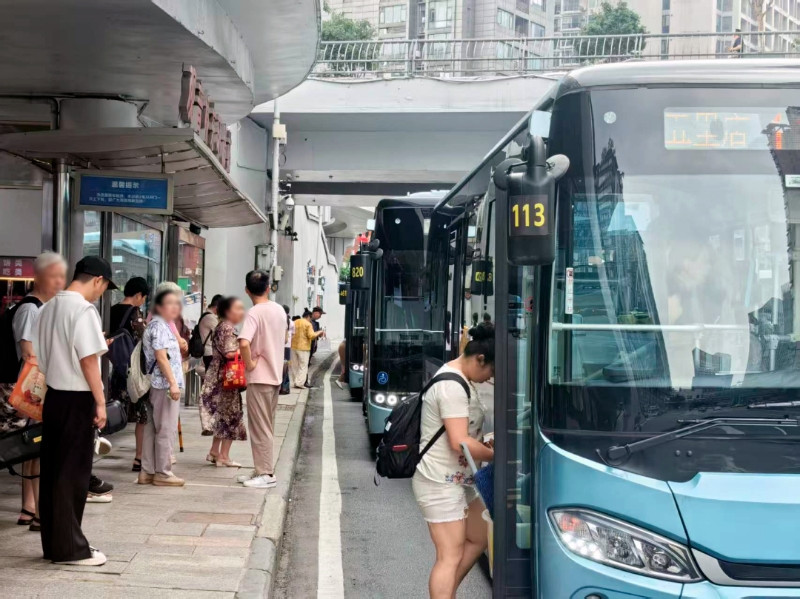
When buses arrive at a stop, can’t see the route number of the vehicle behind? Chongqing has a convenient measure! On May 28, Chongqing Public Transport Operation Company under Chongqing Transport Development and Investment Group announced that the “flexible ear sign” service now covers 578 bus routes, achieving large-scale implementation.
What is an “ear sign”? It is a prominent identifier on the right rearview mirror of the vehicle, displaying the corresponding route number. This helps passengers quickly identify the route they need when multiple buses arrive at the stop in sequence, further improving boarding efficiency.
Currently, Chongqing public transport has installed “ear signs” on 7,206 buses, covering a total of 578 routes. Among these, there are 6,364 “flexible ear signs” and 842 “electronic ear signs,” with vehicle installation coverage nearing 93%.
The “flexible ear signs” support quick replacement of route numbers, solving issues with cross-line dispatch vehicles and mismatched ear sign information. The “electronic ear signs” are installed on new buses, featuring high-brightness LED displays that remain clearly visible at night and in rain or fog.
What changes have occurred after the installation of ear signs? According to measurements at Huangnibang Station, after the ear signs were put into use, the average vehicle dwell time was reduced from 75.22 seconds to 59.67 seconds, improving vehicle entry and exit efficiency and making travel more convenient for citizens.
The public transport operation company will continue to optimize services with attention to detail, actively adopt suggestions from citizens, and make bus travel more convenient and warm.
Chongqing
Chongqing is a major city in southwestern China, known for its dramatic mountainous landscape and role as a key industrial and transportation hub. Historically, it served as the wartime capital of the Republic of China during the Second Sino-Japanese War (1937–1945) and has since grown into a modern metropolis. Today, it is famous for its spicy hotpot cuisine, the Yangtze River cruise, and its unique blend of ancient and contemporary culture.
Huangnibang Station
Huangnibang Station is a historic railway station located in the city of Zhangjiajie, Hunan Province, China. Originally built in the 1970s as part of the Jiaozuo–Liuzhou Railway, it played a key role in transporting goods and passengers through the mountainous region. The station is notable for its classic architecture and scenic surroundings, serving as a gateway for travelers visiting the nearby Wulingyuan Scenic Area.
Chongqing
Chongqing is a major city in southwestern China, known for its hilly terrain and strategic location at the confluence of the Yangtze and Jialing rivers. Historically, it served as the provisional capital of the Republic of China during the Second Sino-Japanese War (1937–1945) and has since grown into a key industrial and economic hub. Today, it is famous for its spicy cuisine, particularly hotpot, and its futuristic skyline lit by countless bridges and skyscrapers.
<div class="my-4 p-4 rounded-lg shadow-md bg-blue-50 border-l-4
Chongqing
Chongqing is a major city in southwestern China, known for its mountainous terrain and strategic location at the confluence of the Yangtze and Jialing rivers. Historically, it served as the provisional capital of China during the Second Sino-Japanese War (1937–1945) and has since developed into a key economic and transportation hub. Today, it is famous for its spicy hotpot cuisine, futuristic skyline, and the UNESCO-listed Dazu Rock Carvings nearby.
Huangnibang Station
Huangnibang Station is a historic railway station in China, originally built as part of the Peking–Hankou Railway in the early 20th century. It served as a key stop for transporting goods and passengers through the region, reflecting the expansion of rail infrastructure during the late Qing Dynasty. Today, the station stands as a preserved cultural site, offering insight into China’s railway heritage and early industrial development.
Yangtze River
The Yangtze River is the longest river in Asia and the third-longest in the world, flowing over 6,300 kilometers through China. Its basin has been the cradle of Chinese civilization for thousands of years, with early settlements and the development of rice agriculture dating back to the Neolithic period. Historically, it served as a vital transportation route and cultural boundary, and it remains central to China’s economy and ecology today.
Jialing River
The Jialing River is a major tributary of the Yangtze River in southwestern China, flowing through the provinces of Gansu, Shaanxi, and Sichuan before joining the Yangtze in Chongqing. Historically, it has been a vital transportation and trade route for centuries, linking the fertile Sichuan Basin with central China. Its name, meaning “good mausoleum,” is thought to reference the river’s association with ancient imperial tombs along its banks.
Wulingyuan Scenic Area
Wulingyuan Scenic Area, located in Hunan Province, China, is a UNESCO World Heritage Site renowned for its dramatic landscape of over 3,000 quartzite sandstone pillars, peaks, ravines, and gorges. Its history dates back millions of years through geological formation, and it has been a source of inspiration for Chinese art and literature for centuries, most famously serving as the visual inspiration for the floating mountains in the film *Avatar*. The area was officially designated as a scenic and historic interest zone in 1988, protecting its unique natural beauty and rich biodiversity.
Jiaozuo–Liuzhou Railway
The Jiaozuo–Liuzhou Railway is a major north-south railway line in China, connecting Jiaozuo in Henan Province to Liuzhou in Guangxi. Its construction began in the 1960s and was completed in stages, playing a strategic role in regional development and resource transport, particularly for coal from Shanxi and Henan. Today, it remains an important artery for freight and passenger traffic in central and southern China.
Chongqing Transport Development and Investment Group
The Chongqing Transport Development and Investment Group is a state-owned enterprise in China responsible for the planning, construction, and management of transportation infrastructure in the Chongqing region. Established in the early 2000s, it has played a key role in modernizing the city’s road networks, bridges, and public transit systems, supporting Chongqing’s rapid urban expansion and its role as a major economic hub in southwestern China.
Chongqing Public Transport Operation Company
The Chongqing Public Transport Operation Company is a key municipal enterprise responsible for managing the city’s extensive bus and public transit network. Established in the mid-20th century, it has played a vital role in supporting Chongqing’s rapid urbanization and unique mountainous geography, evolving from basic bus routes to a modern, integrated system. Today, it operates thousands of vehicles, connecting residents and visitors across the city’s challenging terrain.