Why Meguro River and Kanda River Suddenly Reached “Level 4” — But Don’t Overflow? The Mechanism Explained
[Video] Typhoon No. 6: Rivers swell across Tokyo, with Level 4 warnings for Meguro River and Kanda River. *Filmed with safety precautions.
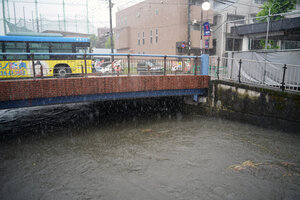
On the morning of the 3rd, as Typhoon No. 6 approached the Kanto region, multiple rivers including the Meguro River and Kanda River issued Level 4 flood risk warnings. Level 4 is the second highest in a five-tier danger scale, corresponding to the threshold for local governments to issue evacuation orders. With the rainy season beginning, such warnings may be announced frequently. What is the urban river disaster prevention system, and how should we respond?
From around 7 a.m. on the 3rd, Level 4 warnings were issued for the Zenpukuji River, the Nogawa and Sengawa rivers in various areas, the Meguro River flowing through Meguro Ward, and the Kanda River. In the three hours up to that morning, record June rainfall of 105.0 mm in one area and 79.0 mm in another was observed. The heavy rain in a short period caused river levels to rise sharply.
Level 4 indicates a dangerous situation where flooding could occur at any time, while Level 5 means water has already overflowed or is imminent, threatening nearby residential areas.
Based on past flood cases, each river observation point has set water level criteria for determining warning levels. The government and prefectures combine actual and predicted water levels to issue warnings.
According to Tokyo authorities, rivers flowing between buildings and residential areas in the city center differ from rivers with embankments and stepped cross-sections. They are surrounded by vertical walls, limiting river width and making water levels rise uniformly.
Given the rapid rise in water levels, warnings are only issued at Level 4 or 5, so Levels 1 to 3 are not typically announced.
Key is the “Regulation Pond”
However, the authorities noted that even if water levels rise…
Meguro River
The Meguro River in Tokyo is a popular cherry blossom viewing spot, lined with over 800 cherry trees that create a stunning tunnel of pink blooms in spring. Historically, the river was a key waterway during the Edo period, used for transportation and irrigation. Today, it is a vibrant urban destination, especially during the annual Meguro River Cherry Blossom Festival.
Kanda River
The Kanda River is a 24.6-kilometer waterway in Tokyo, Japan, that historically served as a vital transportation and flood control route. Originating in the Musashino Plateau, it was a key feature of the city’s Edo-period development, with its banks lined with samurai residences and merchant districts. Today, the river is known for its cherry blossom trees and passes near cultural landmarks like Yushima Shrine and Akihabara.
Zenpukuji River
The Zenpukuji River is a small urban river flowing through Tokyo, Japan, known for its scenic cherry blossom-lined banks. Historically, it was once a natural waterway that played a role in local irrigation, but it has since been largely developed and channelized for flood control. Today, it serves as a popular spot for walking and seasonal hanami (flower viewing) in neighborhoods like Suginami and Setagaya.
Nogawa
Nogawa is a historic district located in the city of Inagi, Tokyo, Japan. It is known for the Nogawa Park, which features the ruins of a 7th-century Buddhist temple, as well as a preserved section of the ancient Tama River terrace. The area’s history dates back to the Kofun period, with archaeological findings indicating early settlement and religious activity in the region.
Sengawa
Sengawa is a neighborhood in Chofu, Tokyo, situated along the banks of the Sengawa River. Historically, it developed as a residential area during the post-war period, with the Sengawa River playing a key role in local agriculture and flood management. Today, it is known for its quiet, family-friendly atmosphere and the Sengawa Shopping Street, which preserves a nostalgic Showa-era charm.
Tokyo
Tokyo, the capital of Japan, was originally a small fishing village named Edo before becoming the seat of the Tokugawa shogunate in the early 17th century. It was renamed Tokyo (“Eastern Capital”) in 1868 when the imperial court moved from Kyoto, marking the start of Japan’s rapid modernization. Today, Tokyo is a sprawling metropolis blending cutting-edge technology with historic temples and neighborhoods, reflecting its rich evolution from a feudal stronghold to a global cultural and economic hub.