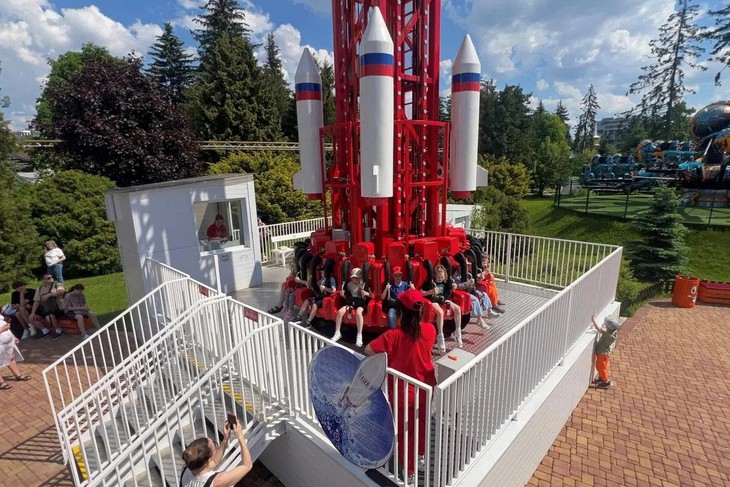
An amusement park in Russia has sparked controversy by naming a thrill ride ‘Oreshnik’ – the same name as a hypersonic missile capable of carrying a nuclear warhead.
According to Reuters, an amusement park in St. Petersburg, Russia, is drawing attention by naming one of its thrill rides “Oreshnik.” This is the name of a hypersonic missile capable of carrying nuclear warheads that Moscow is using in the conflict in Ukraine.
The ride is shaped like a large rocket. When in operation, visitors are repeatedly lifted high and then suddenly dropped at high speed, creating a breathless sensation for participants.
Immediately, this move by the park’s management faced mixed opinions from local public opinion.
Sharing with Reuters, a female visitor expressed confusion: “I don’t think this name is appropriate. Calling it ‘Rocket’ would be better… I don’t understand what this ride has to do with Oreshnik, who came up with that name?”
A man also agreed: “A children’s amusement park should have a name suitable for children, that’s my personal opinion.”
Oreshnik is a Russian hypersonic missile with a range of over 5,000 km. Moscow first launched this type of missile into Ukraine in 2024 and most recently in May of this year.
Russian President Vladimir Putin has stated that current air defense systems “cannot intercept” Oreshnik due to its speed, reportedly more than 10 times the speed of sound. However, Western military experts remain skeptical of this claim.
Previously, on May 4, Putin stated that the recent launches in Ukraine were not actual combat use, but only testing to observe the results.
The Russian President said the results from these tests will be the basis for Moscow to decide on the full deployment of this weapon in the future, including targeting urban areas.
On the morning of May 24, Ukraine’s capital Kiev suffered a large-scale attack with missiles and drones from Russia, shortly after the Ukrainian Air Force warned that Moscow could launch the Oreshnik hypersonic ballistic missile.