The Jakarta government has launched the ‘Five Centuries of Jakarta’ Health Initiative, featuring free cleft lip and palate surgical programs across two different hospitals.
Jakarta’s Assistant for People’s Welfare stated that the program has been ongoing since last year. For the current period, it is being conducted at Tebet Regional Public Hospital and Cempaka Putih Regional Public Hospital.
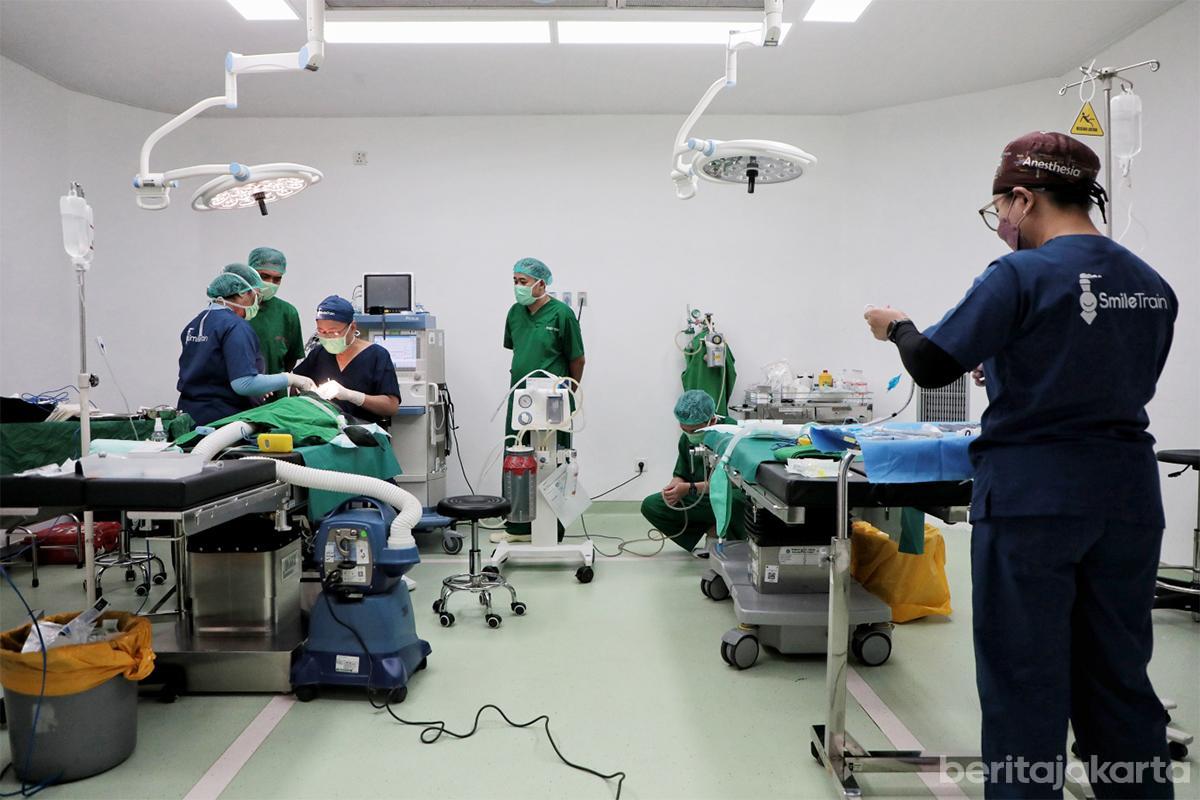
“We chose Type C and D hospitals to bring healthcare services closer to the community and make them more accessible. This policy reaffirms that quality healthcare is not exclusively available at Type A and B hospitals,” he said while observing the cleft lip surgeries at Tebet Hospital, South Jakarta, Wednesday.
He clarified that despite the program primarily targets Jakarta ID holders, the governor is also welcoming those from other regions to apply.
“We’re reaching out to any families or friends who have relatives with cleft lips in need of plastic surgery to join this program,” he added.
He added the program is provided free of charge, involving medical specialists who have extensive experience in handling thousands of similar cases.
“The target is to serve 500 patients through this surgical program by 2027,” he revealed.
He emphasized that the surgery is vital, not only for the patients’ physical health—such as enhancing speech capabilities and improving dietary habits for a healthier lifestyle—but also for its profound impact on psychosocial aspects.
“As patients reach adulthood and interact within society, this condition often leads to feelings of insecurity. Hence, community support is essential to reassure those who are hesitant or anxious, encouraging them to participate in this program,” he explained.
He specified that 13 patients are being treated at Tebet Hospital and 17 at Cempaka Putih Hospital, bringing the total number of participants to 30.
With the furthest participant originating from Papua Province, this initiative proves to be inclusive of all Indonesians of all ages, spanning from infants to adults.
“Typically, patients are discharged directly after their surgical procedures,” he explained.
A hospital director further explained that out of the 30 initial applicants, some were unable to proceed with surgery at this time. The screening process identified issues like insufficient weight or fevers, requiring their operations to be rescheduled.
“Because this program is ongoing for a year, we’ll keep spreading the word through social media and local clinics at the neighborhood level so that we can reach as many people as possible,” she said.
In the meantime, a parent named Mini conveyed her appreciation for the support provided, as her two-year-old son, Faris, underwent a complimentary cleft lip surgery.
“This marks the second time he has received treatment. He will be eligible for a follow-up procedure at the age of seven. I hope for continued support in the future so my son can reach a full recovery comparable to his peers,” she concluded.