What is the truth about the delay in the Senegal national team’s flight to the United States?
The Senegalese Football Federation denied reports in local and regional media that the delay of the national team’s flight to the United States was related to a contractual dispute with national coach Pape Thiaw, confirming that logistical reasons involving flight permits and travel visas were behind the delay.
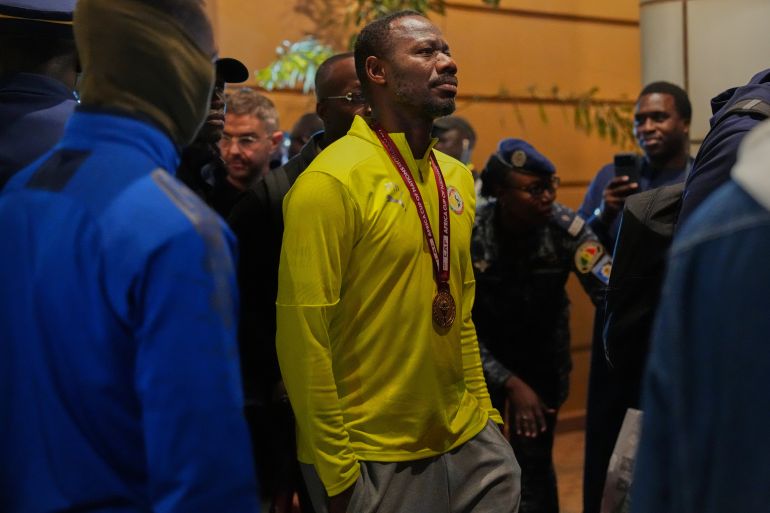
The Senegal team faced a delay of about eight hours before their plane took off from the capital Dakar last Wednesday evening, with the flight finally departing at 11 p.m. local time.
The Senegalese Federation issued a statement saying it wanted to “clarify the facts in the face of misleading information circulated by some media,” denying that Pape Thiaw had refused to accompany the delegation. However, it acknowledged that contract negotiations with the coach are still ongoing.
In contrast, multiple Senegalese sources indicated that Thiaw initially declined to travel with the team until he received guarantees about his contractual status, as his contract ended in February 2026 and he had been working without a formal contract or set salary for more than three months.
The Senegalese Federation denied that Pape Thiaw had refused to accompany the delegation.
Tense context before the World Cup
These developments did not come out of nowhere. The Senegalese Federation found itself in a highly sensitive position ahead of the 2026 World Cup, following the controversy sparked by the team during the 2025 final against Morocco.
In the 83rd minute of that final, Pape Thiaw ordered the players to leave the field in protest of refereeing decisions, before the players returned to the pitch about seventeen minutes later after intervention by the star. The match ended with Morocco winning the cup with a decisive goal in extra time, but the African Football Confederation (CAF) later ruled to strip Senegal of the title and award it to Morocco with a 3-0 score, based on Article 82 of its regulations regarding leaving the field. Thiaw was also suspended for five official matches and fined one hundred thousand dollars, while the Senegalese Federation continues its appeal process before the Court of Arbitration for Sport (CAS).
Thiaw had taken over coaching the “Lions of Teranga” in December 2024, succeeding the previous coach.
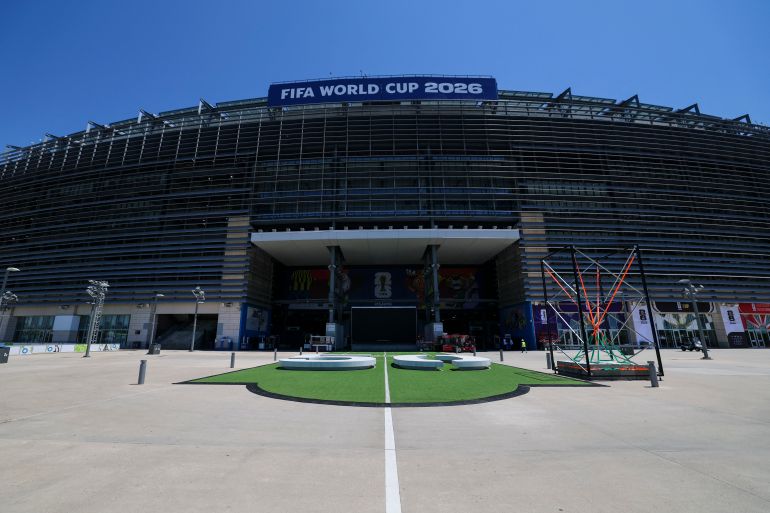
MetLife Stadium in New Jersey will host Senegal’s first match against France.
The American agenda
The Senegalese team’s visit to the United States includes a friendly match against the host U.S. team, scheduled for today, Sunday, at Bank of America Stadium in Charlotte, North Carolina, as part of both teams’ preparations for the World Cup.
Senegal will participate in the 2026 tournament in Group Nine, which includes France, Norway, and Iraq. Senegal’s group stage matches begin on June 16 against France at MetLife Stadium in New Jersey, followed by a match against Norway on June 22 at the same stadium, and concluding the group with a match against Iraq on June 26 at BMO Field in Toronto.
Stade de France
The Stade de France is a national stadium located in Saint-Denis, a suburb of Paris, built for the 1998 FIFA World Cup and inaugurated on January 28, 1998. It was constructed on the site of a former gasworks and has since hosted major sporting events, including the 2007 Rugby World Cup final and the 2024 Summer Olympics opening and closing ceremonies. With a capacity of over 80,000, it serves as the home stadium for the French national football and rugby teams.
Dakar
Dakar is the capital and largest city of Senegal, located on the Cap-Vert peninsula, the westernmost point of mainland Africa. Originally a small fishing village, it developed into a major colonial port under French rule in the 19th century and became the capital of the French West Africa federation. Today, Dakar is a vibrant cultural and economic hub, known for its dynamic music scene, the iconic African Renaissance Monument, and historic sites like Gorée Island, a former slave trade outpost.
Bank of America Stadium
Bank of America Stadium is a multi-purpose football stadium located in Charlotte, North Carolina, serving as the home of the NFL’s Carolina Panthers since its opening in 1996. Originally known as Ericsson Stadium, it was renamed in 2004 after Bank of America purchased the naming rights. The stadium has hosted numerous major events, including the 2019 NFL Draft and several ACC college football championships.
MetLife Stadium
MetLife Stadium is a modern, multi-purpose sports and entertainment venue located in East Rutherford, New Jersey, that opened in 2010. It serves as the home stadium for both the New York Giants and the New York Jets of the National Football League, replacing the adjacent Giants Stadium. The facility has hosted major events, including Super Bowl XLVIII in 2014, making it one of the few stadiums to host a Super Bowl in a cold-weather climate.
BMO Field
BMO Field is a multi-purpose stadium located in Toronto, Ontario, Canada, primarily used for soccer and Canadian football. Originally built in 2007 on the site of the former Exhibition Stadium, it serves as the home of Toronto FC (Major League Soccer) and the Toronto Argonauts (Canadian Football League). The stadium has undergone several expansions to increase its seating capacity and hosted major events, including matches during the 2015 FIFA Women’s World Cup and the 2026 FIFA World Cup.
Toronto
Toronto is the capital city of the province of Ontario and the largest city in Canada, located on the northwestern shore of Lake Ontario. Originally established as the colonial town of York in 1793, it was renamed Toronto in 1834 and grew rapidly as a major hub for trade, immigration, and industry. Today, it is a vibrant, multicultural metropolis known for its iconic CN Tower, diverse neighborhoods, and significant cultural institutions.
New Jersey
New Jersey, one of the original thirteen American colonies, played a pivotal role in the Revolutionary War with key battles like the crossing of the Delaware and the Battle of Trenton. It later became a hub of industrialization during the 19th and 20th centuries, known for its manufacturing, chemical production, and as a major transportation corridor. Today, New Jersey is a diverse state blending historic sites, bustling cities, and scenic shorelines.
Charlotte
Charlotte is the largest city in North Carolina, known as a major financial hub and home to the second-largest banking center in the United States. Originally settled by European colonists in the mid-18th century, it played a role in the American Revolution and later became a key railroad and cotton-trading center. Today, Charlotte is a vibrant, modern metropolis with a rich cultural scene, including museums, sports teams, and a growing food and music culture.