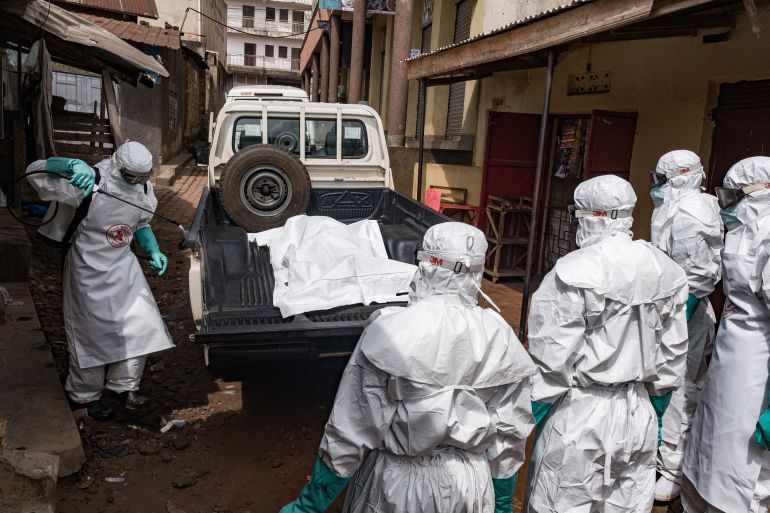
The Ebola outbreak, declared in mid-month, continues to claim more lives in the Democratic Republic of Congo, the epicenter of the outbreak, and neighboring Uganda.

The Director General of the Centers for Disease Control and Prevention in Africa, Jean Kaseya, emphasized in an opinion piece published on Sunday, “We must move at the pace of the outbreak.”

Last week, the Director General of the World Health Organization, Tedros Adhanom Ghebreyesus, warned that the Democratic Republic of Congo faces a “very serious and complex” Ebola outbreak, urging neighboring countries to act “immediately.”

Medical officials and aid workers say they lack even basic supplies like masks after the virus spread for weeks undetected.

The outbreak, which causes severe hemorrhagic fever, was declared on May 15 in Ituri province in northeastern Democratic Republic of Congo (with a population of over 100 million), one of the world’s poorest countries.
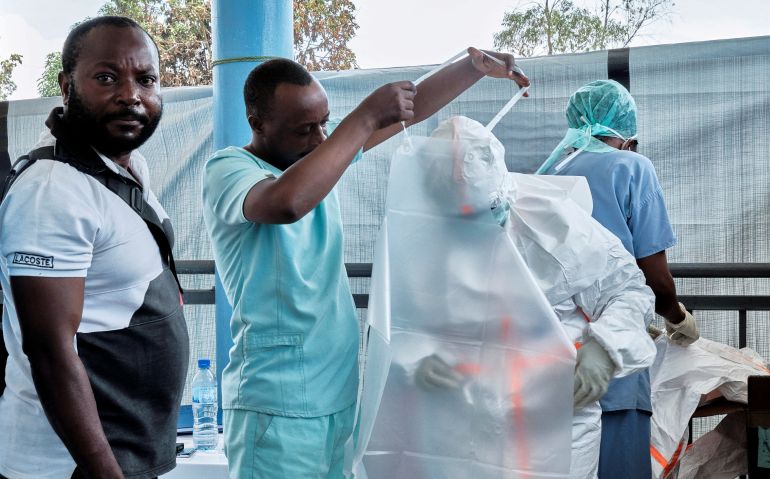
FILE PHOTO: Medical team from the Alliance for International Medical Action (ALIMA), an international NGO dress up in personal protective equipment (PPE) as they set up a treatment centre for the Ebola response, as agencies intensify efforts to contain a new Ebola outbreak caused by the Bundibugyo virus strain, in Rwampara outside Bunia, Ituri province, Democratic Republic of Congo, May 29, 2026. REUTERS/Gradel Muyisa Mumbere/File Photo
After the Ebola outbreak, the WHO declared a public health emergency of international concern, but the true scale of the outbreak remains unknown.

What are the latest statistics?

Kaseya revealed in his article that 263 confirmed infections and 43 deaths from Ebola have been recorded in the Democratic Republic of Congo as of Saturday.

He said the number of suspected cases in both countries exceeds 1,100, with their status being verified, stressing the need to quickly activate national emergency systems and ensure continued investment in epidemic preparedness.

Kaseya had reported last Thursday that the number of suspected fever cases exceeded 1,077, with 246 deaths.

Key information about the disease?

Ebola first appeared in 1976. It is a deadly viral disease transmitted through direct contact with body fluids, believed to have spread to humans from bats. The virus can cause severe bleeding and organ failure.

The last Ebola outbreak in the Democratic Republic of Congo occurred in August 2025, killing at least 34 people before being contained in December 2025.

About 2,300 people died out of 3,500 infected in the deadliest outbreak in the DRC between 2018 and 2020.

According to the World Health Organization, there are three different types of viruses that cause Ebola disease on a large scale:

  • Ebola virus.
  • Sudan virus (no vaccine available).
  • Bundibugyo virus (currently spreading, no vaccine available).

Although licensed vaccines and treatments exist for Ebola, there is no approved vaccine or treatment for the Sudan virus and Bundibugyo virus. Experimental products are being developed rapidly to combat them, according to the WHO.

Early supportive care, including rehydration and symptom treatment, can improve survival chances, and seeking early care can save lives.

Why is it difficult to contain?

The answer lies in three factors, according to experts:

  • A viral strain with no licensed vaccine.
  • A conflict and mining environment with high population mobility.
  • A detection gap spanning three weeks before diagnosis confirmation.

Is it confined to the DRC and Uganda?

Following the Ebola outbreak, the WHO declared a public health emergency of international concern, but the actual size of the outbreak remains unknown. International health authorities suggest current numbers are lower than reality.

Yesterday, Brazilian authorities isolated two men
Democratic Republic of Congo

The Democratic Republic of the Congo (DRC) is a vast Central African nation with a complex history, once ruled as a brutal private colony of King Leopold II of Belgium before becoming a Belgian colony and gaining independence in 1960. Its rich cultural heritage is reflected in diverse ethnic groups, music, and art, though the country has faced decades of political instability, conflict, and humanitarian challenges. Notable sites include Virunga National Park, home to endangered mountain gorillas, and the vibrant capital city of Kinshasa, a hub of music and dance.

Uganda

Uganda, often called the “Pearl of Africa,” is a landlocked country in East Africa known for its diverse wildlife and landscapes, including Lake Victoria and the source of the Nile River. Its history includes ancient kingdoms, British colonial rule from the late 19th century, and independence in 1962, followed by periods of political turmoil under leaders like Idi Amin. Today, Uganda is a vibrant nation celebrated for its cultural heritage, gorilla trekking, and efforts toward recovery and development.

Ituri province

Ituri Province, located in northeastern Democratic Republic of the Congo, is known for its rich biodiversity, including the vast Ituri Rainforest and the Okapi Wildlife Reserve, a UNESCO World Heritage site. Historically, the region has been inhabited by various ethnic groups, such as the Mbuti (pygmy) people, and was part of the larger Congo Free State under King Leopold II’s brutal colonial rule. In recent decades, Ituri has experienced severe ethnic conflicts and violence, particularly from 1999 to 2003, which have deeply impacted its communities and cultural heritage.

Bunia

Bunia is a city in the Democratic Republic of the Congo, located in the Ituri Province near the Ugandan border. Historically, it served as a key administrative and commercial center under Belgian colonial rule, and later became a focal point of conflict during the Second Congo War and the Ituri conflict in the early 2000s. Today, it remains an important hub for trade and humanitarian efforts in the region.

Rwampara

Rwampara is a region in southwestern Uganda, historically part of the ancient Ankole kingdom. It is known for its rolling hills and agricultural significance, particularly in cattle farming. The area holds cultural importance for the Banyankole people, with traditions tied to the former kingdom’s pastoralist heritage.

Brazil

Brazil is the largest country in South America, known for its vibrant culture, diverse ecosystems, and iconic landmarks like the Amazon Rainforest and Christ the Redeemer statue. Originally inhabited by indigenous peoples, it was colonized by Portugal in 1500 and became a major hub for sugar and gold production before gaining independence in 1822. Today, Brazil is celebrated for its lively festivals, such as Carnival, and its rich blend of African, European, and Indigenous influences.