Asset polarization and consumption trends: Decoding the K in the economy.
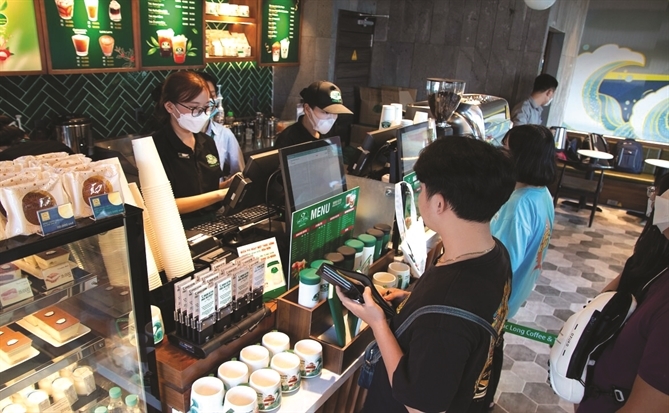
At the end of March, in a café on Le Duan Street, a consultant talked about the house he is building in Ho Chi Minh City, the result of stock market profits from 2025. He frankly admitted to being somewhat lucky to work in the financial sector, with income and opportunities better than average.
In a different context, at a small office in Xuan Hoa Ward, Ho Chi Minh City, colleagues were discussing cutting expenses and managing to balance their finances in the current situation.
This story represents two coexisting financial states: one side still has room to accumulate assets and actively spends, contributing to economic growth, while the other is forced to cut spending and adopt a defensive stance. A typical slice of the K-shaped economy, where opportunities and pressures are increasingly polarized.
The wealth effect
 |
The term “K-shaped economy” became popular after the COVID-19 pandemic to describe divergent economic paths, with one branch going upward for high-income groups and another going downward for the rest of society.
In the United States, data from Moody’s Analytics indicates a stark reality: the economy is polarizing in a K-shaped pattern. Thanks to the “wealth effect,” the richest 10% have sharply increased spending, accounting for over 45% of total consumption. The remaining 60% of households are under heavy pressure from inflation and record-level debt.
Looking back at the domestic market, this story partly reflects slices of the wealth effect. In 2025 alone, the VN-Index rose more than 40%, but the market’s growth was concentrated in a small group of stocks. Even investment funds were left behind the overall market’s rise, as the top 10 stock funds with the highest performance in 2025 ranged only from 17.2% to 36.8%.
In Vietnam, the K-shaped economy is not just a macroeconomic theory but the essence of an uneven recovery. A senior lecturer at the Fulbright School of Public Policy and Management describes the upward branch as including export-oriented sectors, public investment, and tourism, while the downward branch includes domestic consumer goods production. Weak domestic purchasing power, coupled with competitive pressure from Chinese imports, is making retail and domestic production businesses struggle.
Consumption polarization
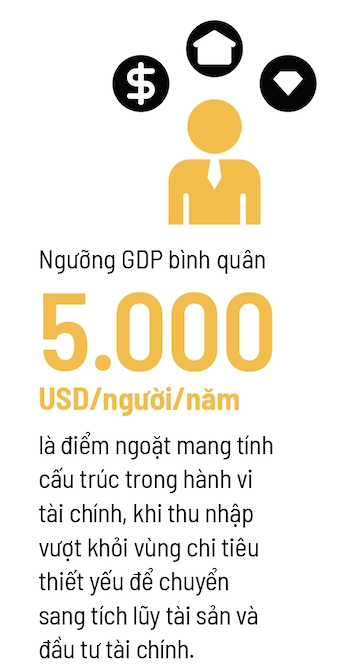
A report on Vietnam Consumer Trends 2026 by Cimigo indicates that Vietnam’s GDP per capita reached about $4,900 in 2025, but consumer behavior is increasingly resembling much more mature markets. Vietnamese consumers are still spending, but more cautiously, expecting higher value and accepting less risk or poor experiences than before. Despite efforts to control inflation, pressure from exchange rates and fluctuations in imported raw material prices is directly eroding the disposable income of low- and middle-income households.
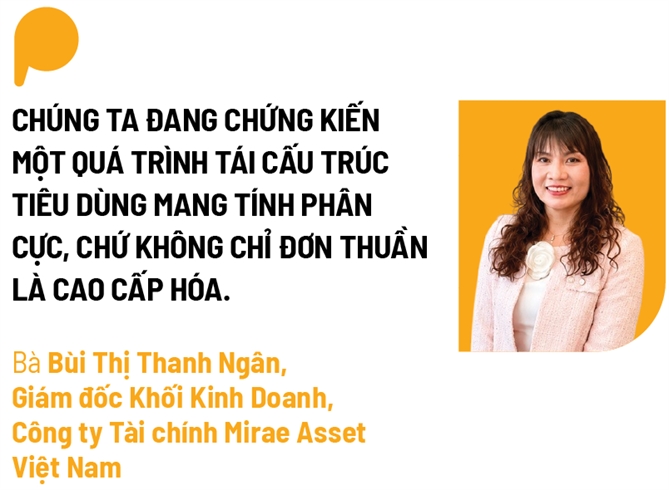
Analyzing the shift in consumption trends in Vietnam, a Director of Business at Mirae Asset Finance Vietnam commented: “We are witnessing a polarized consumption restructuring process, not just a simple upscaling. Consumers increasingly prioritize ‘less but high quality,’ reducing spending on short-term common products to focus on areas with long-term value such as education, healthcare, real estate, and high-end goods.”
 |
She predicts that within the next 5-10 years, the domestic economy is likely to stratify clearly, with one side being a booming high-end market and the other being a mass market that must adapt through business model innovation and technology application to maintain competitiveness.
This is both an opportunity and a challenge for businesses and policymakers. The high-end segment will likely expand strongly, driving the development of supply chains, after-sales services, and quality standardization. Mass-market sectors will be forced to restructure, focusing on sustainable value and experience to retain customers.
In