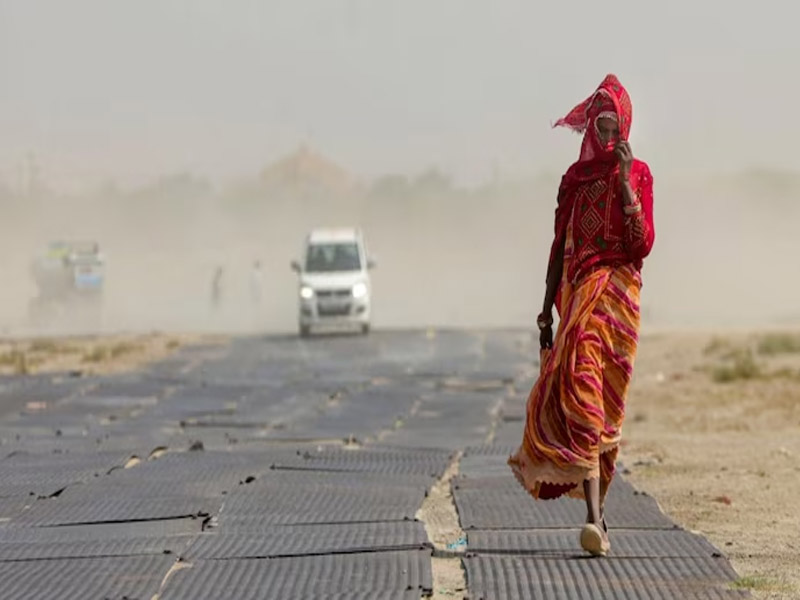
Sriganganagar in Rajasthan became the hottest place in the world on Wednesday, with a temperature of 48.2 degrees Celsius. The city has turned into the hottest location on the planet.
A severe heatwave continued across northwestern India on Wednesday as well. Several cities in Rajasthan, Haryana, and Delhi experienced intense heatwave conditions.
Meteorologists attribute this phenomenon to the geographical location. Dry desert winds and atmospheric conditions are responsible for it. Located in northern Rajasthan near the India-Pakistan border, Ganganagar lies on the edge of the Thar Desert. Intense heatwaves in late May rapidly increase the desert temperature.
Sriganganagar
Sriganganagar is a planned city located in the northern Indian state of Rajasthan, established in the early 20th century as part of the Gang Canal project to irrigate the arid Thar Desert region. Founded by Maharaja Ganga Singh of Bikaner, the city’s development was driven by the canal system that transformed the area into a major agricultural hub. Today, it is known for its vibrant Sikh and Hindu communities, as well as its role in producing crops like wheat, cotton, and mustard.
Rajasthan
Rajasthan, located in northwestern India, is a state renowned for its vibrant culture, majestic forts, and arid desert landscapes. Historically, it was the land of the Rajput kingdoms, known for their fierce warrior traditions and opulent palaces, with cities like Jaipur, Udaipur, and Jodhpur serving as royal capitals. Today, it remains a top tourist destination, offering a glimpse into India’s regal past through its architecture, festivals, and colorful traditions.
Haryana
Haryana is a state in northern India with a rich history dating back to the Vedic period, as it is traditionally considered the birthplace of the ancient Indian epic, the Mahabharata. It was formed as a separate state in 1966, carved out of the former state of Punjab, and is known for its vibrant cultural heritage, including folk music, dance, and festivals. Today, Haryana is a major agricultural and industrial hub, with its capital, Chandigarh, shared with the neighboring state of Punjab.
Delhi
Delhi, the capital of India, is a historic city that has been continuously inhabited for over two millennia, serving as the capital of several ancient and medieval empires, including the Delhi Sultanate and the Mughal Empire. It is renowned for its rich cultural heritage, featuring landmarks such as the Red Fort, Qutub Minar, and Humayun’s Tomb, alongside modern government buildings. Today, Delhi is a bustling metropolis that blends its ancient history with contemporary urban life, reflecting India’s diverse traditions and rapid development.
Thar Desert
The Thar Desert, also known as the Great Indian Desert, is a vast arid region spanning northwestern India and eastern Pakistan. Its history includes being part of the ancient Indus Valley Civilization, with settlements like Mohenjo-daro nearby, and later serving as a crossroads for trade routes and various empires. Today, it is known for its unique culture, sand dunes, and wildlife, including the endangered Indian bustard.
<div class="my-4 p-4
Sriganganagar
Sriganganagar is a planned city in the northern Indian state of Rajasthan, located near the border with Pakistan. Founded in the early 20th century by the Maharaja of Bikaner, Ganga Singh, it was developed as a major agricultural hub after the construction of the Gang Canal (now Indira Gandhi Canal) brought water to the arid region. Today, it is known for its thriving farming community, producing crops like wheat, cotton, and mustard, and features notable sites such as the historic Sriganganagar Fort and the scenic Suratgarh Super Thermal Power Station.
Rajasthan
Rajasthan, located in northwestern India, is a state renowned for its vibrant culture, majestic palaces, and vast Thar Desert. Its history is marked by the rise of powerful Rajput kingdoms between the 6th and 12th centuries, which resisted Mughal expansion while later forging alliances through marriage and tribute. Today, its fortified cities like Jaipur, Jodhpur, and Udaipur preserve this rich heritage as popular tourist destinations.
Haryana
Haryana is a state in northern India with a rich history dating back to the Vedic period, as it is believed to be the land where the ancient epic of the Mahabharata was composed. It was formed on November 1, 1966, after the partition of the former state of Punjab, with Chandigarh serving as its capital. Today, Haryana is known for its agricultural productivity, vibrant folk culture, and significant role in India’s industrial and economic development.
Delhi
Delhi, the capital of India, is a historic city that has been continuously inhabited for over two millennia, serving as the seat of power for numerous empires, including the Delhi Sultanate, the Mughal Empire, and British India. Its rich past is reflected in iconic landmarks such as the Red Fort, Qutub Minar, and Humayun’s Tomb, which blend Persian, Islamic, and Hindu architectural styles. Today, Delhi is a bustling metropolis where ancient traditions coexist with modern urban life.
Thar Desert
The Thar Desert, also known as the Great Indian Desert, is a vast arid region spanning northwestern India and southeastern Pakistan. Its history includes being part of the ancient Indus Valley Civilization, with settlements like Mohenjo-Daro near its edges, and later serving as a crossroads for trade routes and empires. Today, it is known for its unique sand dunes, vibrant culture, and wildlife such as the Indian bustard.