)
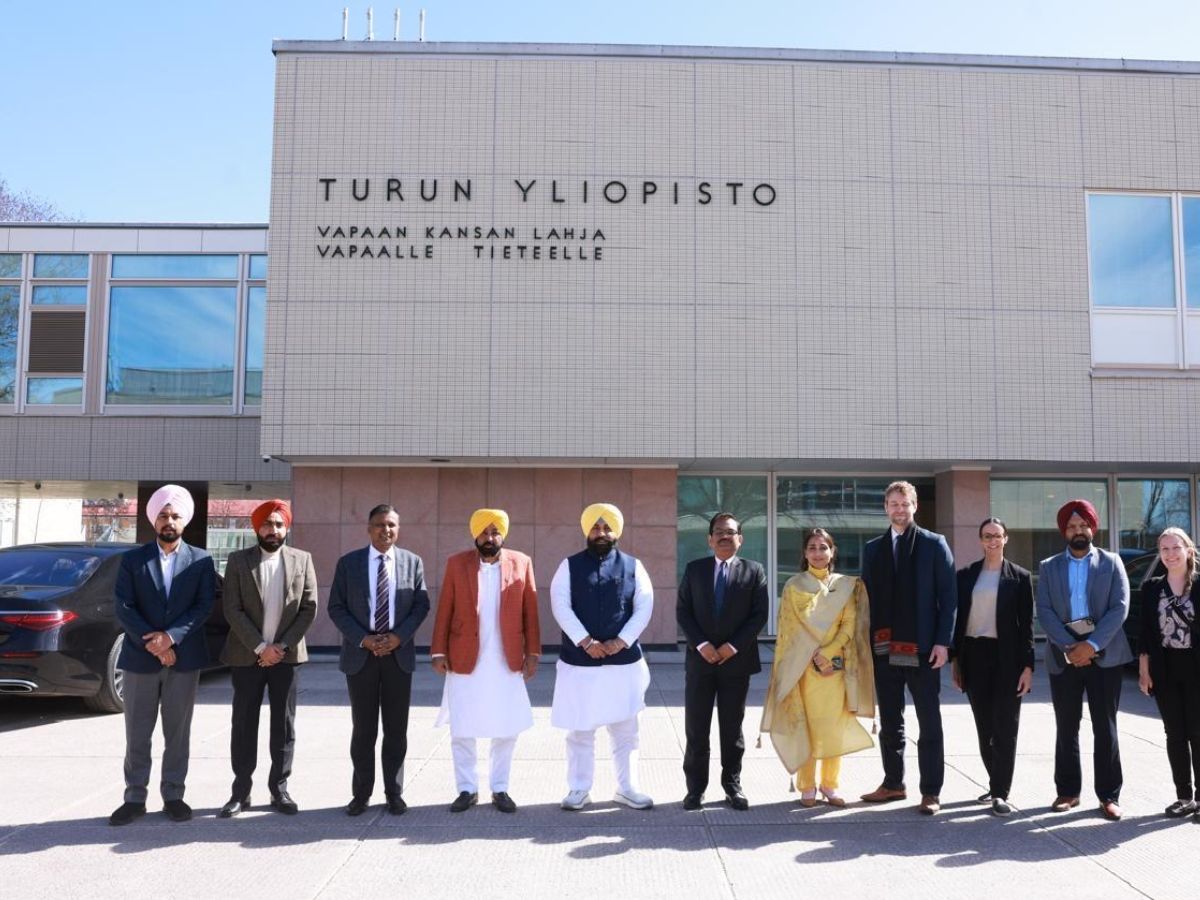
Under the leadership of Chief Minister Bhagwant Singh Mann, collaboration between the Punjab government and Finland’s University of Turku has begun to show visible changes in Punjab’s classrooms. Teaching practices have become more joyful and practical, creating a more effective learning environment for students.
As part of this initiative, education is moving away from rote memorization methods toward a more enjoyable and participatory learning environment. This program, part of Punjab’s broader education revolution, focuses on integrating global expertise into local classrooms. It operates through a structured train-the-trainers model, with about 300 teachers set to be trained to strengthen foundational education.
During his official visit to Finland, Chief Minister Bhagwant Singh Mann visited the Kukulo-Moikoinen Early Childhood Education and Care Center. The Chief Minister stated that this initiative is already delivering excellent results by integrating global educational expertise with local classrooms.
Chief Minister Bhagwant Singh Mann further stated that this partnership, launched through the State Council of Educational Research and Training under the School Education Department, is aimed at strengthening the role of teachers in early and foundational education. It is designed not as a short-term intervention but as a long-term institutional effort to incorporate child-centered and play-based learning into Punjab’s education system, along with best teaching practices.
The program focuses on equipping teachers with research-based methods, ensuring these approaches are adapted to Punjab’s socio-cultural context. He noted that training sessions were held in both Chandigarh and the Finnish cities of Turku and Rauma, including exposing teachers to new classroom techniques through workshops, mentoring practices, and school visits. Notably, by May 2026, around 300 teachers across four groups will have completed training, benefiting students throughout Punjab.
Chief Minister Bhagwant Singh Mann emphasized, “The focus is on making education joyful and interesting. So we are moving away from old rote learning methods toward active engagement. Teachers have also been encouraged to design context-specific projects with expert support to implement these ideas in their own classrooms. Feedback from the field indicates improved student participation and motivation, along with a positive classroom environment.”
He said, “Teachers have expressed greater confidence in experimenting with new methods and adapting lessons to diverse learning needs. A unique feature of this initiative is the emphasis on contextual adaptation rather than directly applying foreign models. Continuous advisory support from Finnish experts has enabled this shift, ensuring that global best practices are meaningfully integrated into local systems.”
During this time, Chief Minister Bhagwant Singh Mann also visited the University of Turku and the Turku Teacher Training School for detailed discussions. He said, “The government now plans to expand the program through a ‘train-the-trainers’ approach, creating a cadre of master trainers to extend its reach across the state.” He added, “Digital platforms and blended training formats are also being developed to support continuous professional development and wider outreach.”
The Chief Minister said, “With a structured system for expansion and a growing pool of trained teachers, this collaboration is seen as a foundation for Punjab’s broader education reforms. The state is committed to strengthening public education so that students are better prepared to succeed, and similar initiatives will be undertaken to maintain momentum in this area.”