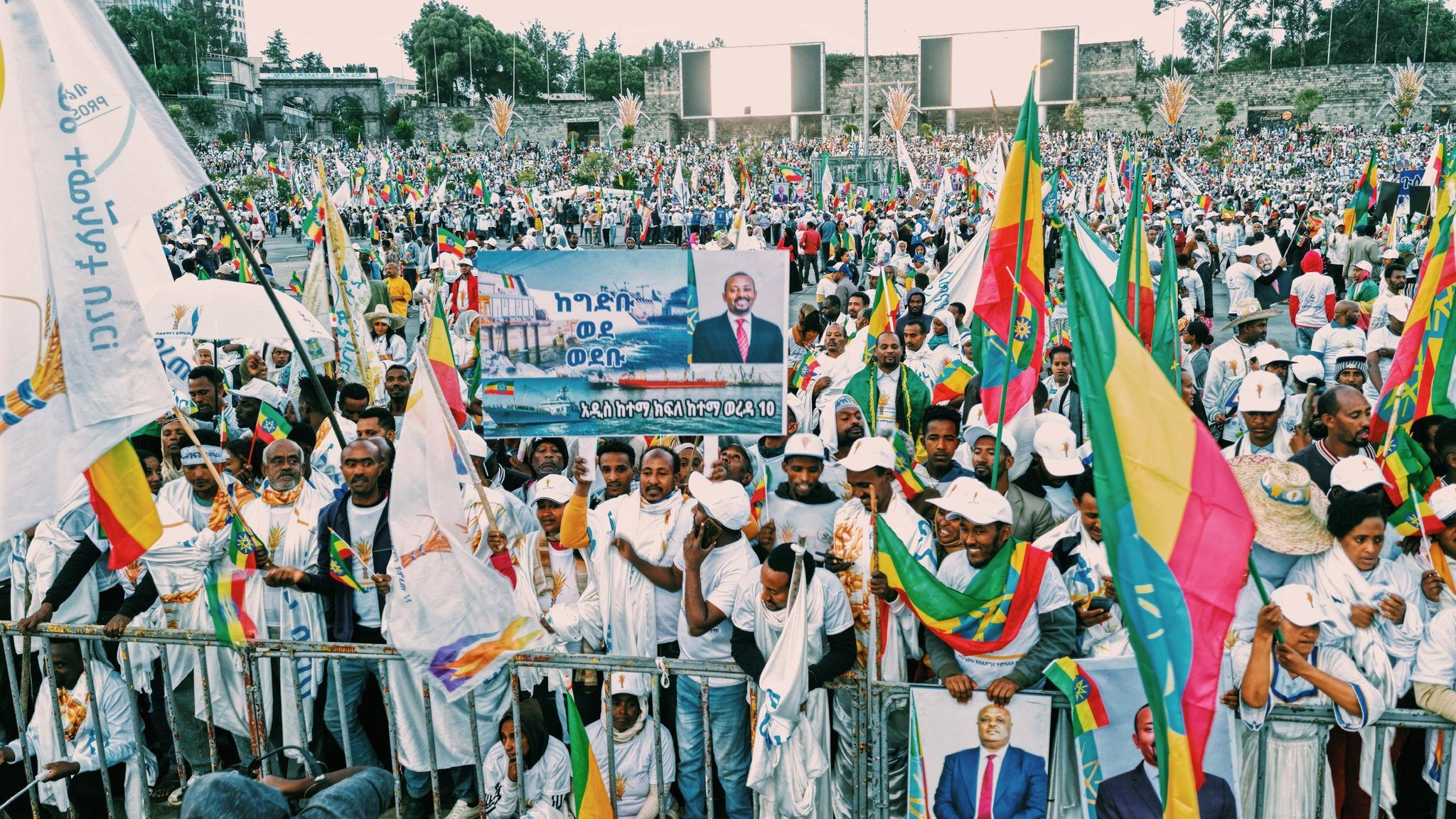
Addis Ababa, May 26, 2026 Ethiopia’s ruling Prosperity Party wrapped up a broad series of nationwide election rallies in major cities and regional towns ahead of the country’s seventh general election, scheduled for June 1, 2026.
On the final day of the campaign, massive rallies and public support events were organized in several parts of the country, including Addis Ababa, Hawassa, Arba Minch, Gondar, Dilla, Wolaita Sodo, Gambela, Debre Markos, Dessie, Bahir Dar, Kombolcha, Debre Berhan, and Metema, attracting hundreds of thousands of supporters in one of the largest coordinated political mobilizations in modern Ethiopian history.
In the capital, the party’s main closing rally was held at Meskel Square, where senior government officials, party leaders, candidates, and thousands of supporters gathered in a festive atmosphere marked by music, flag-waving, and calls for peace and national unity.
The rally was attended by the Mayor of Addis Ababa and member of the Prosperity Party Executive Committee, Adanech Abebe, Deputy Mayor Jantrar Abay, and the head of the Prosperity Party branch in Addis Ababa, Moges Balcha.
In her speech to the crowd, Mayor Adanech described the elections as a crucial opportunity for Ethiopians to affirm their commitment to democratic governance and peaceful political participation.
She emphasized that the Prosperity Party remains committed to constitutional and democratic means of political transition, adding that elections are fundamental to national stability and long-term development.
Across the country, campaign events were organized under the slogan: “Transforming Ethiopia into a model state.”
Supporters, youth groups, women’s associations, and community members participated in many cities and regional centers in marches that combined political messages with cultural performances and public celebrations.
Party officials stated that all campaign activities were carried out in accordance with directives issued by the National Electoral Board of Ethiopia, with the participation of candidates, regional officials, and supporters representing various sectors of society.
As the Ethiopian election date approaches, the upcoming election is widely regarded as one of the most significant political moments in the country’s modern era.
More than 50 million registered voters are expected to participate, making the election a major national event and one of the most anticipated democratic processes in Africa in recent years.
As Ethiopia prepares for election day, the Prosperity Party officially concluded its nationwide election campaigns, calling on citizens to participate peacefully in the democratic process.
According to a report from the National Electoral Board, over 187,000 election officials have been deployed across the country to oversee the voting process.
Meskel Square
Meskel Square is a major public square in Addis Ababa, Ethiopia, named after the Meskel festival, which commemorates the finding of the True Cross. Historically, it has served as a central gathering place for religious celebrations, political rallies, and national events, including the annual Meskel ceremony where a large bonfire is lit. The square symbolizes both Ethiopia’s deep Christian heritage and its modern civic life.
Addis Ababa
Addis Ababa is the capital and largest city of Ethiopia, founded in 1886 by Emperor Menelik II. It became the nation’s permanent capital in 1889 and grew rapidly as a political and cultural hub, home to the African Union headquarters. The city is known for its rich history, including landmarks like the National Museum, which houses the famous fossil “Lucy.”
Hawassa
Hawassa is a city in southern Ethiopia, located on the shores of Lake Hawassa. It serves as the capital of the Sidama Region and is known for its scenic beauty, fish market,
Meskel Square
Meskel Square is a major public square in Addis Ababa, Ethiopia, named after the annual Meskel festival, which commemorates the finding of the True Cross. Historically, the square has been a central gathering place for religious celebrations, political rallies, and national events, including the iconic 1974 revolution that ended the Ethiopian Empire. Today, it remains a vibrant symbol of Ethiopian culture and identity, hosting the colorful Meskel ceremony each September.
Addis Ababa
Addis Ababa, meaning “New Flower,” is the capital and largest city of Ethiopia, founded in 1886 by Emperor Menelik II. It grew rapidly after becoming the nation’s permanent capital in the early 20th century and is notable as the seat of the African Union. The city blends modern development with historic sites like St. George’s Cathedral, reflecting its role as a political and cultural hub in Africa.
Hawassa
Hawassa is a major city in southern Ethiopia, located on the shores of Lake Hawassa. Established in the 1950s as the capital of the Sidama Region, it grew rapidly due to its strategic location and industrial development. The city is known for its scenic lake, fish market, and as a key hub for tourism and trade in the region.
Arba Minch
Arba Minch is a city in southern Ethiopia known for its stunning landscapes, including the Rift Valley lakes of Abaya and Chamo, as well as the Nechisar National Park. The name “Arba Minch” means “four springs” in Amharic, referring to the numerous freshwater springs in the area. Historically, the city grew as an administrative and commercial hub in the 20th century, while the surrounding region is rich in cultural heritage, home to diverse ethnic groups like the Gamo people.
Gondar
Gondar is a historic city in Ethiopia, renowned as the capital of the Ethiopian Empire from the 17th to the 19th centuries. It is famous for its well-preserved medieval castles and palaces, built primarily by Emperor Fasilides and his successors within the Royal Enclosure, a UNESCO World Heritage Site. The city’s architecture reflects a unique blend of Ethiopian, Islamic, and Baroque influences, marking it as a key cultural and political center in Ethiopian history.
Bahir Dar
Bahir Dar is a city in northwestern Ethiopia, located on the southern shore of Lake Tana, the source of the Blue Nile. Historically, it served as a major center for trade and missionary activity, and it is known for its proximity to the Blue Nile Falls and the medieval monasteries on the lake’s islands. Today, it is a popular tourist destination and a key administrative hub for the Amhara Region.
Debre Markos
Debre Markos is a city in northwestern Ethiopia, best known as the capital of the historic Gojjam province. It was founded in the mid-19th century and later became the seat of Emperor Tekle Haymanot, playing a significant role in regional politics. The city is named after the Debre Markos Monastery, a prominent Ethiopian Orthodox Tewahedo site.
Dessie
Dessie is a major city in northern Ethiopia, serving as the capital of the South Wollo Zone. Historically, it was an important commercial and administrative center during the late 19th and early 20th centuries, and it became a key location during the Italian occupation of Ethiopia in the 1930s. Today, it is known for its bustling markets, nearby hot springs, and its role as a gateway to the scenic Ethiopian Highlands.