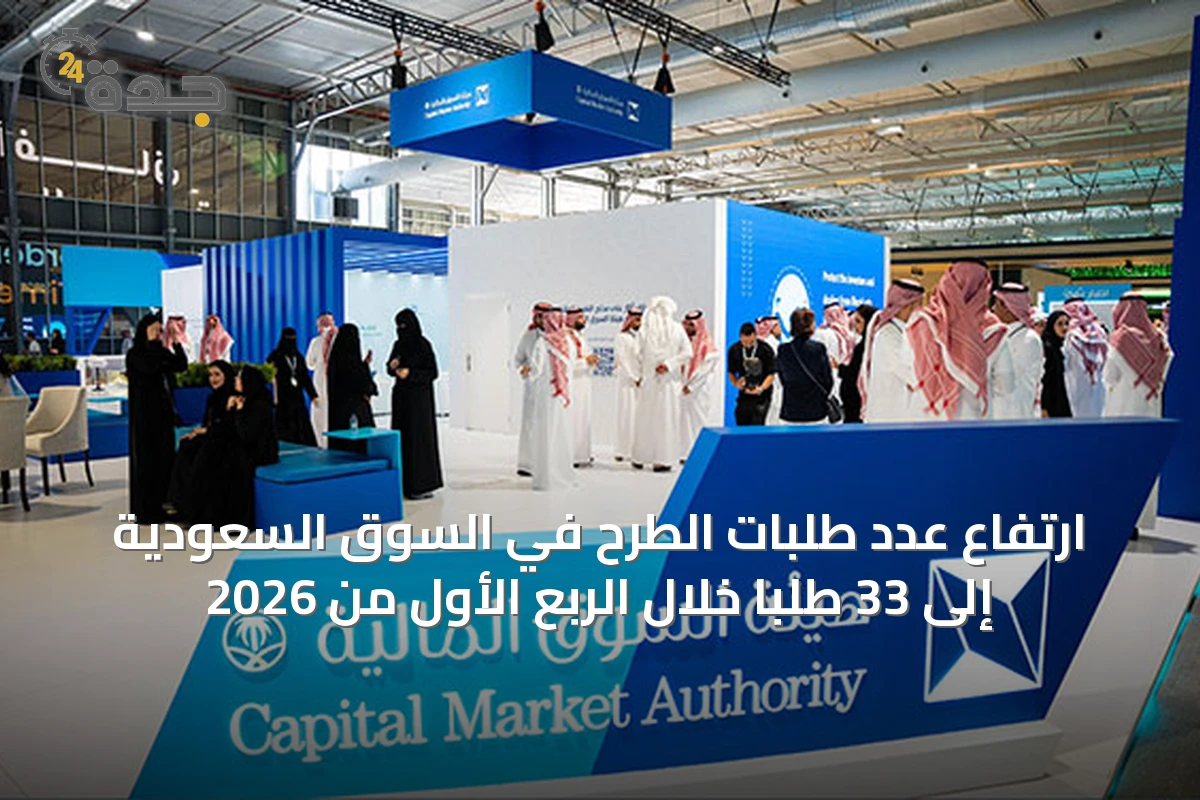
Riyadh – A report by the Capital Market Authority for the first quarter of 2026 showed a notable increase in the number of available listing applications in the kingdom’s two main markets, with total applications reaching 33 compared to 45 at the end of the fourth quarter of the previous year.
Distribution of applications between the two markets
The figures reveal that 10 of these outstanding applications are for the main market (TASI), while 23 applications are for the parallel market (Nomu). This clearly illustrates a diversity in investor interest in listing their securities in both markets.
Decisions issued by the authority during the first quarter
During the same period, the Capital Market Authority issued two approvals for the offering of shares of three companies in the main market, in addition to two approvals for the offering of shares of two companies in the parallel market.
Volume of assets under management in the Saudi capital market
Data indicates that total assets under management by Saudi capital market institutions reached approximately 1.24 trillion riyals by the end of the fourth quarter of last year. Al-Ahli Financial Company topped the list with an estimated volume of managed assets of about 274.5 billion riyals, representing 22.1% of total assets.
Opening the door for direct foreign investments
In a significant step to enhance market liquidity and broaden the investor base, the board of the Capital Market Authority approved the draft regulatory framework that allows all categories of foreign investors from around the world to directly invest in all categories of the main market. This measure aims to stimulate investment flows and enhance capital market liquidity.
Saudi market
A Saudi market, or *souq*, is a traditional marketplace that has been a central part of Arabian culture for centuries, historically serving as a vital hub for trade along ancient caravan routes. These markets typically feature a maze of narrow alleyways and small shops selling a variety of goods, from spices, perfumes, and textiles to gold and handmade crafts. Today, while modern malls are prevalent, traditional souqs like those in Jeddah and Riyadh remain popular for their authentic atmosphere and cultural heritage.
Capital Market Authority
The Capital Market Authority (CMA) is the financial regulatory body overseeing Saudi Arabia’s capital markets, established in 2004 to regulate and develop the securities market and ensure investor protection. Its creation was part of broader economic reforms aimed at modernizing the country’s financial sector and attracting foreign investment. The CMA plays a key role in supervising the Saudi Stock Exchange (Tadawul) and enforcing transparency and fair trading practices.
TASI
TASI, or the Tassili n’Ajjer plateau in southern Algeria, is a UNESCO World Heritage site renowned for its vast collection of prehistoric rock art, dating back over 10,000 years. This cultural landscape features thousands of paintings and engravings depicting wildlife, hunting scenes, and ancient human life, offering a window into the Sahara’s lush past. Its history reflects significant climatic and cultural shifts, from a fertile savanna to the arid desert seen today, with art created by successive populations over millennia.
Nomu
Nomu is a traditional fermented soybean paste from the Nagaland region of Northeast India, often compared to Korean doenjang or Japanese miso. It has been a staple in Naga cuisine for centuries, made by fermenting soybeans in bamboo tubes
Tassili n’Ajjer plateau
The Tassili n’Ajjer plateau is a vast, dramatic landscape in southeastern Algeria, renowned for its prehistoric rock art and unique geological formations. This UNESCO World Heritage site contains over 15,000 engravings and paintings, some dating back to 10,000 BCE, that depict changing climates, wildlife, and early human life in the Sahara. Its cultural and historical significance lies in these ancient artworks, which provide a crucial record of the region’s transition from a lush savanna to the arid desert it is today.
UNESCO World Heritage site
A UNESCO World Heritage site is a landmark or area recognized by the United Nations Educational, Scientific and Cultural Organization as having outstanding cultural, historical, or natural significance to humanity. These sites are legally protected by international treaties to ensure their preservation for future generations. The program began in 1978 with the listing of the first 12 sites, such as the Galápagos Islands and the Wieliczka Salt Mine, and today includes over 1,100 locations worldwide.
Nagaland region
Nagaland is a state in northeastern India known for its rich tribal culture and diverse indigenous communities, including the Angami, Ao, and Konyak tribes. Historically, the region was largely independent until the British colonial era, and it has experienced conflict since the mid-20th century due to separatist movements seeking greater autonomy. Today, Nagaland is famous for its vibrant Hornbill Festival, traditional warrior heritage, and scenic mountainous landscapes.
Saudi Stock Exchange (Tadawul)
The Saudi Stock Exchange, known as Tadawul, is the primary stock exchange in Saudi Arabia and one of the largest in the Middle East. Established in 2007, it succeeded the earlier electronic trading system launched in 2001, and it underwent significant modernization after opening to foreign investors in 2015. Tadawul plays a crucial role in the Kingdom’s Vision 2030 economic diversification plan by listing major state-owned enterprises, such as Saudi Aramco.