Bandung –
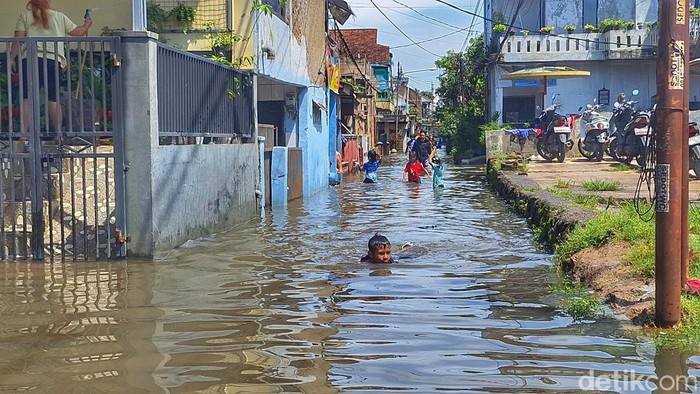
Heavy rain that drenched the Greater Bandung area caused three rivers to overflow simultaneously, flooding main roads and residential areas in Dayeuhkolot District, Bandung Regency, on Tuesday (May 26, 2026).
The Citarum, Cipalasari, and Cigede rivers could not handle the water volume. As a result, floodwaters quickly spread into residential areas, with water levels varying from 10 centimeters to 1.5 meters.
At several points, residents chose to move their belongings to the second floor of their homes. Others decided not to wait for the water to recede and evacuated to shelters prepared by the government.
The Dayeuhkolot District Head, Asep Suryadi, stated that joint personnel remain on standby in the field to anticipate possible subsequent floods, while data collection on affected residents is ongoing.
“The number of affected individuals is around 2,185 people and 772 families,” said Asep.
The areas experiencing the most severe flooding are in Cangkuang Wetan Village, especially in Cibedug Hilir Hamlet RW 01 and Cibedug Girang Hamlet RW 02. In these locations, water levels reached 20 centimeters to 150 centimeters.
“Deep flood areas also include Pasawahan Urban Village, Palasari Hamlet, and Cisirung Hamlet. With water levels reaching 50 centimeters to 120 centimeters,” he said.
Water also entered residential areas in Dayeuhkolot Village. Several areas such as Babakan Sangkuriang, Citeureup, Cilisung, Bojongasih, and Kaum Hamlets were submerged with water levels between 10 and 80 centimeters.
Meanwhile, in Citeureup Village, floods submerged Leuwi Bandung, Lamajang, Lamajang Peuntas, Sukabirus, and Cigempol Hamlets, with water levels reaching 60 centimeters. The floods not only disrupted residential areas but also paralyzed main roads.
“Other flood conditions are on Dayeuhkolot Main Road in front of the post office, with levels of 40 to 60 cm. Then on Dayeuhkolot – Moh Toha Main Road in front of PT Metro Garmen, with levels of 40 to 50 cm,” he explained.
Amid these conditions, hundreds of residents began to be moved to evacuation points. One evacuation site was opened at the Annur Mosque in Citeureup Village. A total of 56 residents from 21 families took shelter there.
“Of those 56 people, there are 3 elderly, 28 adults, 9 toddlers, 1 infant, 3 breastfeeding mothers, 1 person with a disability. Then 5 elementary school students, 3 junior high school students, 2 senior high school students, and 1 sick evacuee,” said Asep.
Another evacuation site was prepared at the Al Ikhlas Mosque in Citeureup Village, accommodating 50 residents from 17 families. This number consists of 5 elderly, 32 adults, 2 toddlers, 1 person with a disability, 1 kindergarten child, 4 elementary school students, 4 junior high school students, and 1 senior high school student.
“So the total evacuees in Citeureup Village are around 106 people and 38 families,” said Asep.
Meanwhile, at the Dayeuhkolot Village Shelter Building, 62 residents from 23 families have also been evacuated from several affected RWs. The details include 34 adults, 5 elderly, 5 toddlers, 1 breastfeeding mother, 1 person with a disability, 8 elementary school children, 5 junior high school children, and 3 senior high school children.
“So we can conclude that the total number of evacuees in Dayeuhkolot District is 168 people and 61 families,” he detailed.
Amid the response efforts, the government noted that residents’ basic needs are becoming a primary concern. What residents most need now are clean water, food, and sleeping gear.
“Urgent needs for affected residents are ready-to-eat food, toddler food, drinking water, blankets, basic necessities, cleaning tools, trolleys,
Citarum
The Citarum River in West Java, Indonesia, is one of the most polluted rivers in the world, largely due to severe industrial and domestic waste dumping. Historically, it has been vital for agriculture, water supply, and hydroelectric power for millions of people, but rapid urbanization and poor waste management have transformed it into an environmental crisis. Despite cleanup efforts, the river remains heavily contaminated, impacting the health and livelihoods of local communities.
Cibedug Hilir Hamlet
Cibedug Hilir Hamlet is a traditional settlement located in the Cigugur District of Kuningan, West Java, Indonesia. It is known for its strong preservation of Sundanese cultural heritage and customs, including traditional architecture and communal living. Historically, the hamlet has maintained its ancestral way of life, with local governance still guided by customary law and rituals passed down through generations.
Cibedug Girang Hamlet
Cibedug Girang Hamlet is a traditional settlement in West Java, Indonesia, known for its well-preserved Sundanese cultural heritage and unique terraced rice fields. The hamlet’s history is rooted in ancient agricultural practices and communal living, with its name derived from the Sundanese words for a type of bamboo and a raised area. Today, it serves as a living cultural site where visitors can experience traditional village life and customs passed down through generations.
Pasawahan Urban Village
Pasawahan Urban Village is a densely populated administrative area located in the Banjar District of Banjar City, West Java, Indonesia. Historically, it developed as part of the region’s urban expansion, with its community primarily engaged in trade and small-scale industries. Today, it reflects a blend of traditional Sundanese culture and modern urban life, serving as a residential and economic hub within the city.
Palasari Hamlet
Palasari Hamlet is a traditional Balinese village located in the mountainous region of East Bali, known for its well-preserved architecture and strong Hindu cultural traditions. The hamlet was historically established as a settlement for local farmers and artisans, and it remains a living example of Bali’s ancient village layout, with a central temple, communal meeting spaces, and family compounds arranged according to customary rules. Today, Palasari is recognized for its serene atmosphere and offers visitors a glimpse into authentic rural Balinese life, away from the more tourist-heavy areas of the island.
Cisirung Hamlet
Cisirung Hamlet, located in West Java, Indonesia, is a traditional rural settlement known for its scenic rice terraces and preserved Sundanese cultural heritage. Historically, the hamlet has been an agrarian community, with its name derived from the Cisirung River that has supported local farming for generations. Today, it offers visitors a glimpse into authentic village life and eco-tourism activities.
Dayeuhkolot Village
Dayeuhkolot Village is a historic settlement in West Java, Indonesia, known for its role as a former administrative center during the Dutch colonial era. Located near Bandung, it served as a key transit point for trade and transportation due to its position along the Citarum River. Today, the village retains cultural heritage sites and traditional architecture that reflect its colonial past and Sundanese roots.
Annur Mosque
Annur Mosque, also known as Masjid Annur, is a prominent mosque located in Singapore, built in the early 1980s to serve the Muslim community in the Sengkang and Punggol areas. It was constructed as part of the Housing and Development Board’s mosque-building program to accommodate the growing population in new towns. The mosque underwent a major upgrading and expansion in the 2010s to enhance its facilities and capacity.