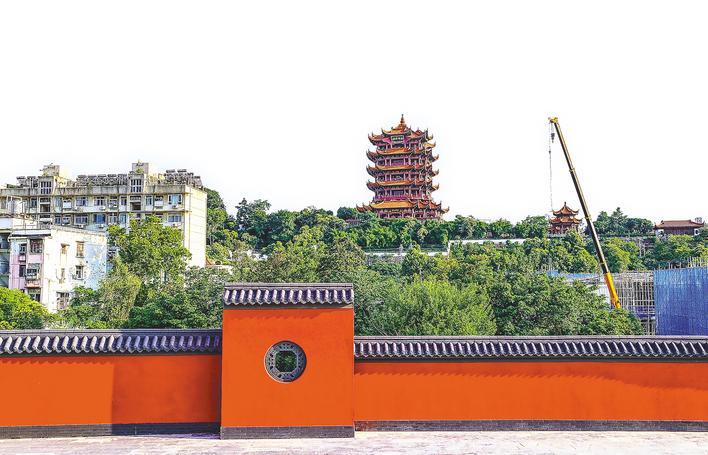
On May 27, an aerial view of the highly anticipated renovation of the new red wall at Wuhan’s Yellow Crane Tower.
A carved lattice window has been opened in the middle section of the red wall, perfectly framing the Yellow Crane Tower in the distance.
On May 28, an on-site visit revealed that the new red wall at the Simentou Yellow Crane Tower subway station is complete and expected to open to the public by the end of this month.
The new red wall is located on the “Yanzhi Floating Island” above the subway station. It is taller, longer, closer to the Yellow Crane Tower, and offers a larger photo-taking area to accommodate more visitors.
On-site visit: Three routes to the “Floating Island”
Exiting from Gate B of the Simentou Yellow Crane Tower Station on Metro Line 5, the previously visible ventilation shafts are now hidden, supporting a floating island-style structure named “Yanzhi Floating Island.”
Why this name?
First, because the site is on the remnant of Yanzhi Mountain in Wuchang, using the local place name. Second, the building adopts a floating island design to highlight its unique style. Though called a “Floating Island,” it is actually an elevated platform built over the subway entrance and ventilation facilities.
How to reach the “Floating Island”?
Three routes are available: a spiral staircase directly opposite Gate B, an antique bluestone step staircase on the right, and a convenient escalator on the other side.
During the visit, Gate B, which was temporarily closed due to construction of the “Floating Island,” has been reopened with multiple signs. A barrier with staff on duty blocks the path from Gate B to the “Floating Island.”
Upon reaching the “Floating Island,” the view opens up: trees have been transplanted and greenery planted on the platform. On the side near the Yellow Crane Tower, a straight new red wall extends, creating a charming contrast with the nearby tower.
The middle section of the wall is slightly elevated, featuring a carved lattice window. Pulling out a phone and adjusting the zoom, the Yellow Crane Tower is perfectly framed within it.
The entire platform covers about 3,000 square meters, with the red wall stretching approximately 40 meters. The block where the “Floating Island” is located is undergoing rapid development, including 11 buildings, expected to be completed by the end of the year. In the future, visitors on top of these buildings will be able to take photos with the Yellow Crane Tower.
The old red wall: A happy accident
The new red wall makes a stunning debut, but the story begins with the old one.
The old red wall, near the Simentou Yellow Crane Tower Station on Metro Line 5, consists of three sections ranging from 2.2 to 2.7 meters in height.
Exiting from Gate C, a turn reveals the Yellow Crane Tower atop Snake Hill. Riding the escalator out, the tower gradually emerges against the red wall, blue sky, and white clouds, creating a striking and impressive photo.
Originally, there was no red wall here.
It came about due to subway construction.
This plot was above the subway station and initially developed as a parking lot. For management, a wall was added; later, for aesthetics, the wall was painted red with green tiles—becoming a “Forbidden City-style” red wall. When paired with the Yellow Crane Tower, it unexpectedly went viral online.
This red wall became a new photo spot for out-of-town visitors to Wuhan. It is another classic case of a happy accident.
To meet visitors’ photo needs, the parking lot wall was once moved back a few meters to create space. The subway also marked safe photo zones with yellow lines.
This “Forbidden City-style” red wall produces stunning photos with a simple snap. Visitors flocked, and the subway adapted. During holidays, crowds surged, with daily passenger traffic peaking at over 200,000, 90% of whom came specifically for photos.
Currently, a section of the old red wall remains below the “Yanzhi Floating Island.” During the visit, some visitors were still taking photos there.
The new red wall: Intentional design
The site of the red wall is at the southern gateway of the Des