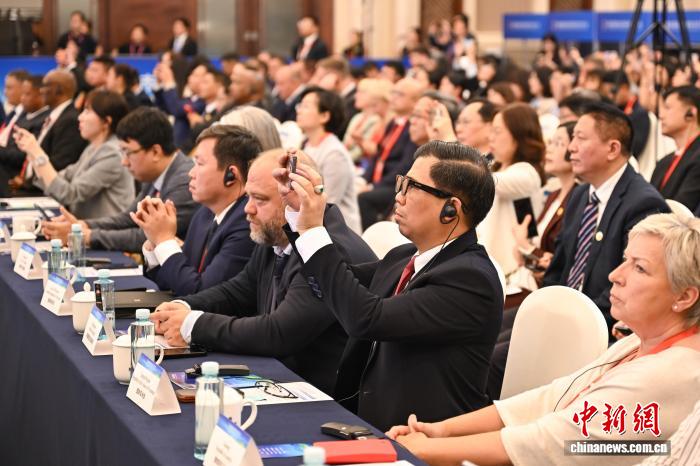
Chongqing, May 20 (Xinhua) — The 2026 Chongqing International Sister Cities Cooperation Conference opened in Chongqing on May 20. Government delegations from 38 cities across 29 countries, representatives of 9 international friendship organizations, diplomatic envoys from 17 countries, and delegates from foreign enterprises and business associations gathered in the mountain city to jointly expand multi-level, wide-ranging, and deep-seated pragmatic cooperation between sister cities.
Prior to the conference, Chongqing had established sister city relations with 59 cities in 39 countries and maintained friendly exchange city relations with 137 cities. At the opening ceremony, Chongqing established friendly exchange relations with Lao Cai Province in Vietnam, Yangon Region in Myanmar, Jizzakh Region in Uzbekistan, and Trenčín Region in Slovakia, while Yuzhong District established friendly exchange relations with Balatonboglár in Hungary and Nesvizh District in Minsk Region, Belarus. Chongqing’s international “circle of friends” added six new cities, and its partner network spanning five continents is becoming increasingly comprehensive.
Over the next three years, Chongqing will cooperate with Minsk Region in Belarus on 13 key projects including industrial robots, medical equipment, and agricultural products; with Seattle in the United States on urban governance, animal protection, and landscape architecture; and with Ulaanbaatar in Mongolia on education and training, sports events, and cultural tourism promotion.
Additionally, China’s Changan Automobile and Uzbekistan’s ADM Group will collaborate to manufacture new energy vehicles. The Nepal-China Economic and Trade Association and the Chongqing Import and Export Chamber of Commerce, as well as the Belarusian Chamber of Commerce and Industry and the Chongqing Council for the Promotion of International Trade, will engage in investment promotion and trade facilitation activities. The Chongqing Municipal Bureau of Human Resources and Social Security will cooperate with Phnom Penh in Cambodia, Minsk Region in Belarus, and North Jeolla Province in South Korea on talent cultivation, mutual recognition of qualifications, and skills competitions.
At the opening ceremony, Chongqing released the “International Sister Cities Vocational Skills Cooperation Initiative,” which aims to promote standard sharing, mutual recognition, joint talent cultivation, mutual integration and promotion, project co-building, mutual benefit and sharing, and joint event hosting and mutual learning. (End)
Chongqing
Chongqing is a major city in southwestern China, known for its dramatic mountainous landscape and role as a key industrial and transportation hub. Historically, it served as the wartime capital of the Republic of China during the Second Sino-Japanese War (1937–1945), which led to rapid development and a lasting legacy of resistance. Today, it is famous for its spicy hotpot cuisine, the Yangtze River cruises, and the futuristic skyline along the river.
Lao Cai Province
Lao Cai Province in northern Vietnam is renowned for its stunning mountainous landscapes and rich ethnic diversity, serving as the gateway to the famous resort town of Sapa. Historically, the area was a remote frontier region and played a key role in trade routes between Vietnam and China, particularly during the French colonial period when it was developed for mining and railway projects. Today, it is a popular destination for trekking and exploring the cultural traditions of ethnic minority groups like the Hmong and Dao.
Yangon Region
The Yangon Region, located in southern Myanmar, is home to the country’s former capital, Yangon (formerly Rangoon), a major commercial and cultural hub. Its history dates back to the 6th century as a Mon settlement, later flourishing under British colonial rule in the 19th and 20th centuries, when it became a key port and administrative center. Today, the region is renowned for its blend of colonial-era architecture and iconic sites like the golden Shwedagon Pagoda, one of Buddhism’s most sacred stupas.
Jizzakh Region
Jizzakh Region is located in central Uzbekistan and has a long history as part of the ancient Silk Road, with its territory once belonging to the Sogdian civilization. The region is known for the scenic Nuratau Mountains and the historic city of Jizzakh, which served as a strategic fortress and trade hub for centuries. Today, it is recognized for its natural landscapes, including the Zaamin National Park, and its agricultural production.
Trenčín Region
The Trenčín Region in western Slovakia is known for its rich history, centered around the medieval Trenčín Castle, which dates back to the 11th century and was a key stronghold of the Kingdom of Hungary. The region’s spa town, Trenčianske Teplice, has been a popular wellness destination since the 16th century. Today, the area blends historical landmarks with natural beauty, including the Strážov Mountains and Váh River valley.
Balatonboglár
Balatonboglár is a popular resort town on the southern shore of Lake Balaton in Hungary, known for its mild climate and sandy beaches. Historically, it was a significant wine-producing region, and during World War II, it served as a safe haven for Polish refugees, with a notable Polish-Hungarian friendship monument commemorating this bond. Today, it attracts visitors for its recreational activities, the iconic observation tower on Szőlő-hegy (Vineyard Hill), and cultural festivals.
Nesvizh District
Nesvizh District, located in central Belarus, is historically significant as the home of the Nesvizh Castle, a UNESCO World Heritage site that served as the residence of the powerful Radziwiłł family from the 16th to the 20th centuries. The district’s history is deeply intertwined with the family’s influence, who transformed Nesvizh into a cultural and political hub, establishing the first printing press in Belarus and a renowned collection of art and manuscripts. Today, the area is celebrated for its well-preserved Renaissance and Baroque architecture, including the castle and the nearby Corpus Christi Church, which houses the Radziwiłł family crypt.
Minsk Region
The Minsk Region is the central and most populous region of Belarus, surrounding the capital city of Minsk. Historically, it was part of the Grand Duchy of Lithuania and later the Polish-Lithuanian Commonwealth before being incorporated into the Russian Empire in the late 18th century. The region played a significant role during World War II, suffering heavy destruction under Nazi occupation, and today it is a key economic, cultural, and industrial hub of the country.