Major action in case of derogatory remarks against BR Ambedkar, former VHP leader RBVS Maniyan arrested
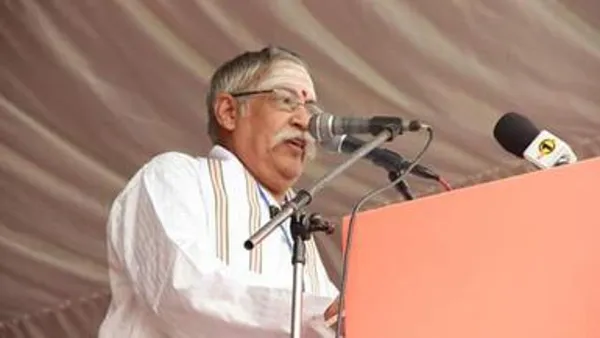
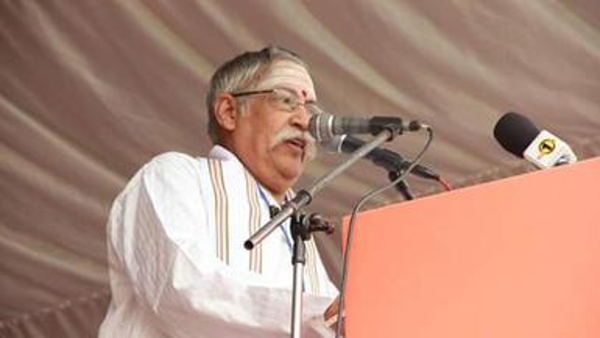
Former Vishva Hindu Parishad functionary RBVS Manian has been arrested for allegedly making derogatory comments about BR Ambedkar and Dalits. Chennai police arrived at his home on Thursday to take him into custody.
The arrest of former VHP leader RBVS Manian was made in connection with offensive remarks against the Dalit community and Bhim Rao Ambedkar. A statement from Chennai police said that during a spiritual event at Bharatiya Vidya Bhavan in T Nagar on September 11, Manian made insulting comments against Dalits, which went viral on social media. Based on this, Manian was arrested this morning and will be produced in court.
Charges against Manian
Chennai police have registered a case against RBVS Manian under IPC sections 153, 153A(1)(a), 505(1)(b), and 505(2), as well as sections 3(1)(r), 3(1)(u), and 3(1)(v) of the Scheduled Castes and Scheduled Tribes (Prevention of Atrocities) Act, 1989.
What did the former VHP leader say?
During a spiritual event at Bharatiya Vidya Bhavan in T Nagar, the former VHP leader said that the Indian Constitution was not created by a single person. Manian stated that the Constitution was the result of a collective effort. He claimed that the Constitution was prepared by a team of 300 members under the leadership of the country’s first president, Rajendra Prasad. He said that some crazy people are claiming that Ambedkar alone made the Constitution, and that these people have mortgaged their intelligence. He also said that Ambedkar was not from the same caste as VCK president Thirumavalavan, claiming that Thirumavalavan was a Chakaliyar while Ambedkar was a Paraiyar. He further stated that Rajendra Prasad should have been credited with making the Constitution instead of Ambedkar, and that Ambedkar was only the chairman of the drafting committee.
Bharatiya Vidya Bhavan
Bharatiya Vidya Bhavan is an Indian educational and cultural trust founded in 1938 by Dr. K. M. Munshi, with the mission to promote and preserve Indian art, culture, and values. It has grown into a global network of institutions offering courses in languages, music, dance, and philosophy, while also publishing books and organizing cultural events. The organization played a key role in the Indian independence movement by fostering a renaissance of indigenous knowledge and continues to serve as a bridge between traditional Indian heritage and modern education.
T Nagar
T Nagar, officially known as Thyagaraya Nagar, is a major commercial and residential hub in Chennai, India. It was developed in the 1920s on land previously used as agricultural fields, named after the social reformer and politician Sir P. Thyagaraya Chetty. Today, it is famous for its bustling markets, jewelry stores, and the iconic Pondy Bazaar, making it a vibrant center for shopping and culture.
Indian Constitution
The Indian Constitution is the supreme law of India, adopted on November 26, 1949, and came into effect on January 26, 1950. It was drafted by the Constituent Assembly, led by Dr. B.R. Ambedkar, over nearly three years, drawing from various global sources to create the world’s longest written constitution. This document established India as a sovereign, socialist, secular, democratic republic, guaranteeing fundamental rights and guiding the nation’s governance.
Rajendra Prasad
Dr. Rajendra Prasad was the first President of independent India, serving from 1950 to 1962. A key figure in the Indian independence movement, he was a close associate of Mahatma Gandhi and played a crucial role in drafting the Indian Constitution. His legacy is honored at the Rajendra Prasad Museum in Patna, which houses personal artifacts and documents from his life.
BR Ambedkar
Dr. B.R. Ambedkar (1891–1956) was a prominent Indian jurist, economist, and social reformer who led the movement against caste discrimination and championed the rights of Dalits. He served as the principal architect of the Indian Constitution and played a pivotal role in shaping modern India’s legal and social framework. After converting to Buddhism in 1956, he inspired a mass religious movement that continues to influence millions today.
Vishva Hindu Parishad
The Vishva Hindu Parishad (VHP) is a right-wing Hindu nationalist organization founded in 1964 by M. S. Golwalkar and S. S. Apte, with the aim of uniting and defending Hindu interests in India. It gained prominence in the 1980s and 1990s for its role in the Ram Janmabhoomi movement, which sought to build a temple at the site of the Babri Masjid in Ayodhya. The VHP remains a key affiliate of the Rashtriya Swayamsevak Sangh (RSS) and continues to advocate for Hindu cultural and political causes.
Scheduled Castes and Scheduled Tribes (Prevention of Atrocities) Act, 1989
The Scheduled Castes and Scheduled Tribes (Prevention of Atrocities) Act, 1989 is a landmark Indian law designed to prevent violence and discrimination against historically oppressed communities. Enacted to address the failure of existing laws to curb caste-based atrocities, it establishes special courts and defines specific offenses, such as forced labor and public humiliation. The Act has been amended over time, most notably in 2015 and 2018, to strengthen protections and expedite justice for victims.
VCK
The VCK likely refers to the Vietnam Cultural Village (Văn hóa Việt Nam), though “VCK” is not a standard abbreviation for a major cultural site. If you meant a specific location like the Văn Miếu (Temple of Literature) in Hanoi, it is a historic Confucian temple founded in 1070, serving as Vietnam’s first national university. Alternatively, if “VCK” stands for a different site, please provide more context for an accurate summary.