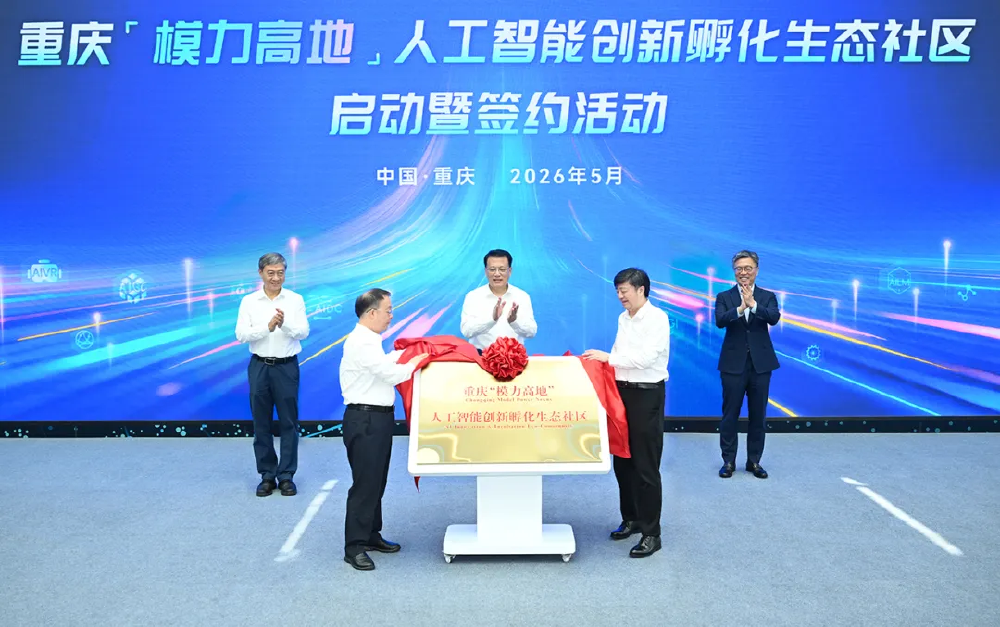
The current artificial intelligence landscape is fiercely competitive, with various regions vying to build AI innovation ecosystems.
The “Model Power Heights” AI Innovation Incubation Ecological Community has officially been put into use, and efforts are underway to build an “AI Bay Area.” Since the start of this year, Chongqing has been rapidly advancing its AI industry layout, accelerating the creation of the “Model Power Heights.” As the name suggests, “Model” refers to model or agent technology, while “Power” represents the computing power foundation. The original intent behind this initiative is to solidify the foundation for Chongqing’s AI application development.
As a key manufacturing base in China, Chongqing is accelerating the development of the “33618” modern manufacturing cluster system, actively embracing the “AI+” trend. Its deep manufacturing heritage, diverse production processes, and vast industrial scenarios provide natural deployment environments, real-world testing grounds, and continuous iteration opportunities for AI large models.
Riding the industrial wave and leveraging its fertile industrial soil, the manufacturing hub of Chongqing is harnessing its robust industrial advantages to ignite the “Model Power” of AI development.

Strong Foundation: Massive Industrial Data Provides a Powerful Engine for “Model Power.”
The competition in AI fundamentally revolves around the “iron triangle” of computing power, data, and algorithms. As a manufacturing powerhouse, Chongqing holds unique advantages in developing the AI industry.
Massive industrial data serves as high-quality fuel for AI development. Internet data played a crucial role in the early development of large models. Under similar conditions, more data input leads to stronger AI. However, research suggests that high-quality information from reliable sources may be exhausted by 2032.
Industry experts point out that for AI to achieve further breakthroughs, it must move beyond the digital world into the physical world. In recent years, Chongqing has promoted “intelligent transformation and digitalization” in enterprises, fostering deeper integration between the real economy and the digital economy. By 2025, the city had built 211 smart factories and 1,231 digital workshops, representing 2.1-fold and 2.4-fold increases, respectively, compared to 2020.
As automation and digitalization levels in Chongqing’s manufacturing sector rise annually, massive amounts of data are generated in areas such as production line operations, quality inspection, and logistics warehousing. This data provides rich resources for AI applications and serves as high-quality raw material for training industry-specific large models.
Deep industry expertise can make Chongqing’s “Model Power” smarter. “Fundamentally, algorithms are not controlled by IT professionals but by experts in electricity, infrastructure, coal, medicine, and various other fields,” as noted in a recent interview. The core competitiveness of algorithms relies not solely on programmers but more deeply on engineers, experts, and skilled talent who understand specific industries.
As a manufacturing hub, Chongqing holds a significant advantage in this regard. By the end of last year, the city had 5.68 million skilled workers, including 1.82 million highly skilled professionals. The steadily improving talent supply provides solid support for industrial transformation and serves as an “intellectual reservoir” for the AI industry.
Since last year, Chongqing has accelerated the establishment of a “12+N” industry brain system, with 12 industry brains and 11 sub-sector brains already online. These models, built on proprietary industrial data and refined by industry experts, possess strong professional attributes that cannot be easily replicated by general-purpose models.
From the national-level “AI+Manufacturing” Special Action Implementation Opinions, which accelerates the deep integration of AI into manufacturing, to