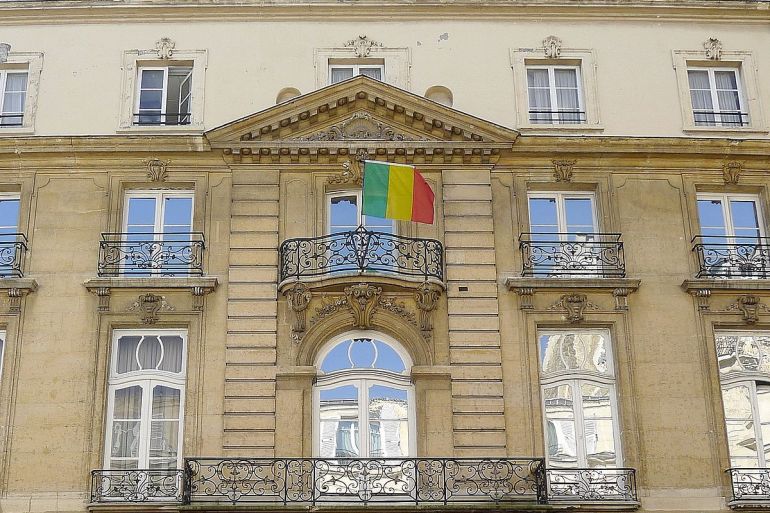
The Embassy of the Republic of Mali in France published an official response on Wednesday, addressed to the French newspaper La Croix, protesting an article published on May 18 under the title “On Their Way to Take Control of Azawad, Northern Mali,” which the embassy considered biased and an affront to the country’s sovereignty.
The embassy stated that it read the article “with astonishment” and denounced what it described as a “moral deviation” by the newspaper, accusing it of “giving a platform to terrorist groups” without presenting the government forces’ narrative, violating basic source verification rules.
The embassy’s objection focuses on the use of the term “Tuareg” to describe fighters of the “Front for the Liberation of Azawad,” as it considered this confusion an “insult” to the Tuareg community as a whole, which it described as aspiring to peace and security, and portrayed as a victim of acts of violence attributed to the front and its ally, “Jama’at Nasr al-Islam wal Muslimin.”
The embassy also objected to the term “Azawad,” describing it as a “usurpation” with no recognized territorial entity in Mali, and criticized the newspaper for not consulting historians or anthropologists on this matter.
On the ground, the embassy affirmed that the Malian armed forces are conducting active operations across the national territory, with “tangible progress” claimed in several areas, including the Kidal region, and stressed that the army operates within the framework of respect for international law, contrary to what was stated in the objected article, according to the statement.
The embassy added that it remains ready to provide journalists with the necessary information for a “better understanding of the situation” in Mali, while La Croix had not yet publicly responded to the right of reply.
La Croix had addressed in its article the progress of the “Front for the Liberation of Azawad” on the ground. According to Radio Monte Carlo International’s reading of the article’s content, the front intends, after taking control of the city of Kidal in northern Mali, to continue fighting to take control of the northern half of the country, while its second goal is to overthrow the current regime in Bamako, which the rebels accuse of “using violence” against the northern population.
This exchange comes amid rising security tensions in northern Mali. The Malian defense minister was killed on April 26, 2026, in a car bomb attack targeting his home, and Tuareg fighters took control of the city of Kidal.
Azawad
Azawad is a historical region in northern Mali, largely encompassing the Sahara Desert and the Niger River basin. In 2012, Tuareg-led rebels declared it an independent state, but the declaration was not internationally recognized and the territory was soon retaken by Malian and French forces. The area has a complex history involving Tuareg, Songhai, and other ethnic groups, and remains a site of ongoing political and security challenges.
Mali
Mali is a West African country with a rich history, once the heart of the powerful Mali Empire, which flourished from the 13th to 16th centuries and was renowned for its wealth, trade, and centers of learning like Timbuktu. Today, it is home to several UNESCO World Heritage sites, including the legendary city of Timbuktu and the Cliff of Bandiagara (Land of the Dogons), reflecting its deep cultural and architectural heritage. Despite modern challenges, Mali remains a significant cultural crossroads in Africa.
France
France is a Western European country known for its rich history, culture, and global influence. It was a center of major historical events such as the French Revolution and the rise of Napoleon, which shaped modern democracy and legal systems. Today, France is famous for landmarks like the Eiffel Tower, its art, cuisine, and as a leading hub for fashion and philosophy.
La Croix
La Croix is a prominent 19th-century Catholic monument located on a hill overlooking the city of Lyon, France. It was erected in the 1820s to commemorate the end of a cholera epidemic and has since become a beloved local landmark, often associated with the city’s religious heritage and offering panoramic views of the surrounding area.
Kidal
Kidal is a historic town in northeastern Mali, once a key trading hub for the Tuareg people and part of the trans-Saharan trade routes. It was founded in the 11th century and later became a stronghold of the Kel Adagh Tuareg confederation, playing a central role in various Tuareg rebellions for autonomy. Today, Kidal remains a culturally significant but remote and conflict-affected area, known for its traditional architecture and as a symbol of Tuareg identity.
Bamako
Bamako is the capital and largest city of Mali, located along the Niger River. Originally a small fishing and trading village inhabited by the Bambara people, it grew significantly under French colonial rule in the late 19th and early 20th centuries, becoming a major administrative and commercial hub. Today, Bamako is a vibrant cultural center, known for its music scene, markets, and landmarks like the National Museum of Mali.
Radio Monte Carlo International
Radio Monte Carlo International is a historic radio station founded in 1943 in Monaco, originally established as a tool for wartime propaganda and later evolving into a major broadcaster of music and cultural programming. It gained particular fame for its Arabic-language service, launched in 1972, which became a leading source of news and entertainment across the Middle East and North Africa. Today, it continues to operate as a prominent international radio network, known for its multilingual broadcasts and influence on regional media.