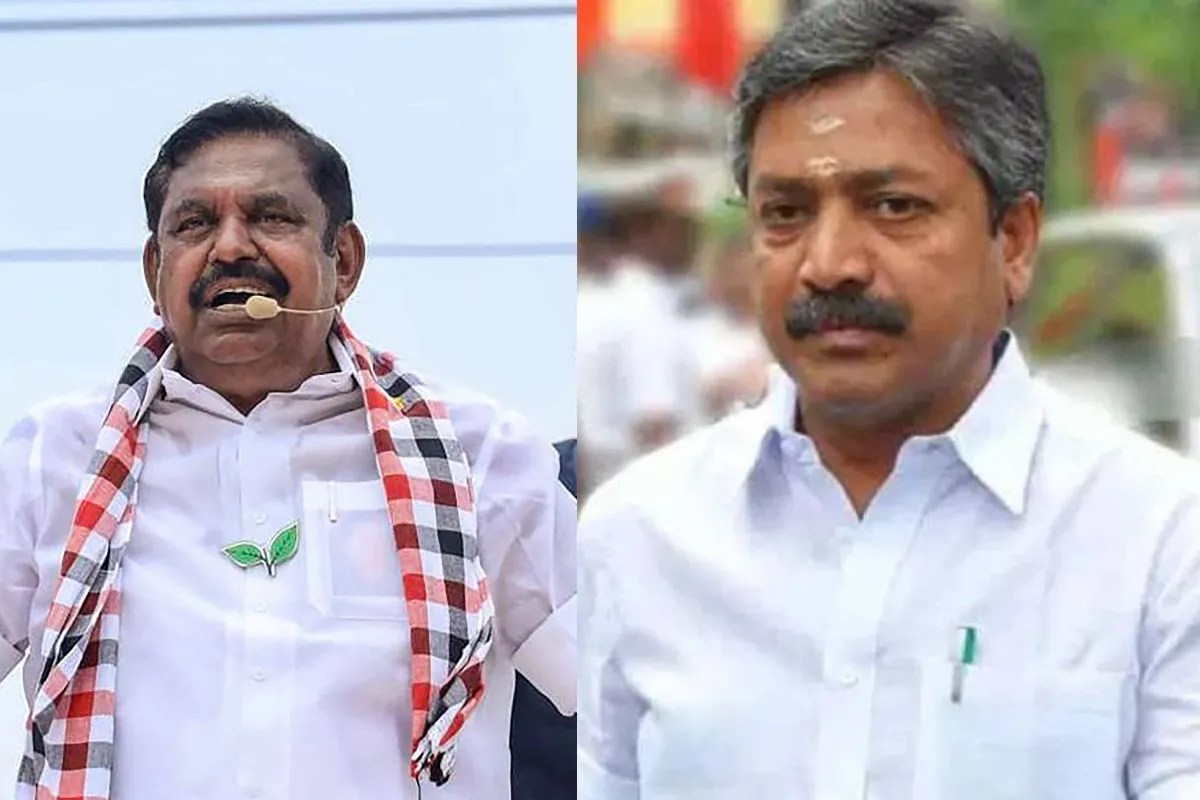
After the new Tamil Nadu government was formed, AIADMK’s internal rift became public as legislators appeared in different factions at the swearing-in ceremony.
AIADMK Internal Rift: After the formation of the new government in Tamil Nadu, the internal strife within the opposition AIADMK party has begun to surface openly. On Monday, party lawmakers were seen sitting in different factions during the Assembly session. According to reports, lawmakers supporting party General Secretary Edappadi K. Palaniswami and those aligned with senior leader C.V. Shanmugam were seated separately. The long-standing grievances and differences within the party are now coming to the forefront.
Discussions about the rifts inside the AIADMK intensified when political activity increased regarding the formation of the government in Tamil Nadu. During this period, news emerged that 28 party lawmakers were lodged at a private resort in Puranakuppam, Puducherry. At the time, it was reported that these lawmakers were supporters of senior AIADMK leader C.V. Shanmugam. This led to speculation that different factions had become active within the party. The lawmakers sitting separately during the oath-taking ceremony in the Assembly appeared to reinforce these discussions.
Tamil Nadu Chief Minister Vijay.
It is noteworthy that on Monday, Vijay took the oath as a lawmaker at the Chennai Secretariat. Pro-tem Speaker M.V. Karuppaiya administered the oath to him. All lawmakers also took the oath along with him. Earlier, in his first address after becoming Chief Minister, Vijay promised to run a transparent government. He said, “Please give me some time. I will gradually fulfill the promises I have made and strive to implement them with complete honesty. This is your government.”
Tamil Nadu debt crisis.
Tamil Nadu Assembly
The Tamil Nadu Assembly, located in Chennai, is the legislative seat of the state government. Its current building, the historic Fort St. George complex, was originally constructed in 1640 by the British East India Company and later repurposed for legislative use. The assembly has been central to Tamil Nadu’s political history, witnessing key debates and decisions since the state’s formation.
Puranakuppam
Puranakuppam is a small village located in the Chengalpattu district of Tamil Nadu, India, known for its ancient Shiva temple, the Puranakuppam Ekambareswarar Temple, which dates back to the Chola period. The temple features intricate stone carvings and inscriptions that highlight its historical significance as a center of worship and local culture. Today, the village remains a quiet settlement, preserving its traditional heritage and serving as a site of religious importance for devotees.
Puducherry
Puducherry, formerly known as Pondicherry, is a union territory in southern India that was a prominent French colonial settlement from the 17th century until 1954. This history is reflected in its distinct Franco-Indian architecture, tree-lined boulevards, and the French Quarter, which contrasts with the traditional Tamil areas. The city is also famous for the Sri Aurobindo Ashram and the experimental township of Auroville, making it a unique blend of Tamil culture, French heritage, and spiritual community.
<h3 class="text-lg font-semibold mb-2
Fort St. George complex
The Fort St. George complex, located in Chennai, India, was established in 1644 by the British East India Company as a fortified trading post, marking the first major English settlement in the Indian subcontinent. It played a pivotal role in British colonial expansion and later housed the Tamil Nadu Legislative Assembly. Today, the complex features St. Mary’s Church, the oldest Anglican church in Asia, and a museum showcasing artifacts from the colonial era.
Puranakuppam Ekambareswarar Temple
The Puranakuppam Ekambareswarar Temple is a historic Hindu shrine dedicated to Lord Shiva, located in the village of Puranakuppam in Tamil Nadu, India. Its origins date back several centuries, with local traditions suggesting it was built during the medieval Chola or later Vijayanagara periods, reflecting the region’s rich architectural and religious heritage. The temple remains an active place of worship, known for its serene atmosphere and intricate stone carvings that depict various deities and mythological scenes.
Sri Aurobindo Ashram
The Sri Aurobindo Ashram, located in Pondicherry, India, was founded in 1926 by the spiritual leader Sri Aurobindo and his collaborator, the Mother (Mirra Alfassa). It serves as a community dedicated to the practice of Integral Yoga, emphasizing spiritual growth and human unity. The ashram grew from a small group of disciples into a renowned spiritual center, attracting seekers from around the world.
Auroville
Auroville is an experimental township in Tamil Nadu, India, founded in 1968 with the vision of human unity and peace. It was conceived by Mirra Alfassa, known as “The Mother,” as a place where people from all nations could live together harmoniously, beyond politics, religion, and nationality. The city’s iconic centerpiece is the Matrimandir, a golden spherical structure used for meditation, symbolizing the collective aspiration for a higher consciousness.