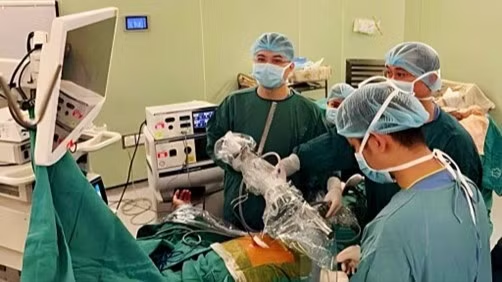
With just a small incision under the breastbone, surgeons can simultaneously treat damage in both lungs without needing to change the patient’s position during the entire surgery.
Primary spontaneous pneumothorax is a common condition in young people, especially in thin, tall men with no prior chronic lung disease. The main cause is the rupture of bullae at the lung apex.
According to the Head of the Department of Thoracic and Vascular Surgery at Bach Mai Hospital, many studies show that more than half of patients have bullae appearing in both lungs. Among them, not a few cases, after treatment on one side, continue to experience pneumothorax on the opposite side.
Previously, to treat bilateral lung bullae, patients often had to undergo two separate surgeries. Very few cases had both lungs treated in a single operation due to concerns about risks related to respiration, bleeding, significant postoperative pain, and prolonged surgical time.
The Head of the Department noted that the search for a less invasive, safer method that still ensures treatment of damage in both lungs simultaneously and helps patients recover faster has always been a concern for the medical team.
Unlike traditional thoracoscopic surgery that goes through the chest wall, the new technique uses an approach under the breastbone. Surgeons only need to make a small skin incision of about 3-4 cm under the breastbone, then dissect into the retrosternal space to access both lungs sequentially.
A sternal lifting frame is used in the endoscopic surgery under the breastbone. This frame system is a combination of available instruments and a sternal lifting device designed by the Department of Thoracic Surgery itself.
A special feature of the technique at Bach Mai Hospital is the additional use of a sternal lifting frame—an innovation that helps expand the space between the breastbone and the pericardium, creating a more favorable surgical field for the surgeon to operate.
“Thanks to the use of the sternal lifting frame, we can see more clearly, operate more conveniently, and increase safety during the surgery,” the Head of the Department shared.
With this technique, the patient only needs to lie on their back throughout the surgery, without having to change position when moving from one lung to the other, which helps minimize risks related to respiration and shortens surgical time.
Especially, because it does not go through the intercostal space, the technique significantly limits damage to the intercostal nerves—the main cause of chronic pain compared to traditional thoracoscopic surgery.
According to doctors from the Department of Thoracic and Vascular Surgery, the biggest advantage of the technique is that it can simultaneously treat damage in both lungs in just one surgery. This helps patients avoid undergoing two separate surgeries, reduces the risk of multiple anesthesia sessions, saves costs, and shortens treatment time.
Additionally, due to its minimally invasive nature, patients usually experience less pain after surgery, can move early, have a shorter hospital stay, and recover faster. The aesthetic factor is also a significant advantage, as the entire intervention is performed through a single small incision located under the breastbone.
Globally, the technique of endoscopic surgery under the breastbone to remove bilateral lung bullae was first reported in 2015 by Chao-Yu Liu (Taiwan, China). In Vietnam, Bach Mai Hospital is the first facility to use a sternal lifting frame to improve the surgical field and optimize surgical outcomes.
The new endoscopic technique helps reduce postoperative pain, shorten recovery time, and was recently awarded first prize at the 2025 Hanoi Medical Sector Youth Creative Technique Competition.
Experts assess that the successful implementation of this technique is an important step forward for the thoracic surgery specialty in Vietnam, approaching modern treatment trends in the world.
Not stopping at treatment effectiveness, the technique also demonstrates the strong development direction of Bach Mai Hospital in applying minimally invasive intervention methods, improving the quality of life for patients.
In recent
<div class="my-4 p-4 rounded-lg shadow-md bg-blue-50 border-l-4 border-blue-


![[Podcast] Tin tức ngày 20-7: Gửi 29 triệu tin nhắn Zalo hướng dẫn ứng phó bão số 3 Wipha](https://asiacity.news/wp-content/uploads/2025/07/media-cdn-v2.laodong.vn-storage-newsportal-2025-7-20-1543395-_bao-so-3-14h-150x150.gif)