Japan urges China to punish suspect and ensure safety of its nationals after attack.
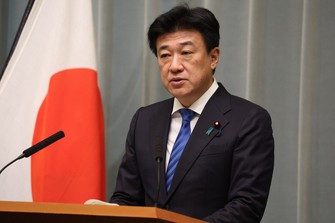
Japanese Chief Cabinet Secretary Minoru Kihara is seen at the prime minister’s office in Tokyo on Oct. 22, 2025.
Japan on Wednesday said it called on China to guarantee the safety of its nationals in the country and to severely punish the suspect in a knife attack in Shanghai that injured two Japanese citizens.
The government said the two individuals were receiving treatment at a hospital after being injured in Tuesday’s attack on a Japanese restaurant in the Chinese city. Local authorities said the attacker was apprehended later.
Chief Cabinet Secretary Minoru Kihara told a press conference in Tokyo that Japan’s diplomatic mission and its Foreign Ministry called on China to “clarify the facts of the case and give a clear explanation” and “severely punish the suspect.”
The case follows the fatal stabbing of a 10-year-old Japanese boy in Shenzhen, southern China, in September 2024, which shocked the Japanese expatriate community.
Ties between the countries have been strained in recent months following Japanese Prime Minister Sanae Takaichi’s parliamentary remarks in November suggesting Japan could deploy its defense forces in the event of a conflict over Taiwan, the self-ruled island claimed by Beijing.
Shanghai
Shanghai is a major global financial hub and one of China’s most populous cities, known for its modern skyline and historic waterfront. Its history as a port city dates back centuries, but it rose to prominence in the 19th and early 20th centuries as a treaty port, where foreign concessions and international trade shaped its unique blend of Eastern and Western architecture and culture. Today, Shanghai is a dynamic metropolis that preserves landmarks like the Bund and the French Concession alongside futuristic skyscrapers in Pudong.
Tokyo
Tokyo, the capital of Japan, is a bustling metropolis that blends ultramodern skyscrapers with historic temples. Originally a small fishing village called Edo, it rose to prominence in the early 17th century when the Tokugawa shogunate made it the political center, later becoming the imperial capital in 1868. Today, Tokyo is a global hub for technology, culture, and cuisine, renowned for landmarks like the Imperial Palace, Shibuya Crossing, and ancient sites such as Senso-ji Temple.
Shenzhen
Shenzhen, a major city in southern China, transformed from a small fishing village into a global technology hub after being designated as China’s first Special Economic Zone in 1980. This rapid development, driven by economic reforms and foreign investment, turned it into a model for modern urbanization and innovation. Today, Shenzhen is known for its skyscrapers, tech companies like Huawei and Tencent, and vibrant cultural scene.
Taiwan
Taiwan, officially known as the Republic of China, is an island nation in East Asia with a rich history shaped by indigenous cultures, Chinese migration, and periods of Dutch, Spanish, and Japanese colonization. After World War II, it came under the control of the Chinese Nationalist government, which relocated there in 1949 following the Chinese Civil War. Today, Taiwan is a vibrant democracy known for its technological advancements, bustling night markets, and stunning natural landscapes like Taroko Gorge.
Shanghai
Shanghai is a major global financial hub and one of China’s most populous cities,
Shanghai
Shanghai is a major global financial hub and China’s largest city, located on the eastern coast at the mouth of the Yangtze River. Its history as a prominent port and trading center dates back centuries, but it saw explosive growth in the 19th and 20th centuries, especially during its era as an international settlement under foreign powers. Today, Shanghai is famous for its stunning modern skyline, exemplified by the Pudong district, alongside historic landmarks like the Bund and traditional gardens such as Yuyuan Garden.
Tokyo
Tokyo is the bustling capital of Japan, originally a small fishing village named Edo before it became the seat of the Tokugawa shogunate in 1603. After the Meiji Restoration in 1868, the emperor moved from Kyoto to Edo, renaming it Tokyo, meaning “Eastern Capital.” Today, it is a global hub of culture, technology, and tradition, blending historic temples and palaces with cutting-edge skyscrapers and neon-lit districts.
Shenzhen
Shenzhen is a major city in southern China, known for its rapid transformation from a small fishing village into a global technology hub. Its modern history began in 1980 when it was designated as China’s first Special Economic Zone, which spurred explosive economic growth and urbanization. Today, Shenzhen is a bustling metropolis famous for its innovation, skyscrapers, and as the home of leading tech companies like Huawei and Tencent.
Taiwan
Taiwan, officially the Republic of China, is an island nation in East Asia with a rich and complex history. Originally inhabited by indigenous Austronesian peoples, it was colonized by the Dutch and Spanish in the 17th century before being ruled by the Qing dynasty and later Japan from 1895 to 1945. After World War II, the Kuomintang (Nationalist) government retreated to Taiwan in 1949, establishing a separate political entity that has since developed a vibrant democracy and unique cultural identity.