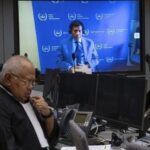
MANILA, Philippines — The Philippine National Police and the National Bureau of Investigation have been ordered to enforce the arrest warrant against Senator Ronald “Bato” Dela Rosa.
During a press briefing on Thursday, May 21, it was stated that the warrant is valid and that the senator can be considered a fugitive from justice.
“I would like to confirm, the Philippine law enforcement agencies, which would include the PNP, the National Bureau of Investigation, are now tasked to effect the arrest of Senator Bato Dela Rosa.”
It was added that the senator should face the case at the International Criminal Court.
“Senator Bato is a fugitive from justice, and he should be brought to the ICC to face the charges before him.”
According to the statement, the panel of prosecutors requested all CCTV footage from the Metropolitan Manila Development Authority related to events following Dela Rosa’s departure from the Senate around 2:30 a.m. on May 14.
The ICC issued a warrant against Dela Rosa concerning allegations of crimes against humanity of murder linked to killings from July 2016 to April 2018.
International Criminal Court
The International Criminal Court is a permanent international tribunal located in The Hague, Netherlands, established to prosecute individuals for genocide, war crimes, crimes against humanity, and the crime of aggression. It was created by the Rome Statute, which came into force on July 1, 2002, marking a historic step toward global accountability. The ICC serves as a court of last resort, intervening only when national courts are unwilling or unable to handle such serious crimes.
Philippine National Police
The Philippine National Police (PNP) is the primary law enforcement agency in the Philippines, established under Republic Act 6975 in 1990, which merged the Philippine Constabulary and the Integrated National Police. Its history traces back to the Spanish colonial era’s Guardia Civil and later the Philippine Constabulary founded in 1901 during American rule. Today, the PNP is responsible for maintaining peace, order, and public safety across the country.
National Bureau of Investigation
The National Bureau of Investigation (NBI) is a premier investigative agency in the Philippines, established in 1936 under Commonwealth Act No. 181 to serve as the country’s equivalent of the U.S. Federal Bureau of Investigation. Its history traces back to its formation as a division of the Department of Justice, tasked with handling major crimes and providing technical support to law enforcement. Today, the NBI continues to operate as the primary agency for complex criminal investigations, forensics, and intelligence gathering in the Philippines.
Senate
The Senate is a key legislative body in many governments, most notably the United States Senate, which was established in 1789 as part of the bicameral Congress. It was designed to represent states equally, with two senators per state, and has played a central role in shaping national laws, treaties, and confirming presidential appointments. Its history includes landmark debates on issues like civil rights and federal power, reflecting the evolving democratic process.
International Criminal Court
The International Criminal Court (ICC) is a permanent international tribunal located in The Hague, Netherlands, established to prosecute individuals for genocide, crimes against humanity, war crimes, and the crime of
Philippine National Police
The Philippine National Police (PNP) is the primary law enforcement agency in the Philippines, established in 1991 under Republic Act 6975, which merged the Philippine Constabulary and the Integrated National Police. Its history traces back to the Spanish colonial era’s Guardia Civil, evolving through American and post-independence periods. Today, the PNP is responsible for maintaining peace, order, and public safety across the country.
National Bureau of Investigation
The National Bureau of Investigation (NBI) is a key law enforcement agency in the Philippines, originally established in 1936 as the Division of Investigation under the Department of Justice. Modeled after the U.S. Federal Bureau of Investigation (FBI), it was later renamed and expanded to handle major crimes, background checks, and forensic investigations. As the country’s primary criminal investigation unit, the NBI plays a crucial role in upholding justice and public safety.
International Criminal Court
The International Criminal Court (ICC) is a permanent international tribunal headquartered in The Hague, Netherlands, established to prosecute individuals for genocide, crimes against humanity, war crimes, and the crime of aggression. It was created by the Rome Statute, which came into force on July 1, 2002, and serves as a court of last resort when national jurisdictions are unwilling or unable to act. The ICC represents a landmark in global justice, aiming to hold the most responsible perpetrators of mass atrocities accountable.
Senate
The Senate is a key legislative body in many governments, most notably the United States Senate, which was established in 1789 as part of the U.S. Congress. It was created to provide equal representation for each state, with two senators per state, and has played a central role in shaping national laws, treaties, and confirmations. The term “Senate” originates from the ancient Roman Senate, a deliberative assembly that advised leaders and influenced governance.
Metropolitan Manila Development Authority
The Metropolitan Manila Development Authority (MMDA) is a government agency in the Philippines responsible for planning, coordinating, and implementing policies to manage traffic, urban development, and public services in Metro Manila. Established in 1995 through Republic Act 7924, it replaced the earlier Metro Manila Commission to address the growing challenges of congestion and infrastructure in the rapidly urbanizing capital region. The MMDA is known for its role in regulating traffic flow, flood control, and waste management, though it operates without direct legislative or police powers.