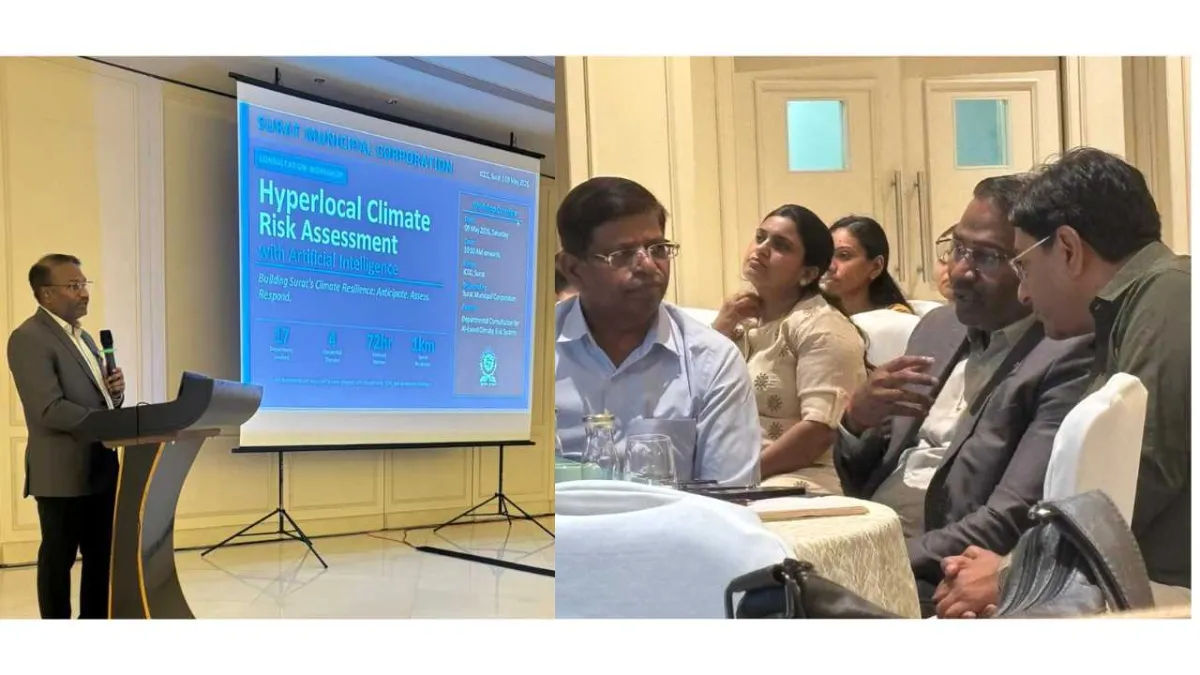
High-Tech Project Launched in Surat in Collaboration with US Research Institute: Hyper-Local Monitoring of Mosquito-Borne Diseases
Surat. The Surat Municipal Corporation is moving forward to become a global model in the fight against malaria and mosquito-borne diseases.
Given the growing health challenges due to climate change and rapid urbanization, the municipal corporation has begun developing a new epidemic control strategy using modern technology and international research.
In this context, the prestigious US National Institutes of Health (NIH) has launched a special research project in Surat to study the impact of temperature and humidity on the spread of urban malaria.
The project aims to understand how changing weather and climate patterns affect mosquito-borne diseases.
High-level review meeting chaired by the Municipal Commissioner
A high-level annual review meeting was held, chaired by Surat Municipal Commissioner M. Nagarajan, to review the progress of this international project. Scientists, health experts, and administrative officials from India and the United States participated in the meeting.
The meeting discussed in detail the research conducted so far on “thermal suitability” for urban malaria transmission, data analysis, and future strategy.
AI-based modeling for live malaria tracking
Addressing the meeting, Municipal Commissioner M. Nagarajan stated that traditional methods are no longer sufficient for epidemic control. Scientific research and data-driven decisions have become essential for health security in modern cities.
He said the municipal corporation is now focusing particularly on artificial intelligence (AI)-based data analysis. Under this project, a “hyper-local climate risk assessment model” is being developed, which will enable live analysis of the potential risk of mosquito breeding in different areas of the city.
Advance warning on areas where mosquito risk may increase
This new technology will make it possible to identify which neighborhoods, societies, or zones in the city have temperature and humidity levels favorable for mosquitoes. This will allow the health department to receive early alerts and take timely preventive measures.
The municipal corporation believes this project could serve as an effective model not only for Surat but also for other major cities in the country in the future.
Surat
Surat is a major port city in the Indian state of Gujarat, with a rich history dating back to the 16th century when it was a thriving center for trade under the Mughal Empire. Known as the “Gateway to Mecca,” it was a key departure point for pilgrims and a hub for diamond cutting and textile exports. Today, Surat is a bustling modern city, famous for its diamond industry and as one of the fastest-growing urban centers in India.
United States
The United States is a large and diverse country in North America, founded in 1776 after declaring independence from Great Britain. It has a rich history shaped by Indigenous civilizations, European colonization, the American Revolution, westward expansion, the Civil War, and waves of immigration. Today, it is known for its cultural influence, economic power, and iconic landmarks such as the Statue of Liberty, the Grand Canyon, and the White House.
Surat
Surat is a historic port city in the Indian state of Gujarat, known for its significant role in maritime trade during the Mughal era, particularly in the 16th and 17th centuries. It was a major hub for exporting textiles, spices, and diamonds to Europe, Africa, and the Middle East, and was visited by British, Dutch, and Portuguese traders. Today, Surat remains an important economic center, famous for its diamond cutting and polishing industry, as well as its textile manufacturing.
United States
The United States is a large and diverse country in North America, founded in 1776 after the thirteen original colonies declared independence from Great Britain. Its history is marked by westward expansion, the abolition of slavery after the Civil War, and its rise as a global economic and military power in the 20th century. Today, it is known for its cultural influence, democratic institutions, and landmarks like the Statue of Liberty and the Grand Canyon.
US National Institutes of Health (NIH)
The US National Institutes of Health (NIH) is the nation’s premier medical research agency, headquartered in Bethesda, Maryland. Founded in 1887 as a one-room Laboratory of Hygiene, it has grown into a sprawling complex of 27 institutes and centers dedicated to improving human health through scientific discovery. The NIH plays a critical role in funding and conducting research that has led to major medical breakthroughs, including treatments for cancer, heart disease, and infectious diseases.