Exhibition features charcoal drawing of black-and-white Ohtani and a torn American flag.
In the 1980s, amidst the bubble economy and the rise of New Painting in art, American artist Robert Longo (born 1953), who gained attention for his realistic charcoal works, is holding his first solo exhibition in Japan in about 30 years. His black-and-white expressions pierce through history and society.
A large work over two meters wide, titled “American Samurai,” depicts a player holding a bat in pitch-black darkness. It appears almost photographic, with a slick, glossy texture.
Longo reveals that this piece is the starting point for the current exhibition, which features 33 new and recent works centered on charcoal drawings. “I focused on the fact that the top player in America’s most important entertainment is now Japanese. This time, I am dealing with a lot of history that layers the past and present.” It is not simply a work riding on the popularity of Ohtani. “I want my works to serve as an anchor that holds images in memory and connects perceptions.”
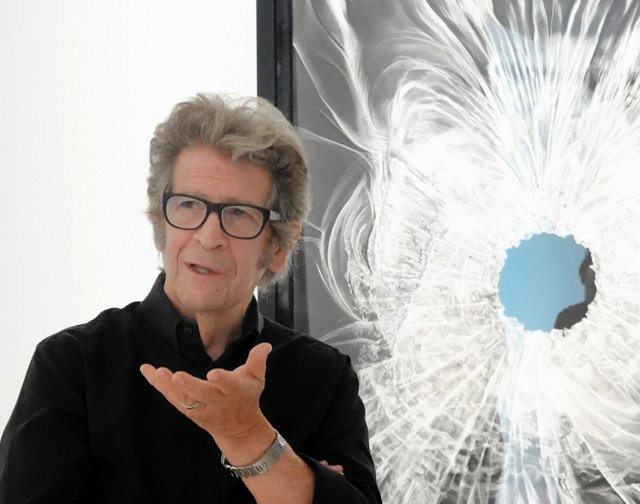
Among the pieces are a large work depicting cotton flowers in full bloom, symbolizing the history of the American South, a piece representing glass with bullet holes, a relief-like work evoking President Kennedy and his wife just before being struck by an assassin’s bullet, and President Trump, along with a display of torn paintings.
Multiple images are combined to complete a single painting, and the white areas reveal the paper’s color through unpainted sections or erasing. “I layer many elements to create multiple meanings. I hope viewers can also see the traces of time in the details of the creation process.”
Regarding charcoal, he notes, “Humans have used it since the era of cave paintings, and since it involves burning wood, it also connects to funerary rites.” The slight blurriness creates a sense of lingering emotion and lyricism.
There is also a piece depicting a “Terminator”-like robotic hand. “In my childhood, technology was something that helped people, but now it seems to be trying to annihilate us,” he says. About AI, he laments, “It is constantly learning from us. So now it is learning from this deplorable politics. That’s troubling.” However, he did not forget to add a sarcastic remark: “I wonder if my works are also being used as material for AI.”
Until June 17 at Pace Gallery in Azabudai Hills, Tokyo. Closed on Mondays.
American Samurai
“American Samurai” is not a physical place or cultural site but rather a 1992 martial arts film directed by Sam Firstenberg. The movie follows a young American man who travels to Japan to train in the way of the samurai, ultimately seeking revenge for his father’s death. It blends Western action tropes with Japanese warrior traditions, though it is a fictional narrative rather than a representation of historical samurai culture.
American South
The American South is a region in the southeastern United States known for its distinct cultural heritage, including music, cuisine, and literature. Historically, it was defined by an agricultural economy reliant on enslaved labor, leading to the Civil War and a long period of Reconstruction and segregation. Today, the South blends its complex history with modern growth, preserving traditions like blues and jazz while confronting its legacy of racial inequality.
President Kennedy
“President Kennedy” most commonly refers to John F. Kennedy, the 35th President of the United States, who served from 1961 until his assassination in 1963. His presidency is remembered for the Cuban Missile Crisis, the establishment of the Peace Corps, and his vision for space exploration. Numerous cultural sites
American Samurai
“American Samurai” is a 1992 martial arts film directed by Sam Firstenberg, starring David Bradley and Mark Dacascos. The story follows an American journalist who travels to Japan to investigate his brother’s mysterious death during a samurai competition, uncovering a corrupt martial arts organization. The film blends Western action tropes with Japanese samurai culture, reflecting the 1990s fascination with cross-cultural martial arts narratives.
American South
The American South is a region in the southeastern United States known for its distinct cultural heritage, shaped by a history of plantation agriculture, slavery, and the Civil War. It is famous for its contributions to music genres like blues, jazz, and country, as well as its unique cuisine and literature. The region has undergone significant social change, particularly during the Civil Rights Movement of the mid-20th century, which sought to end racial segregation and discrimination.
President Kennedy
The term “President Kennedy” most commonly refers to John F. Kennedy, the 35th President of the United States, who served from January 1961 until his assassination in November 1963. His presidency is remembered for key events such as the Cuban Missile Crisis, the early stages of the Vietnam War, and his support for the Civil Rights Movement. Kennedy’s legacy is also marked by his inspiring rhetoric, including his famous call to “ask not what your country can do for you,” and his vision for space exploration.
Pace Gallery
Pace Gallery is a leading contemporary art gallery founded in 1960 by Arne Glimcher in Boston, with its flagship location now in New York City. It has played a pivotal role in the art world by representing and exhibiting works from major 20th and 21st-century artists, including Pablo Picasso, Alexander Calder, and Jean Dubuffet, while expanding globally to cities like London, Geneva, and Hong Kong.
Azabudai Hills
Azabudai Hills is a large-scale, modern urban development complex in the Minato district of Tokyo, Japan. Completed in 2023, it was built on the site of a former residential and commercial area, incorporating a mix of luxury residences, offices, retail spaces, and lush greenery. The project is part of a broader redevelopment effort to transform the neighborhood, with its centerpiece, the Mori JP Tower, standing as one of the tallest buildings in Japan.
Tokyo
Tokyo, the capital of Japan, is a sprawling metropolis that blends ultramodern skyscrapers with historic temples and shrines. Originally a small fishing village named Edo, it rose to prominence in the early 17th century when it became the seat of the Tokugawa shogunate, and was renamed Tokyo (“Eastern Capital”) after the Meiji Restoration in 1868. Today, it stands as a global hub for culture, technology, and commerce, while preserving landmarks like the Imperial Palace and ancient Senso-ji Temple.