|
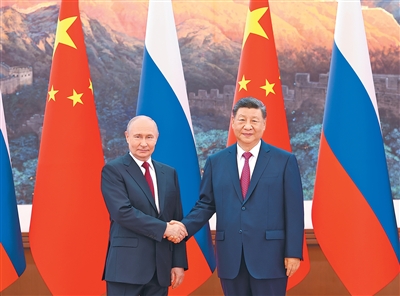
On the morning of May 20, President Xi Jinping held talks with Russian President Vladimir Putin, who was on a state visit to China, at the Great Hall of the People in Beijing. |
 |
|
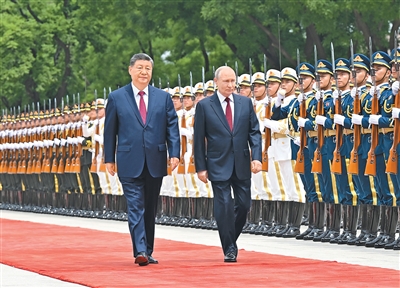
On the morning of May 20, President Xi Jinping held talks with Russian President Vladimir Putin, who was on a state visit to China, at the Great Hall of the People in Beijing. Before the talks, Xi Jinping held a welcome ceremony for Putin at the East Gate Square of the Great Hall of the People. |
On the morning of May 20, President Xi Jinping held talks with Russian President Vladimir Putin, who was on a state visit to China, at the Great Hall of the People in Beijing. The two heads of state agreed to extend the Sino-Russian Treaty of Good-Neighborliness and Friendly Cooperation.
The two heads of state held small-group and large-group talks successively.
Xi Jinping pointed out that this year marks the 30th anniversary of the establishment of the Sino-Russian strategic partnership of coordination and the 25th anniversary of the signing of the Sino-Russian Treaty of Good-Neighborliness and Friendly Cooperation. The signing of the treaty established a legal foundation for long-term good-neighborly friendship and comprehensive strategic coordination, leading to a leapfrog development in bilateral relations. The relationship has reached its current height step by step because both sides have continuously deepened political trust and strategic coordination with perseverance, expanded cooperation in various fields with a spirit of reaching higher levels, and defended international justice and fairness while promoting a community with a shared future for mankind with courage amid complexity. Under the current international situation, as permanent members of the UN Security Council and major world powers, China and Russia should focus on long-term strategy, use higher-quality comprehensive strategic coordination to support each other’s development and revitalization, and promote a more just and reasonable global governance system.
Xi Jinping noted that China and Russia adhere to developing a new-era comprehensive strategic partnership of coordination based on equality, mutual respect, trustworthiness, and win-win cooperation. Political trust is deepening, and cooperation in trade, investment, energy, technology, culture, and regional affairs is progressing steadily, with stronger people-to-people bonds. The relationship has entered a new phase of greater achievements and faster development. Unswervingly promoting the long-term, healthy, stable, and high-quality development of Sino-Russian relations is a strategic choice based on the fundamental interests of both countries and global development trends. All departments should fully implement the important consensus reached between him and President Putin, seize historical opportunities, and make the foundation of mutual trust stronger, the quality of cooperation more substantial, and the path of friendship wider.
Xi Jinping emphasized that both sides should focus on their development and revitalization goals, fully leverage the comprehensive and complete nature of the Sino-Russian cooperation mechanism, strengthen overall planning for all-round cooperation, promote practical cooperation in trade, investment, energy, transportation, technology innovation, and other areas to upgrade, actively lay out cooperation in frontier fields, and create new growth engines with new quality productive forces. They should continue the tradition of friendship across generations, strengthen cultural, educational, film, tourism, and sports exchanges, and solidify the social and public foundation for bilateral friendship. They should deepen multilateral coordination, further enhance cooperation and coordination in multilateral platforms such as the United Nations, the Shanghai Cooperation Organization, BR
Great Hall of the People
Great Hall of the People
Beijing
Tiananmen Square
Sino-Russian Treaty of Good-Neighborliness and Friendly Cooperation
United Nations
Shanghai Cooperation Organization
BR
Related news
China and EU to Hold Emergency Talks on Rare Earth Issue? Foreign Ministry Responds
Liaoning accelerates digital government development

Summer Nears End, But Slender West Lake Remains a Popular Tourist Destination
Beijing downgrades mountain flood warning to yellow at 6:30 AM on August 5