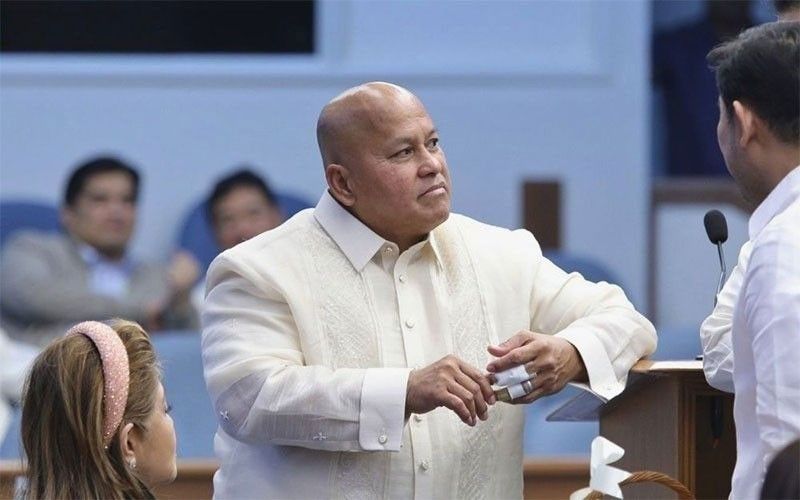
Senator Ronald “Bato” dela Rosa attends the Senate session on Monday, May 11, 2026, hours before being placed under Senate protective custody amid reports of an alleged ICC arrest warrant.
MANILA, Philippines — By a vote of 9-5-1, the Supreme Court (SC) on Wednesday dismissed the petition of Senator Ronald “Bato” dela Rosa for a temporary restraining order (TRO) and status quo ante order against the arrest warrant issued by the International Criminal Court (ICC).
The decision was made during a special En Banc session.
The SC clarified that the decision only concerns the request for interim relief and is not a final resolution of the entire case.
“The SC only decided on the prayers for interim relief. The main issues raised by the parties in their pleadings and motions are yet to be resolved in the main case,” according to the SC.
The court will still discuss whether dela Rosa can be considered a “fugitive” and whether the ICC arrest warrant against him is valid.
In his manifestation, dela Rosa requested the “TRO and/or SQAO” to prevent the Department of Interior and Local Government (DILG), Department of Foreign Affairs (DFA), Department of Justice (DOJ), Philippine National Police (PNP), the Philippines, and the Criminal Investigation and Detection Group (CIDG) from enforcing the arrest warrant issued by the ICC, a red notice from the International Criminal Police Organization, or any foreign judicial or quasi-judicial instrument without a Philippine judicial warrant.
Supreme Court
The Supreme Court of the United States is the highest federal court in the country, established by Article III of the Constitution in 1789. It holds the power of judicial review, allowing it to interpret the Constitution and overturn laws deemed unconstitutional, a principle solidified in the landmark 1803 case Marbury v. Madison. Located in Washington, D.C., its iconic neoclassical building was completed in 1935, symbolizing the court’s role as a pillar of American justice.
Senate
The Senate is a key legislative body in many governments, most notably the United States Senate, which was established in 1789 as part of the bicameral Congress under the U.S. Constitution. It was designed to provide equal representation for each state, with two senators per state, and has played a central role in shaping national policy, confirming presidential appointments, and ratifying treaties throughout American history. The Senate’s origins trace back to ancient Rome, where the term “senate” (from Latin *senex*, meaning “old man”) referred to a council of elders that advised leaders and governed the republic.
International Criminal Court
The International Criminal Court (ICC) is a permanent international tribunal headquartered in The Hague, Netherlands, established to prosecute individuals for genocide, crimes against humanity, war crimes, and the crime of aggression. Its founding treaty, the Rome Statute, was adopted in 1998 and entered into force on July 1, 2002, making it the first permanent court of its kind. The ICC serves as a court of last resort, intervening only when national jurisdictions are unwilling or unable to genuinely prosecute such serious crimes.
Department of Interior and Local Government
The Department of the Interior and Local Government (DILG) is an executive department of the Philippine government responsible for promoting peace and order, public safety, and strengthening local governance. Its history traces back
Supreme Court
The Supreme Court is the highest federal court in the United States, established by Article III of the Constitution in 1789. It holds the power of judicial review, allowing it to declare laws unconstitutional, and its landmark decisions have shaped American law and society. The Court originally met in New York City and Philadelphia before moving to its current neoclassical building in Washington, D.C., which was completed in 1935.
Senate
The Senate, as an institution, originated in ancient Rome as the primary deliberative body of the Roman Republic, advising magistrates and shaping policy. Today, it commonly refers to the upper house of a bicameral legislature in many modern democracies, such as the United States Senate, which was established in 1789 to represent states equally. Its history reflects a evolution from aristocratic advisory councils to key legislative chambers with powers like confirming appointments and ratifying treaties.
International Criminal Court
The International Criminal Court (ICC) is a permanent international tribunal located in The Hague, Netherlands, established to prosecute individuals for genocide, war crimes, crimes against humanity, and the crime of aggression. It was created by the Rome Statute, which came into force on July 1, 2002, after being ratified by 60 countries. The ICC serves as a court of last resort, intervening only when national courts are unwilling or unable to prosecute such serious international crimes.
Department of Interior and Local Government
The Department of Interior and Local Government (DILG) is a key executive department of the Philippine government responsible for promoting peace and order, ensuring public safety, and strengthening local government units. Established in 1950, it oversees the Philippine National Police, Bureau of Fire Protection, and Bureau of Jail Management and Penology, among others. Its history reflects the country’s efforts to decentralize governance and enhance local autonomy through various legislative reforms, including the Local Government Code of 1991.
Department of Foreign Affairs
The Department of Foreign Affairs (DFA) is the government ministry responsible for managing a country’s international relations, diplomacy, and foreign policy. Its history typically dates back to the establishment of a nation’s independent foreign service, evolving from earlier colonial or post-colonial administrative structures to handle embassies, consulates, and treaties. The DFA plays a crucial role in protecting national interests abroad and fostering international cooperation.
Department of Justice
The Department of Justice (DOJ) is a federal executive department of the United States government, established in 1870 to enforce the law and administer justice. Its origins trace back to the Office of the Attorney General, created in 1789, with the DOJ itself formed to handle the growing legal needs of the nation. Today, it oversees key agencies like the FBI and the Federal Bureau of Prisons, playing a central role in upholding the rule of law.
Philippine National Police
The Philippine National Police (PNP) is the country’s primary law enforcement agency, established under the Philippine Constitution and formally organized in 1991 through Republic Act 6975, which merged the Philippine Constabulary and the Integrated National Police. Its history traces back to earlier colonial and post-independence police forces, evolving to emphasize civilian control and professionalization. Today, the PNP is responsible for maintaining peace, order, and public safety across the Philippines.
Criminal Investigation and Detection Group
The Criminal Investigation and Detection Group (CIDG) is a major investigative unit of the Philippine National Police, responsible for handling serious and complex crimes. Established in 1953 as the Philippine Constabulary’s Criminal Investigation Service, it has evolved into a key agency for counter-intelligence, anti-organized crime efforts, and high-profile case resolutions. Headquartered in Camp Crame, Quezon City, the CIDG plays a crucial role in upholding law and order in the Philippines.