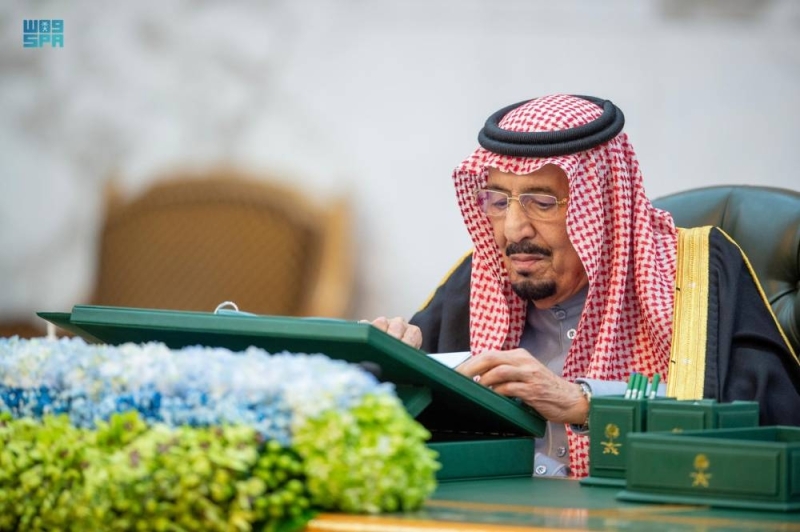
The Custodian of the Two Holy Mosques, King Salman bin Abdulaziz, chaired the Cabinet session held yesterday (Tuesday) in Jeddah, during which the Cabinet approved the executive regulations for the system of protecting whistleblowers, witnesses, experts, and victims.
At the beginning of the session, the Cabinet reviewed the implementation tracks of the plans prepared for this year’s Hajj season 1447 AH, and what has been achieved within the framework of the Guests of the Rahman service program in terms of integration and coordination among various state agencies, and the efforts of the Hajj system in developing all services provided to pilgrims, and harnessing human, technical, and organizational capabilities in Mecca, the holy sites, and Medina; contributing to raising operational readiness levels and providing the highest degrees of comfort and reassurance for the Guests of Rahman coming from inside and outside the Kingdom.
In this context, the Council appreciated the efforts of the Ministry of Interior and other government agencies and the follow-up of the Supreme Hajj Committee to facilitate the arrival of pilgrims to the Sacred House of God from their countries; by continuing to implement the “Makkah Route” initiative for the eighth year, from which more than 1.2 million pilgrims have benefited so far within a framework of continuous expansion that included 10 countries and 17 international ports; aligning with the Kingdom’s aspirations to provide the finest services to the delegations of Rahman.
Subsequently, the Cabinet was briefed on the content of the two phone calls of the Crown Prince and Prime Minister Prince Mohammed bin Salman with the President of the UAE, Sheikh Mohamed bin Zayed Al Nahyan, and the Emir of Qatar, Sheikh Tamim bin Hamad Al Thani, and what took place during them in terms of reviewing areas of joint cooperation, in addition to discussing regional developments and international efforts made to enhance the security and stability of the region.
The Cabinet renewed its affirmation that the Kingdom will never hesitate to take all measures necessary to protect its security, preserve its stability, and ensure the safety of its citizens and residents on its territory, praising in this regard the high capabilities of the armed forces in defending the homeland and preserving its gains and capabilities.
The Council expressed its support for the outcomes of the emergency meeting of interior ministers of the Gulf Cooperation Council states held in Riyadh, which included an affirmation that Gulf security is an indivisible whole, and stressed the importance of doubling joint coordination to face current challenges and developments in the region.
The Council affirmed that the establishment of the Saudi-Spanish Strategic Partnership Council represents an important step towards elevating bilateral relations between the two friendly countries and expanding horizons of cooperation in promising economic and investment sectors through working on joint initiatives and projects with tangible outcomes.
On the local front, the Cabinet considered the completion of the operation of the main stations of the “Riyadh Metro” project as an extension of the rapid progress witnessed by the public transport system in the capital, and an embodiment of the path of developing an integrated urban infrastructure that contributes to improving the quality of life, diversifying means of mobility, and enhancing reliance on public transport and raising its efficiency; in line with the targets of the Kingdom’s Vision 2030.
The Council noted that it valued the achievement of 24 awards by male and female students of the Kingdom in the competitions of the International Science and Engineering Fair “ISEF 2026”, thereby continuing to record multiple achievements that reflect leadership in the fields of innovation and scientific excellence at the regional and international levels.
The Cabinet reviewed the topics on its agenda, including topics that the Shura Council participated in studying, and also reviewed the conclusions of the Political and Security Affairs Council, the Economic and Development Affairs Council, the General Committee of the Cabinet, and the Experts Authority of the Cabinet regarding them.
The Council authorized the Minister of Interior or his delegate to negotiate with the Malaysian side regarding a draft memorandum of understanding for cooperation in the field of civil defense and civil protection between the government of the Kingdom of Saudi Arabia and the government of Malaysia, and to sign it, while the Council approved a memorandum of understanding between the government of the Kingdom and the government of the State of Kuwait in the field of export development.
It also authorized the Minister of Culture, Chairman of the Board of Directors of the Museums Authority, or his delegate, to negotiate with the Moroccan side regarding a draft memorandum of understanding for cooperation in the field of museums between the Authority and the National Foundation of Museums in the Kingdom of Morocco, and to sign it. Additionally, the Council authorized the Minister of Culture, also Chairman of the Board of Trustees of the King Salman Global Academy for the Arabic Language, or his delegate, to negotiate with the Tunisian side regarding a draft memorandum of understanding for cooperation in