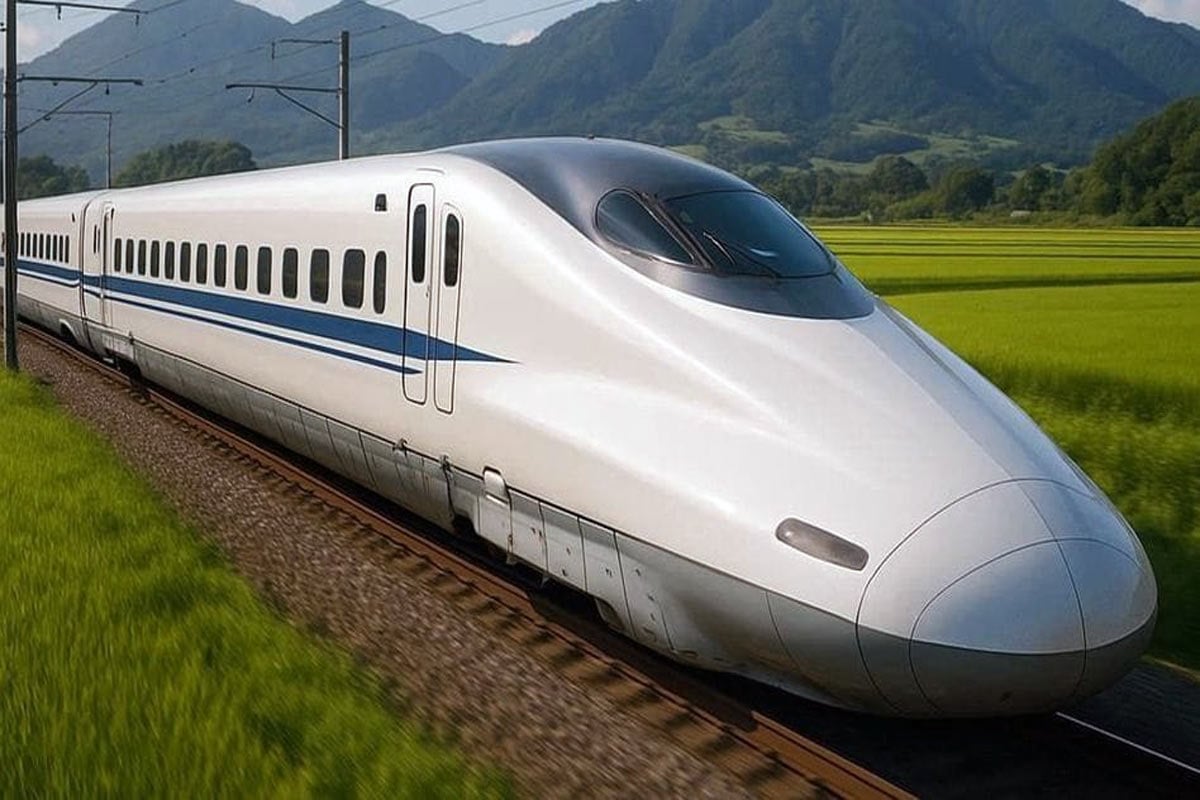
The state has seen a change of power, forming a double engine government. Following this, Siliguri is set to join the country’s bullet train map. The railways have taken initiative to launch the New Jalpaiguri-Varanasi bullet train project. A deadline has been set to prepare the Detailed Project Report by March next year. Once the report is ready, it will be sent to the Railway Board for approval. Upon receiving the green signal from the board, full-scale track construction will begin.
According to railway sources, the initial survey work for the proposed Siliguri-Varanasi bullet train corridor may begin from July this year. When the high-speed bullet train is operational, traveling from Varanasi to Siliguri via Patna in Bihar will take only 2 hours and 55 minutes. This high-speed train will connect three states: West Bengal, Bihar, and Uttar Pradesh. The National High Speed Rail Corporation Limited has formed a special survey team for this mega railway project. The team will start aerial and ground surveys from July. Following this, the final route and technical details of the corridor will be finalized. The target is to complete the Detailed Project Report by March 2027. Once done, it will be sent to the Railway Board for approval. After receiving the green signal, railway line construction will begin.
Further reading:
The initial survey work for the proposed Siliguri-Varanasi bullet train corridor may begin from July this year. When the high-speed bullet train is operational, traveling from Varanasi to Siliguri via Patna in Bihar will take only 2 hours and 55 minutes. This high-speed train will connect three states: West Bengal, Bihar, and Uttar Pradesh.
India’s first bullet train will run on the Mumbai-Ahmedabad route. The official design, or first look, of that train has already been released by Indian Railways. The train will run at a speed of 320 kilometers per hour on a 508-kilometer-long rail corridor. According to railway sources, the train has been built using Japan’s Shinkansen technology. Everything from the train’s design to signaling and safety standards has been taken from Japan. The entire project is being implemented following the Modi government’s Make in India policy. The same is now set to be launched on the New Jalpaiguri-Varanasi corridor. This is expected to bring significant changes in tourism and other sectors in North Bengal.
This initiative has brought hope to the northern chambers of commerce and tourism organizations. Officials believe that the launch of the Siliguri-Varanasi bullet train will significantly alter the commercial landscape of the north. In particular, the tourism industry will see a boost. Because with the bullet train, it will be possible to travel from Varanasi to Siliguri in just 2 hours and 55 minutes. This will increase the influx of domestic and international tourists to the Duars and hills of the north. Raj Basu, head of Help Tourism, said, “The launch of the bullet train service will open new avenues for business expansion and employment.” On the other hand, Siliguri’s BJP MLA Shankar Ghosh stated that people will be able to travel directly from Siliguri to Varanasi in the blink of an eye via bullet train. North Bengal is on the verge of a revolutionary change in its communication system.
Varanasi
Varanasi, one of the world’s oldest continuously inhabited cities, is a major spiritual hub in India, located on the banks of the Ganges River. For thousands of years, it has been a center of Hindu pilgrimage, learning, and culture, associated with the god Shiva and believed to offer liberation from the cycle of rebirth. Its ghats, temples, and vibrant rituals have drawn seekers and travelers for centuries, making it a living symbol of ancient Indian civilization.
Siliguri
Siliguri is a major city in the Indian state of West Bengal, serving as a key commercial and transportation hub for the northeastern region. Its modern development began in the 19th century under British colonial rule, when it became a vital railway junction linking the plains to the hill stations of Darjeeling and Sikkim. Today, it is known for its strategic location near the borders of Nepal, Bhutan, and Bangladesh, and its role as a gateway to the Himalayan states.
New Jalpaiguri
New Jalpaiguri is a major railway junction and city in the Indian state of West Bengal, serving as a key gateway to the northeastern states and the Himalayan region. It was developed in the early 20th century, with the New Jalpaiguri Junction railway station opening in 1962 to replace the older Siliguri Junction as a critical hub for broad-gauge rail lines. The city’s name combines “Jalpaiguri,” the district it belongs to, with “New” to distinguish it from the older town, reflecting its strategic role in connecting India’s plains to the hills.
Patna
Patna, the capital of Bihar, India, is one of the world’s oldest continuously inhabited cities, originally known as Pataliputra. It served as the capital of powerful ancient empires, including the Maurya and Gupta dynasties, and was a major center of learning and culture. Today, it remains a key historical and political hub, home to landmarks like the Golghar and the Patna Museum.
Bihar
Bihar, a state in eastern India, is one of the country’s oldest inhabited regions with a rich history as a major center of power and learning. It was the heartland of the ancient Magadha kingdom, which gave rise to two of India’s greatest empires—the Maurya and Gupta—and was home to the renowned Nalanda University, a leading Buddhist center of education from the 5th to 12th centuries. Today, Bihar is known for its cultural heritage, including Buddhist and Jain pilgrimage sites like Bodh Gaya, where Buddha attained enlightenment.
West Bengal
West Bengal is a culturally rich state in eastern India, known for its history as the center of British colonial power in Calcutta (now Kolkata) and the Bengal Renaissance. It was a key region in the Indian independence movement and was partitioned in 1947 during the Partition of India, leading to the creation of Bangladesh. Today, it is celebrated for its diverse heritage, including the Sundarbans mangrove forest, classical arts, and the famous Durga Puja festival.
Uttar Pradesh
Uttar Pradesh is a culturally and historically rich state in northern India, often considered the heartland of Indian civilization. It is home to the ancient cities of Varanasi and Ayodhya, as well as the iconic Taj Mahal in Agra. Throughout history, the region has been central to the rise of major empires, including the Maurya, Gupta, and Mughal dynasties, and played a pivotal role in India’s independence movement.
Mumbai-Ahmedabad
The Mumbai-Ahmedabad corridor is a major economic and transportation route in western India, connecting the financial capital Mumbai with the cultural and commercial hub of Ahmedabad in Gujarat. Historically, this region along the western coast was part of ancient trade networks, and the route gained prominence during British colonial rule with the development of railways and textile industries. Today, the corridor is undergoing a transformation with the construction of India’s first high-speed rail line, linking the two cities and boosting regional connectivity.