
Vietnam is preparing for a redefinition of the capital flow worth hundreds of billions of USD that the digital asset market could bring.
As the scorching heat of the southern summer peaks in late April, the heat in the digital asset market also enters its most dramatic phase. This is no longer a game for small groups but has become an arena for Vietnam’s leading financial and technology conglomerates.
The Debut of Domestic Exchanges
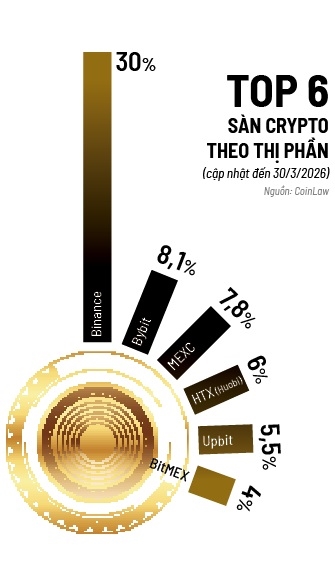 |
Within just 24 hours after the news of the pilot operation of a digital asset exchange from Q3 was announced, a wave of foreign capital immediately poured in. OKX Ventures, the investment fund of the world’s 4th largest exchange, along with HashKey, quickly announced an investment in CAEX, a subsidiary of VPBank. The emergence of CAEX is just the tip of the iceberg. Many sources indicate that at least 5 domestic “big players” have applied for trial licenses, including CAEX (VPBank), backed by international capital and a dynamic banking ecosystem; VIVEX, a promising alliance between technology conglomerate FPT and multi-industry group Gelex; TCEX, representing Techcombank, a bank strong in digital platforms; LPEX, belonging to Loc Phat Bank; and Sun Group’s exchange, an unknown entity from the leading real estate and tourism conglomerate.
Vietnam does not hide its intention to bring this “gray area” under absolute control. Resolution 05/2025/NQ-CP has erected extremely stringent market entry barriers, turning this into a playground only for true “big fish.” Exchanges must prove their financial resources with a minimum charter capital of 10,000 billion VND (equivalent to 400 million USD).
Additionally, to ensure national financial security, the ownership ratio of foreign investors in these exchanges is strictly limited to 49%. Unlike the freedom of international exchanges, domestic exchanges must ensure: transactions are entirely in Vietnamese Dong (VND); strict compliance with Anti-Money Laundering (AML) and Know Your Customer (KYC) standards; all withdrawal/deposit activities must go through the banking system to ensure transparency.
The most notable point is that Resolution 05 stipulates that after 6 months from the first domestic exchange’s operation, investors who continue to trade on “illegal” exchanges (not licensed by the Ministry of Finance) will face serious legal troubles, from administrative fines to criminal prosecution.
 |
“Platforms that have not been licensed will not be allowed to provide services in Vietnam,” stated To Tran Hoa, Deputy Head of the Standing Committee of the Digital Asset Exchange Market Management Board. This will greatly impact Vietnamese digital asset investors, because if they fail to transfer assets from unlicensed exchanges in time, they could face legal trouble in the future.
The Challenge of Attracting Capital from Foreign Exchanges
Vietnam has long been a “phenomenon” on the global digital asset map. According to data from Chainalysis and Triple-A, Vietnam ranks 7th globally in the rate of population owning digital assets (about 17-21% of the population); the capital flow passing through exceeds 200 billion USD (period 2024-2025); profits from crypto investments by Vietnamese people rank top in Southeast Asia.
The lack of a clear legal framework for many years has caused a large amount of foreign currency to flow to international exchanges, while also creating loopholes for fraud and money laundering activities. Therefore, the pilot operation of the exchange opens up unprecedented opportunities, including attracting technology FDI capital: large financial institutions like OKX Ventures and HashKey Capital have begun injecting capital into domestic partners (like CAEX of VPBank) in preparation for licenses.
 |
Vietnamese businesses can have a new capital mobilization channel through issuing digital assets based on real-world assets (RWA), helping to unlock capital for real estate and technology projects. Of course, taxes from digital asset transactions will become a significant source of revenue when transactions are conducted through
<div class="my-4 p-4 rounded-lg