On May 19, a press conference was held in Hangzhou for the “Start of the 15th Five-Year Plan, Forge Ahead on a New Journey” series. A municipal official stated at the conference that the overall goal of Hangzhou’s “15th Five-Year Plan” outline is quantified as “2 times 30,000”. That is, by 2030, Hangzhou’s gross domestic product is expected to reach a new level of 3 trillion yuan, and the per capita gross domestic product is expected to exceed 30,000 US dollars, reaching the level of developed economies.
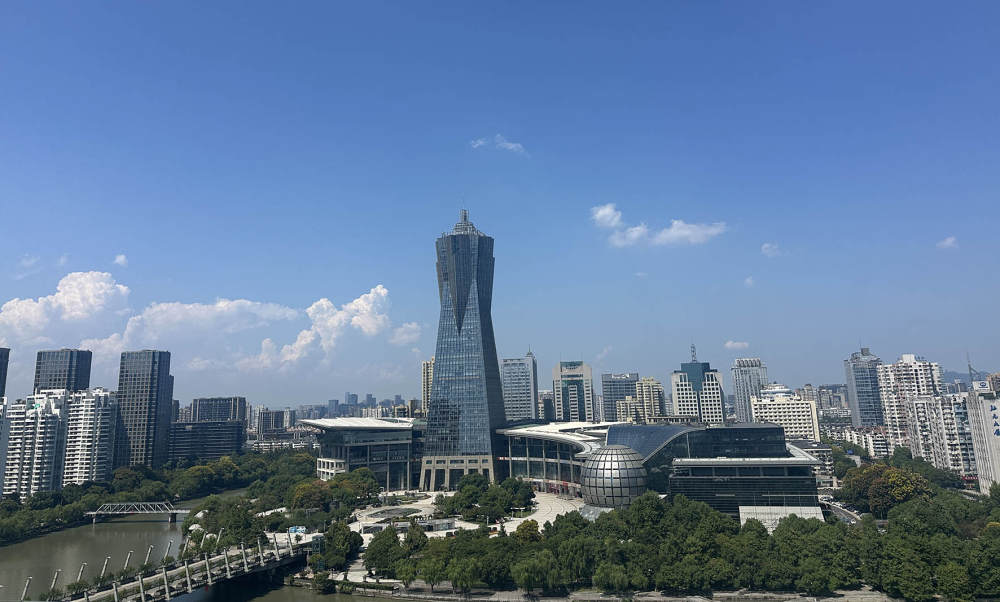
(Hangzhou cityscape)
During the “15th Five-Year Plan” period, Hangzhou will adhere to technological innovation as the primary driving force, making building the first city for artificial intelligence innovation and development, creating a higher level city of innovation and vitality, and constructing a modern industrial system with Hangzhou characteristics its top priorities. Hangzhou proposes to accelerate the leap from a platform economy represented by “Internet+” to an intelligent economy represented by “Artificial Intelligence+”.
Building a “296X” Cluster as a New Growth Pole
Industry is the core of urban development. During the “15th Five-Year Plan” period, a key lever for promoting high-quality manufacturing development in Hangzhou is cultivating and building the “296X” advanced manufacturing clusters. This involves creating two trillion-level clusters in artificial intelligence and visual intelligence, nine hundred-billion-level clusters including embodied intelligent robots and other intelligent terminals, integrated circuits, and “6+X” future industry clusters such as synthetic biology and brain-like intelligence.
According to a municipal official, during the “15th Five-Year Plan” period, Hangzhou will implement a special “Artificial Intelligence + Manufacturing” action plan, focusing on building AI factories, deploying industry-specific large models, and cultivating industrial intelligent agent platforms, using AI technology to lead the digital and intelligent transformation of manufacturing.
Hangzhou will fully promote the deep integration of technological and industrial innovation, especially focusing on the “6+X” future industries, accelerating the construction of future industry pilot zones, and creating the “296X” cluster as a new growth pole.
How will Hangzhou leverage its own advantages to integrate into a new pattern of regional innovation and development?
A municipal official stated in response to a question that Hangzhou will promote platform sharing, actively connect with scientific and technological innovation resources in places like Shanghai, and actively promote the co-building and sharing of major scientific and technological innovation platforms in the Yangtze River Delta. This includes particularly promoting linkages between core carriers like Shanghai Zhangjiang and the Hangzhou West Science and Technology Innovation Corridor, supporting the opening and sharing of national laboratories, large scientific devices, and other “national heavy equipment” with enterprises and research institutions in the Yangtze River Delta.
At the same time, Hangzhou will promote industrial linkages, deepen its advantages in artificial intelligence innovation, strengthen and optimize the “296X” advanced manufacturing clusters, and especially take the initiative to integrate into the construction of world-class industrial clusters in Shanghai (Yangtze River Delta) International Science and Technology Innovation Center, such as integrated circuits, biomedicine, and artificial intelligence, to promote high-quality industrial development in Hangzhou.
The official also mentioned that Hangzhou will promote the interconnection of factors, striving to break down regional barriers and facilitate the efficient flow of talents, capital, technology, data, and other factors within the Yangtze River Delta region. Hangzhou will co-build and share talent recruitment channels with Shanghai and other cities in the Yangtze River Delta, promote the mutual recognition of talent policies and qualifications, deepen scientific and technological financial collaboration with various regions, and jointly build cross-regional capital matching platforms. At the same time, Hangzhou will also strive to smooth channels for technology trading and data sharing, aggregating scattered resources into incremental development driving the construction of the Shanghai (Yangtze River Delta) International Science and Technology Innovation Center.