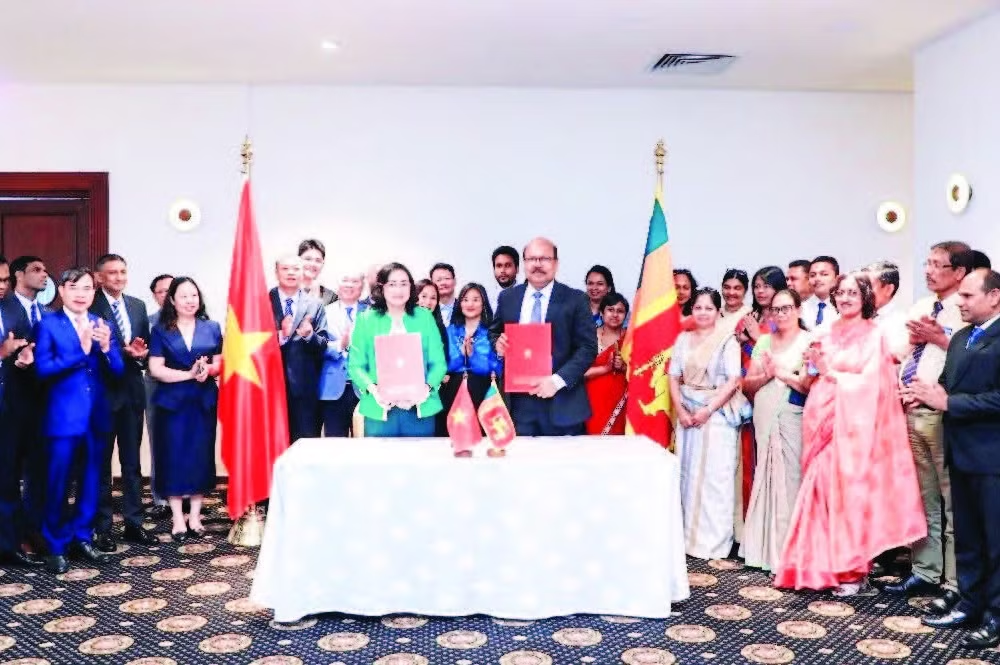
At the invitation of Sri Lankan President Anura Kumara Dissanayake, General Secretary and President To Lam, along with a high-ranking Vietnamese delegation, will pay a state visit to Sri Lanka from May 7 to 8, 2026.
Sri Lanka
Sri Lanka, an island nation in South Asia, has a rich history dating back over 2,500 years, with ancient kingdoms like Anuradhapura and Polonnaruwa flourishing as centers of Buddhism and trade. Colonized by the Portuguese, Dutch, and British, it gained independence in 1948 and became a republic in 1972. Today, it is known for its diverse culture, stunning landscapes, and UNESCO World Heritage sites such as the Sigiriya rock fortress and the Temple of the Tooth in Kandy.
Anuradhapura
Anuradhapura is an ancient city in Sri Lanka that served as the island’s first capital and a major center of Theravada Buddhism for over 1,300 years, from the 4th century BCE. It is renowned for its well-preserved ruins, including massive stupas (dagobas), intricate monasteries, and the sacred Sri Maha Bodhi tree, which is said to be a sapling from the tree under which Buddha attained enlightenment. The site, now a UNESCO World Heritage location, was largely abandoned after repeated invasions in the 10th century and later reclaimed by the jungle before being rediscovered.
Polonnaruwa
Polonnaruwa is the second capital of Sri Lanka, succeeding Anuradhapura as a royal city in the 11th century. It flourished under King Parakramabahu I, who built extensive irrigation systems, temples, and palaces, making it a center of Buddhist culture. Today, it is a UNESCO World Heritage site, known for its well-preserved ruins, including the Gal Vihara rock carvings and the Royal Palace complex.
Sigiriya rock fortress
Sigiriya rock fortress, located in central Sri Lanka, is a UNESCO World Heritage site that dates back to the 5th century AD. It was built by King Kashyapa I, who transformed a massive granite rock into a fortified palace and citadel, adorned with elaborate gardens, frescoes, and a massive lion-shaped gateway. After the king’s defeat, the site later became a Buddhist monastery before eventually falling into ruin and being rediscovered in the 19th century.
Temple of the Tooth in Kandy
The Temple of the Tooth, or Sri Dalada Maligawa, in Kandy, Sri Lanka, is a sacred Buddhist site that houses the relic of the tooth of the Buddha. Built in the 16th century within the royal palace complex, it has served as a key symbol of sovereignty and religious devotion, surviving multiple attacks over the centuries. Today, it remains an active temple and a major pilgrimage destination, especially during the annual Esala Perahera festival.