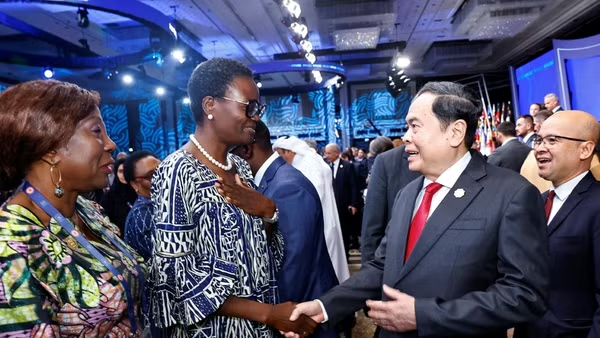
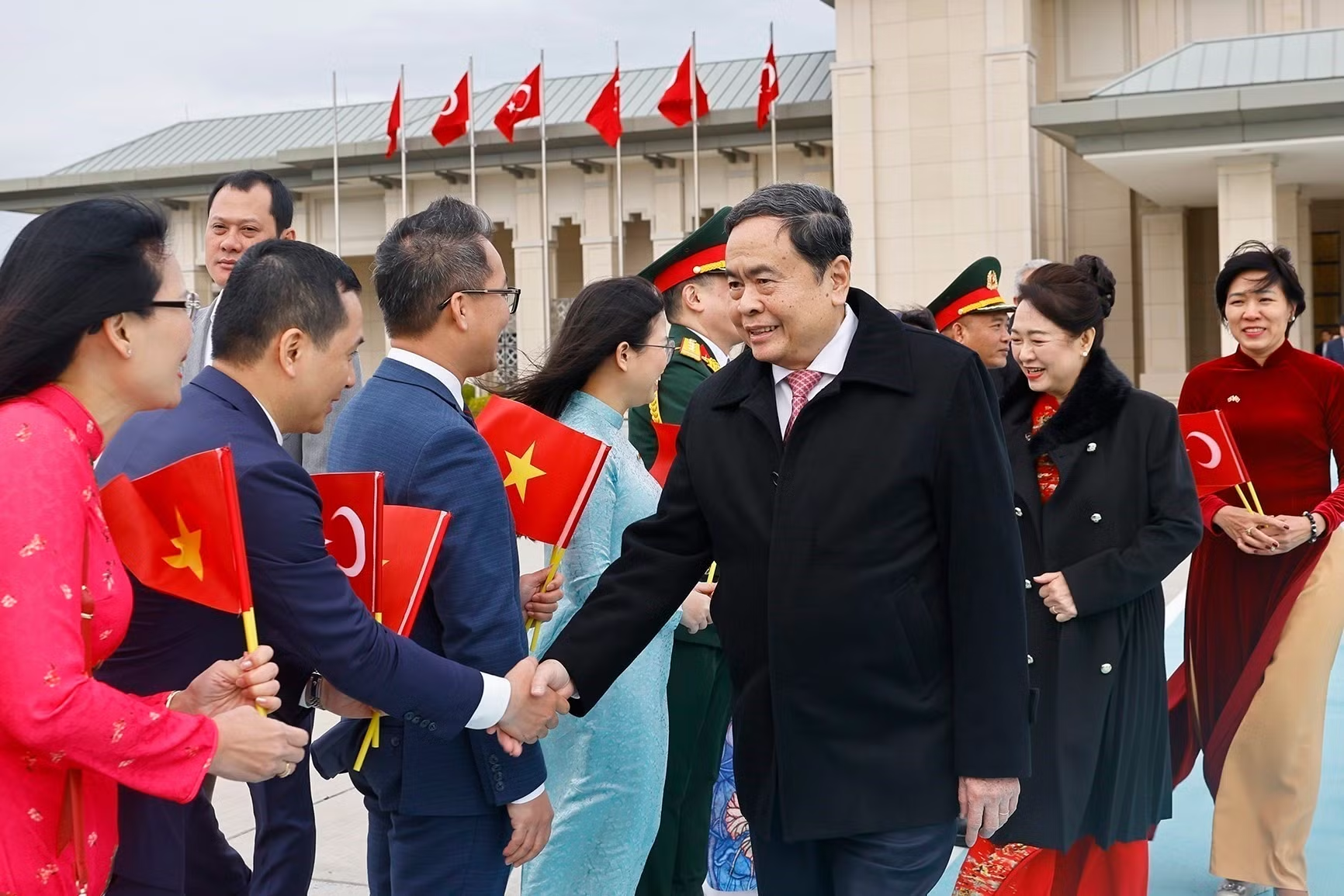
On the morning of April 18, the Chairman of the National Assembly and his spouse, along with the Vietnamese high-level delegation, departed from Istanbul to return home, successfully concluding the program of attending the 152nd Assembly of the Inter-Parliamentary Union (IPU-152) and conducting a number of bilateral activities in Turkey.
Istanbul Airport
Istanbul Airport is a major international hub that opened in 2018, replacing the older Atatürk Airport as the primary airport serving Istanbul. It was built to handle the city’s growing global air traffic and is designed to become one of the world’s largest airports, with a capacity for up to 200 million passengers annually upon full completion.
Istanbul
Istanbul is a historic metropolis straddling Europe and Asia, originally founded as Byzantium before becoming the Eastern Roman capital of Constantinople. It later served as the magnificent center of the Ottoman Empire for centuries, symbolized by landmarks like the Hagia Sophia and Topkapi Palace. Today, it is Turkey’s largest city, renowned for its unique blend of ancient heritage, vibrant bazaars, and iconic skyline punctuated by minarets and domes.
Turkey
Turkey, officially the Republic of Türkiye, is a transcontinental country bridging Southeastern Europe and Western Asia, with a history spanning ancient civilizations like the Hittites, classical empires such as Byzantium, and the powerful Ottoman Empire, which lasted for over six centuries until the modern republic’s founding in 1923. Its cultural landscape is profoundly shaped by this layered history, visible in iconic sites like the Hagia Sophia in Istanbul—a former Byzantine church and Ottoman mosque—and the ancient Greco-Roman ruins of Ephesus. Today, it is a major cultural and historical destination, known for its unique blend of Eastern and Western traditions, cuisine, and architecture.
Inter-Parliamentary Union
The Inter-Parliamentary Union (IPU) is a global organization of national parliaments, founded in 1889 to promote peace and cooperation through parliamentary diplomacy. It is the oldest international political assembly, initially created by parliamentarians dedicated to resolving conflicts peacefully, and today it works to strengthen democratic institutions and represent the parliamentary voice in global affairs.
<div class="my-4 p-4
Istanbul Airport
Istanbul Airport is a major international aviation hub that opened in 2018, replacing the former Atatürk Airport as the primary airport serving Istanbul. Built to handle over 200 million passengers annually, it reflects Turkey’s modern ambitions and strategic location bridging Europe and Asia. Its history is tied to a large-scale national infrastructure project aimed at establishing a global transit center for the 21st century.
Istanbul
Istanbul is a historic metropolis straddling Europe and Asia, originally founded as Byzantium before becoming the Eastern Roman capital of Constantinople. It later served as the magnificent center of the Ottoman Empire for centuries, symbolized by landmarks like the Hagia Sophia and Topkapi Palace. Today, it is Turkey’s largest city, renowned for its unique blend of ancient heritage, vibrant bazaars, and iconic skyline punctuated by minarets and domes.
Turkey
Turkey, officially the Republic of Türkiye, is a transcontinental country located at the crossroads of Europe and Asia, historically known as Anatolia. This region has been the cradle of numerous civilizations, including the Hittites, Greeks, Romans, Byzantines, and the Ottoman Empire, which ruled for over six centuries before the modern republic was founded in 1923. Today, it is renowned for its unique blend of Eastern and Western cultures, historic sites like Ephesus and Hagia Sophia, and vibrant cities such as Istanbul.
Hagia Sophia
Hagia Sophia is a historic architectural marvel in Istanbul, Turkey, originally constructed as a Christian cathedral in 537 AD under the Byzantine Emperor Justinian I. It served as the seat of the Eastern Orthodox Church for nearly a thousand years before being converted into a mosque after the Ottoman conquest in 1453. In 1935, it was secularized and turned into a museum, and in 2020 it was reconverted into a functioning mosque, reflecting its layered religious and cultural significance.
Topkapi Palace
Topkapi Palace in Istanbul served as the primary residence and administrative headquarters of the Ottoman sultans for nearly 400 years, from the 15th to the 19th century. Following the Ottoman conquest of Constantinople, it was constructed under Sultan Mehmed II in the 1450s and expanded over time, housing a vast collection of imperial treasures, relics, and important state archives. Today, it is a major museum showcasing the opulence and history of the Ottoman Empire.
Byzantium
Byzantium was an ancient Greek city founded around 657 BCE on the site of modern-day Istanbul, Turkey. It later became the capital of the Eastern Roman (Byzantine) Empire under Emperor Constantine the Great in 330 CE, who renamed it Constantinople, serving as a major political, cultural, and economic center for over a millennium. The city’s strategic location on the Bosporus Strait made it a crucial hub between Europe and Asia.
Constantinople
Constantinople was the capital of the Byzantine Empire, founded by Roman Emperor Constantine the Great in 330 AD on the site of the ancient Greek city of Byzantium. It served as a major political, cultural, and economic center of the Christian world for over a millennium before being conquered by the Ottoman Turks in 1453, who renamed it Istanbul.
Ephesus
Ephesus is an ancient Greek city located in present-day Turkey, founded around the 10th century BCE. It later became a major Roman port city, renowned for grand structures like the Library of Celsus and the Temple of Artemis, one of the Seven Wonders of the Ancient World. The city holds significant early Christian history, as it is mentioned in the Bible and was visited by the Apostle Paul.