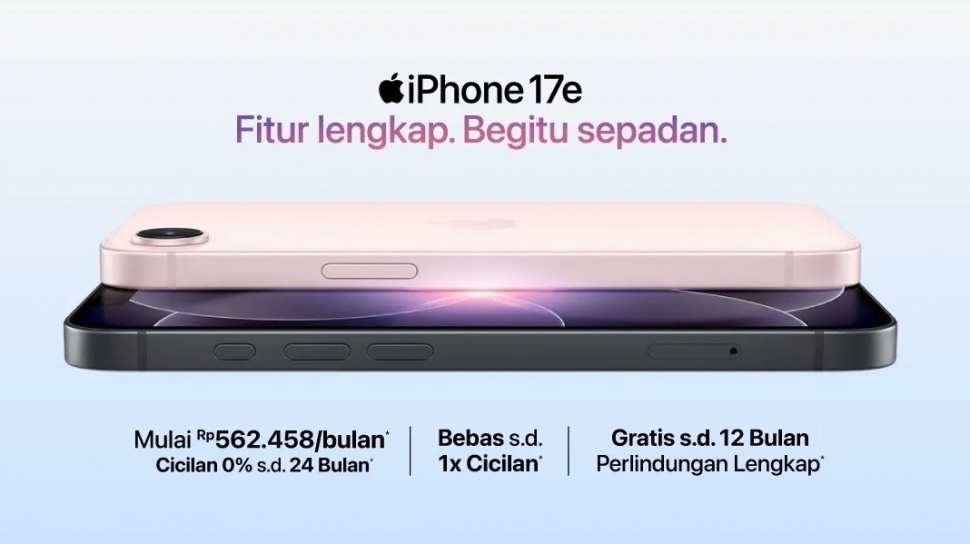
Are you thinking about upgrading your phone but confused about which one to choose? The iPhone 17e is a very reasonable choice if you want fast performance without having to pay a fortune for the Pro series. This is highly anticipated by many people.
Here is a review of its features and specifications.
1. A18 Chip That Makes the iPhone 17e Fast
The heart of the iPhone 17e already uses the A18 chip. This is the same chip found in the standard iPhone 16.
So if you play heavy games like Genshin Impact or edit 4K video, this phone will handle it without overheating or lagging. Apple Intelligence also runs smoothly here.
You can use AI features to summarize chats or create images directly from the phone. This performance is a big step up from its predecessor, which still used an older chip. For this price, getting an A18-class chip is a big win.
2. 48MP Camera on the iPhone 17e for Aesthetic Photos
When it comes to the camera, the iPhone 17e doesn’t mess around. It has a 48MP rear camera that finally makes your photos sharp and detailed.
Unlike the SE series where you only got a 12MP camera that struggled in low light, now it’s a different story. You can take photos at night and the results are still clean.
There are also Photographic Styles and Smart HDR 5 features that make the colors in your photos look natural without needing long edits.
For beginner content creators, this camera is more than enough to make Reels or product photos that look good.
3. 6.1-Inch OLED Display That’s Comfortable for the Eyes
The display on the iPhone 17e has moved to OLED technology. It’s 6.1 inches with Super Retina XDR resolution. This means the blacks are truly black, not gray like the old LCD.
Watching movies or scrolling through TikTok becomes much more comfortable for the eyes. The brightness is also very high at up to 1000 nits for outdoor use. No more stories of a dark screen under sunlight. The design is also full screen without a home button, making it look more modern and premium.
4. iPhone 17e Battery Lasts a Full Day
The battery is a major highlight because the iPhone 17e is claimed to have the longest battery life among all iPhones ever made.
It is said to last up to 26 hours of video playback. For those of you who are active all day from morning to night, this phone will accompany you until you sleep without needing to carry a charger everywhere.
Charging also uses USB-C, so one cable works for all your Apple devices. No need to bother looking for a Lightning cable anymore.
5. 5G Connectivity and Other Features on the iPhone 17e
The last point that shouldn’t be missed is connectivity. The iPhone 17e already supports 5G, so your internet will be very fast for streaming or downloading apps.
It also has Face ID which is secure for unlocking the phone and paying with Apple Pay. The back uses glass and an aluminum design that makes the phone feel premium in hand.
The Action Button feature is also available for those who like to set up quick shortcuts for the camera or flashlight.
So, can you imagine why the iPhone 17e is so worth buying now? Its specifications are no joke for a price around 13 million.
If you don’t want to miss out on promotions or have it go out of stock, just check the latest price. Better to checkout now before regretting it later.
Genshin Impact
“Genshin Impact” is not a physical place or cultural site, but a popular open-world action role-playing video game developed by the Chinese company miHoYo (now HoYoverse), released in 2020. The game is set in the fantasy world of Teyvat, which is divided into seven nations, each inspired by real-world cultures and mythologies, such as Liyue (based on China) and Mondstadt (based on medieval Germany). Its history within the game involves the struggle between the seven elemental Archons and the player’s journey as the “Traveler” to find their lost sibling.
OLED
OLED stands for Organic Light Emitting Diode, a display technology that uses organic compounds to produce light when an electric current is applied. First developed in the 1980s by researchers at Eastman Kodak, OLED technology has since evolved to power high-contrast, flexible, and energy-efficient screens in devices like smartphones and televisions. Its ability to achieve true blacks and vibrant colors makes it a leading innovation in modern display technology.
Super Retina XDR
Super Retina XDR is not a place or cultural site, but a display technology developed by Apple for its iPhone and other devices. Introduced in 2019 with the iPhone 11 Pro, it features a high dynamic range (HDR) OLED screen with significantly improved brightness and contrast compared to earlier Retina displays. The technology enhances color accuracy and visual clarity, making it a key component in Apple’s mobile device evolution.
USB-C
The USB-C connector is a modern, reversible standard for data transfer and charging, developed by the USB Implementers Forum in 2014. It was designed to unify previous USB types, offering higher power delivery and faster speeds, and has since become widely adopted across smartphones, laptops, and other devices. Its creation aimed to simplify connectivity, replacing multiple legacy ports with a single, compact solution.
5G
5G is the fifth generation of wireless cellular technology, succeeding 4G LTE, and was first commercially launched in 2019. Its development began in the 2010s, driven by the need for faster data speeds, lower latency, and the ability to connect massive numbers of devices for the Internet of Things (IoT). As a transformative infrastructure, 5G enables innovations like autonomous vehicles, smart cities, and advanced telemedicine, reshaping global communication and industry.
Face ID
Face ID is a facial recognition system developed by Apple for its iPhone and iPad Pro models, first introduced with the iPhone X in 2017. Its history stems from Apple’s acquisition of PrimeSense, the company behind Microsoft’s Kinect, which provided the foundational 3D mapping technology. The system uses a dot projector and infrared camera to create a detailed depth map of the user’s face, enabling secure device unlocking, authentication, and payments.
Apple Pay
Apple Pay is a mobile payment and digital wallet service developed by Apple Inc., launched in 2014 to enable secure, contactless transactions using iPhones, Apple Watches, and other Apple devices. It builds on earlier NFC technology and partnerships with major banks and credit card networks, revolutionizing in-store and online payments. While not a cultural site, Apple Pay has become a widely adopted global standard for convenient, private financial transactions.
Action Button
“Action Button” is not a specific physical place or cultural site, but rather a term commonly associated with video game controllers or user interfaces—specifically the primary input button used for actions like jumping, shooting, or interacting. In a broader cultural context, it gained notable recognition through the online video essay series *Action Button Reviews* by Tim Rogers, which analyzes video games with deep historical and critical depth. The phrase itself has no historical site or location, but it symbolizes a core element of interactive media history, evolving from early arcade buttons to modern gaming peripherals.


![Partai Kebangkitan Bangsa (PKB) menggelar lomba desain karikatur Ketua Umum PKB Muhaimin Iskandar alias Gus Imin. [Suara.com/dok]](https://asiacity.news/wp-content/uploads/2025/07/43754-karikatur-150x150.webp)